Binary Deobfuscation 101 🐍
Taming real world malware obfuscations
Introduction
When it comes to reverse engineering of real world malware samples, we are not provided with a clean binary which is just one F5 away 😅 . Instead we get somewhat obfuscated samples which is a major hinderence in binary analysis/reverse engineering. Well to deal with this, we are left with only one option which is you guessed it right Deobfuscation. So here you will read about most well known obfuscation techniques and how to deal with them using miasm a free and open source (GPLv2) reverse engineering framework. As I was learning miasm by reading it source (pain) because it has poorly managed documentation and less examples. Even there official blog is outdated somehow wrtten in 2016-2019. So i saw a perfect opportunity to write about miasm, after all its a great framework.
Who is this post for?
If you are getting your hands dirty in binary deobfuscation this is for you, as i will go from basic concepts to advance (kind of). You can read about Advance Binrary Deobfuscations. I will discuss some of the solutions of ABD Exercises that I have done and giving basic overview of miasm After that we will do deobfuscation of real world malware samples Which included Multiple Obfuscations Such as:
Opaque predicates, Virtual Machine Based Obfuscation, Indirect Jumps, Indirect Calls and Control Flow Flattening.
For some basic examples i will be using src from ABD
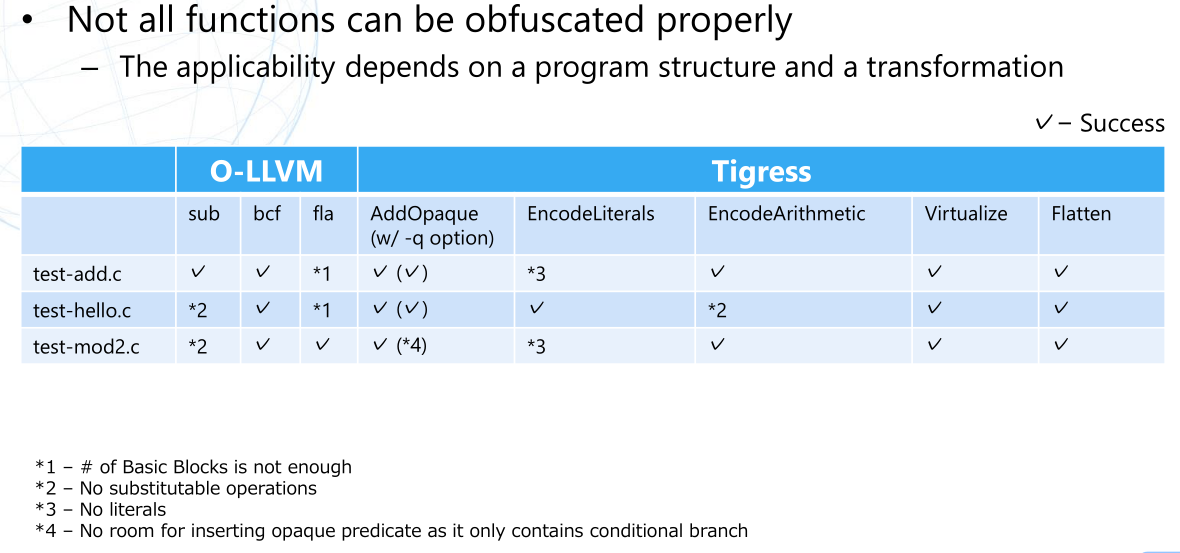
Because of this fact i cannot pick a single source so the source will be changing during basic deobfuscation examples :p
Dead Code Removal
Basic Example Source:
1
2
3
4
5
6
7
8
9
10
11
12
13
14
15
16
17
18
19
20
21
22
23
#include <stdio.h>

unsigned int target_function(int n)
{
    int a,b,c,r;

    a = 12;
    b = 56;
    c = 127;

    r = a + b + c + n;

    return r;
}

int main(int argc, char* argv[])
{
    unsigned int n = target_function(argc);

    printf("n=%u\n", n);

    return 0;
}
Disassembly:
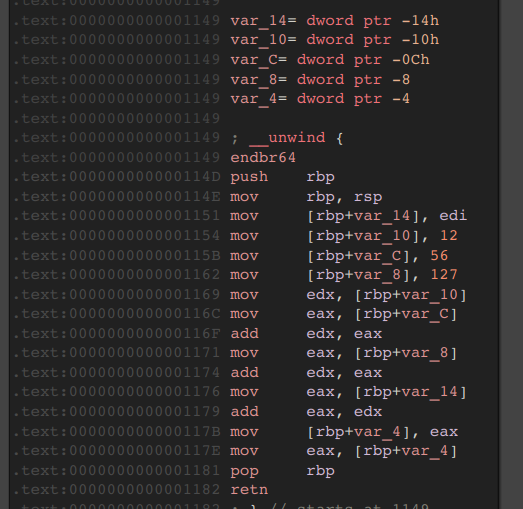
Here we can clearly see that these three values are added the the function argument.
But even a very simple example, nothing but addition, when obfuscated with ollvm sub pass. it becomes like this:
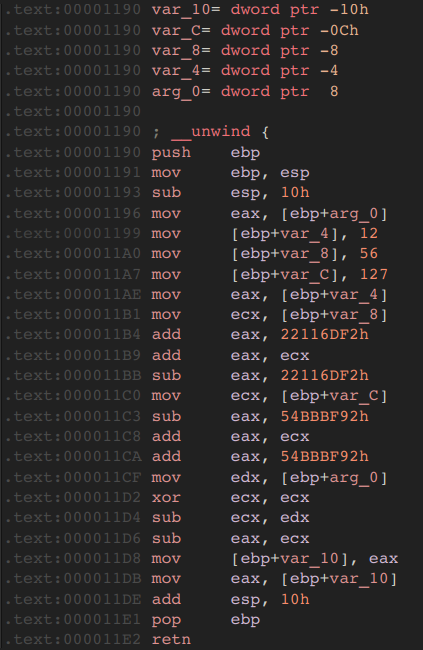
It may not seem very complicated but just to give you the idea that simple addition and there are junk code some constants that we didn’t even had in our binary and additional instructions which are nothing but junk, if done this iteratively it becomes massive problem.
Data Flow Analysis & Constant Propagation
To deal with this we will perform some Data Flow Analysis which is a fundamental part of Compiler Optimizations Techniques by lifting the x86 architecture to miasm’s Intermediate Representation.
1
2
3
4
5
6
7
8
# these are miasm inits
loc_db = LocationDB() # for managing locations and addreses
container = Container.from_stream(open(file, 'rb'), loc_db=loc_db) # Init Binary Container
machine = Machine(container.arch) # architecture-specific toolkit
mdis = machine.dis_engine(container.bin_stream, loc_db=loc_db) # disassembly engine
asmcfg = mdis.dis_multiblock(addr) # whole assembly control flow graph of the target address
lifter = machine.lifter_model_call(loc_db=loc_db) # initialization of the lifter
ircfg = lifter.new_ircfg_from_asmcfg(asmcfg=asmcfg) # lifting x86 asmcfg to miasm's own IR-CFG
These are the initialization stage of miasm (almost) every time we will do this so i might skip later
1
open('asmcfg.dot', 'w').write(asmcfg.dot()); open('ircfg', 'w').write(ircfg.dot())
we can also view the asmcfg and ircfg like this
the asmcfg is similar as you saw as it is x86 assembly
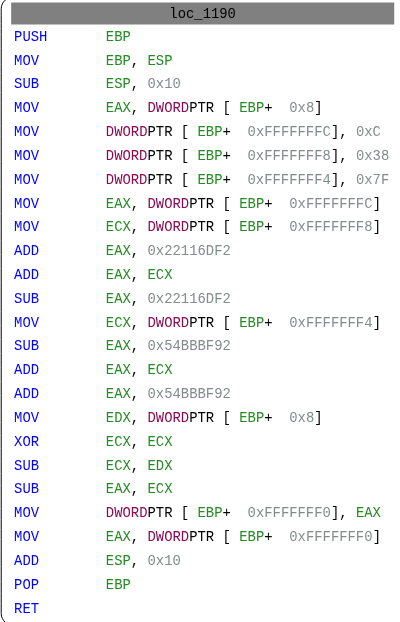
But Miasm’s IR is a lil complicated you can say:

You will later see in this blog that Hexrays IR also has Explicit semantics for EFLAGS after each computation instruction.This is Because the IR needs to be a complete, self-contained semantic model of the instruction — including side effects so that later analysis (symbolic execution, optimization) is correct without needing hidden/implicit CPU behavior.
So we will do Dead Removal and Constant Propagation using miasm.
1
2
3
4
5
6
7
8
9
10
11
12
13
14
15
16
17
deadrm = DeadRemoval(lifter=lifter)  # create dead-code elimination pass for this lifter
entry_points = set([mdis.loc_db.get_offset_location(addr)])  # get LocKey used as CFG entry point
init_infos = lifter.arch.regs.regs_init  # initial symbolic values for all registers

# runs constant propagation over the IR CFG starting from addr with the given initial register state, folding known constant values through expressions.
cst_propag_link = propagate_cst_expr(lifter, ircfg, addr, init_infos)

modified = True
while modified:  # keep optimizing until no more changes occur
    modified = False
    modified |= deadrm.do_dead_removal(ircfg=ircfg)      # remove unused/dead IR assignments
    modified |= remove_empty_assignblks(ircfg)           # remove blocks left empty after dead removal
    modified |= merge_blocks(ircfg, entry_points)         # merge mergeable blocks to simplify CFG


open(f'ircfg_simplified.dot', 'w').write(ircfg.dot()) # constant propagated, clean unobfuscated ir
Here is the IRCFG now !
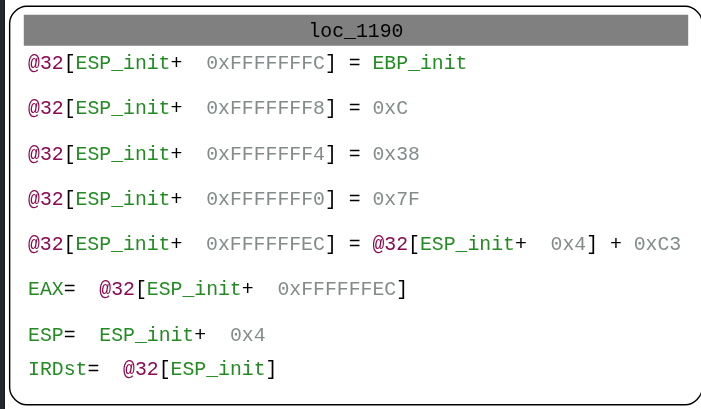
So now on this basic example the dead code is removed and optimized
Unfortunately Miasm IR is not backword compatible to x86, so we can’t just recompile the clean binary, tho it “had” conversion to LLVM IR but this is also broken in latest Miasm versions due to the use of depreciated LLVM-Lite APIs
The full script can be found here
Opaque Predicates
In computer programming, an opaque predicate is a predicate, an expression that evaluates to either “true” or “false”, for which the outcome is known by the programmer a priori, but which, for a variety of reasons, still needs to be evaluated at run time.
so its just having multiple Basic Blocks that are never executed, Which results in increase number of basic blocks and function sizes are increased.
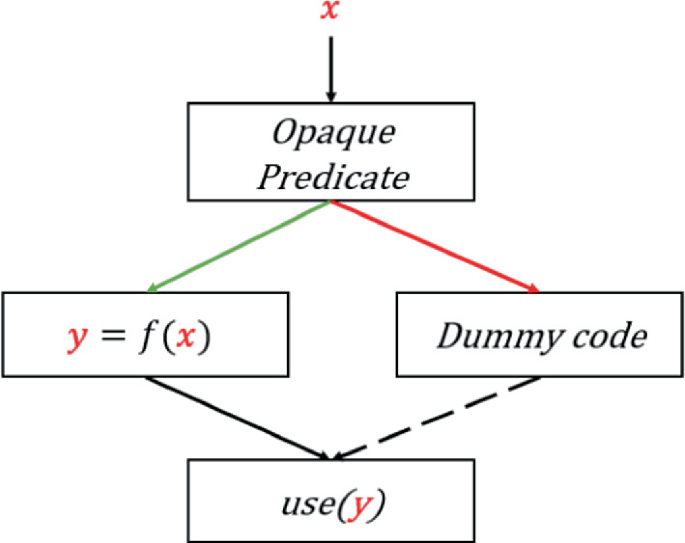 Classic Opaque Predicates
i never thought of deobfuscating hello world lol. We are choosing this example now because it has ollvm bcf.
Basic Example Source:
1
2
3
4
5
6
7
8
9
10
11
12
13
#include <stdio.h>

void target_function(void)
{
    char* msg = "hello world";
    printf("%s\n", msg);
}

int main(int argc, char* argv[])
{
    target_function();
    return 0;
}
Disassembly:
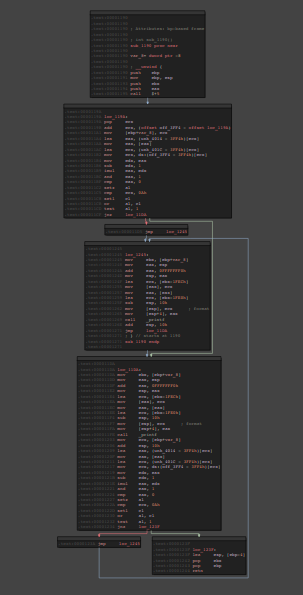
Well a hello world can’t have those many basic blocks 😂
General Heuristic to deal with Opaque Predicates
we will execute each basic block via Symbolic Execution and check if the result is an Condition then, if it is we will convert the miasm expression to z3 IR. and check is anyof the branch from the condition is unsat, If it is then we know that it is an opaque branch and thus will never be executed.
1
2
3
4
5
6
# here 'l' is the branch 1 and the 'r' is the branch 2 of the basic block possible condition
def is_opaque(l, r):
    s = z3.Solver()
    t = TranslatorZ3() # converting miasm expression to z3 IR
    s.add(t.from_expr(l) == t.from_expr(r)) # adding to the z3 solver
    return s.check() == z3.unsat # returns true if unsat/opaque branch
Iterating though each basic block in the asmcfg and execute it symbolically.
1
2
3
4
5
6
7
8
9
10
11
12
13
14
15
16
17
18
19
20
[...]
for bb in asmcfg.blocks:
    # init sybolic execution
    sb = SymbolicExecutionEngine(lifter=lifter)
    # symbolic execution of bb
    r = sb.run_block_at(ircfg=ircfg, addr=bb.lines[0].offset)
    if not isinstance(r, ExprCond):
        continue
    vaddr = bb.lines[-1].offset
    # cond? jump: fall
    jcc = is_opaque(r, r.src1); fall = is_opaque(r, r.src2)
    # print('jcc ', jcc, 'fall ', fall) # debug
    if jcc: # jcc is opaque so it won't jmp
        # patch the jcc with nops, so it just falls
        print('Patched NOP: ', hex(vaddr)) # not hitting in this example
    elif fall: # fall is opaque so it won't fall
        # convert jcc to jmp
        print('Replace jcc', hex(vaddr))
    else:
        print(f'Skip valid conditional at: {hex(offset)}')
patching to nop is very trivial, just see the jcc size and patch to b’\x90’ * instruction_size. But patching jcc to jmp we have to take care of the relative address. in this example the jcc are 6 bytes as they are rel32 jumps you check more on x86 conditional jumps
So in this case we will read 4 bytes (skipping the 2 jcc default bytes) and because the formula is rel32 = address to jump - (address of jmp instruction + instruction_size) as the jcc was 6 bytes so reading and +1 becomes the new-rel32.
1
2
3
4
5
6
7
8
9
    # helper functions
    p32 = lambda d: struct.pack('<I', d)
    u32 = lambda d, i: struct.unpack('<I', d[i:i+4])[0]
    [...]
    elif fall: # fall is opaque so it won't fall
        # replace with direct jump
        print('Replace jcc', hex(vaddr)) # debug
        new_rel32 = u32(binary, offset+2) + 1 # read 4 bytes of rel & as jmp has 1 less byte size than jcc +1 so new_rel = oldrel + 1
        binary[offset: offset + 6] = b'\xE9' + p32(new_rel32) + b'\x90'
The Whole script is can be found here
X-tunnel
Opaque predicates alone are not hard to deal with, i think they are trivial, lets take the example of this apt malware.
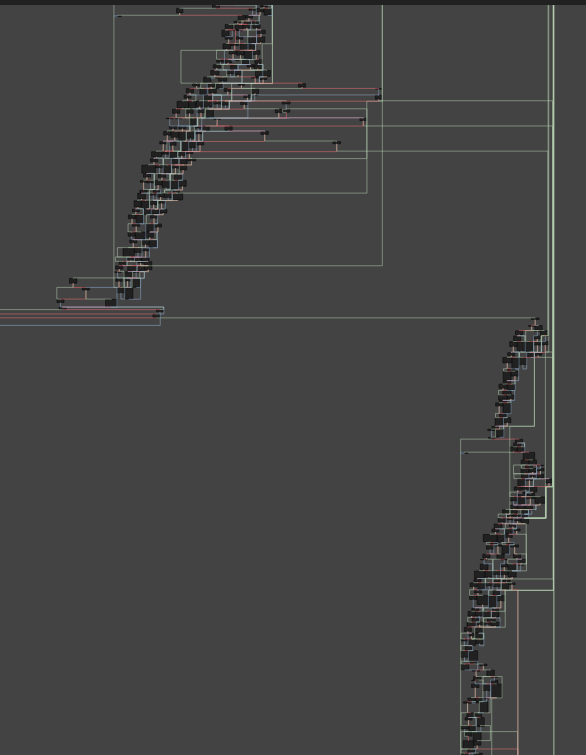 fully opaque CFG
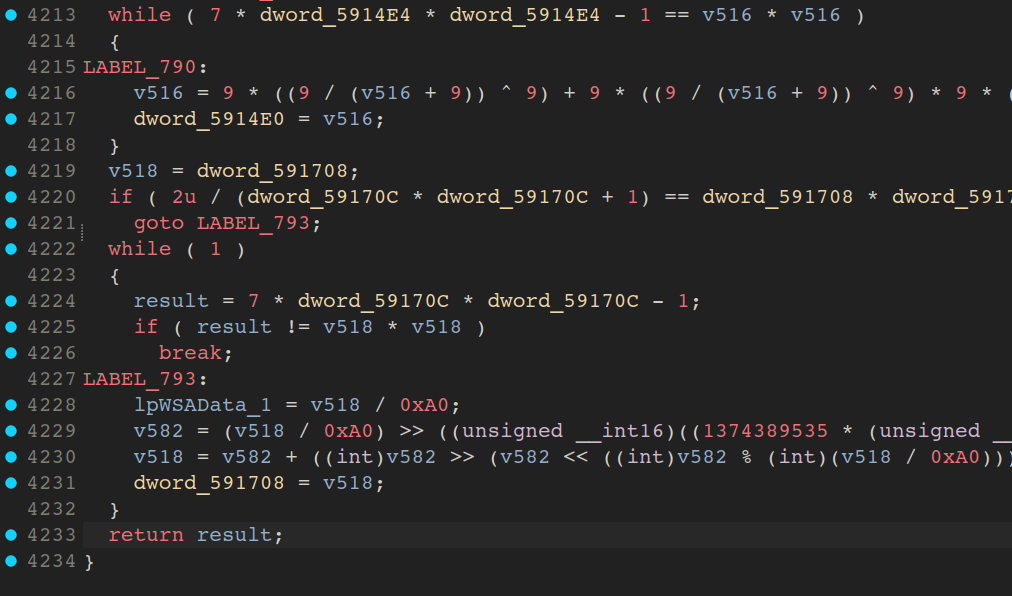 Opaque Function decompilation
It’s decompilation is more than 4k LOC.
1
2
3
4
5
6
7
8
9
10
11
12
13
14
15
16
17
18
19
20
21
22
23
24
25
26
27
28
29
30
31
32
33
34
35
36
37
38
39
40
41
42
43
44
45
46
47
48
49
50
51
52
53
54
55
56
57
from miasm.core.locationdb import LocationDB
from miasm.analysis.binary import Container
from miasm.analysis.machine import Machine
from miasm.ir.translators.z3_ir import TranslatorZ3
from miasm.ir.symbexec import SymbolicExecutionEngine
from miasm.expression.expression import ExprCond
import z3
import lief
import struct

file = 'x-tunnel.bin'
addr = 0x424760

p32 = lambda d: struct.pack('<I', d)
u32 = lambda d, i: struct.unpack('<I', d[i:i+4])[0]
pe = lief.PE.parse(file); binary = bytearray(open(file, 'rb').read())
va = lambda addr: pe.va_to_offset(addr)

loc_db = LocationDB()
container = Container.from_stream(open(file, 'rb'), loc_db=loc_db)
machine = Machine(container.arch)
mdis = machine.dis_engine(container.bin_stream, loc_db=loc_db)
lifter = machine.lifter_model_call(loc_db=loc_db)
asmcfg = mdis.dis_multiblock(addr)
ircfg = lifter.new_ircfg_from_asmcfg(asmcfg=asmcfg)

def is_opaque(l, r):
    s = z3.Solver()
    t = TranslatorZ3()
    s.add(t.from_expr(l) == t.from_expr(r))
    return s.check() == z3.unsat

for bb in asmcfg.blocks:
    # init sybolic execution
    sb = SymbolicExecutionEngine(lifter=lifter)
    # symbolic execution of bb
    r = sb.run_block_at(ircfg=ircfg, addr=bb.lines[0].offset)
    if not r.is_cond():
        continue
    ins = bb.lines[-1]
    vaddr = ins.offset; offset = va(vaddr)
    # cond? jump: fall
    jcc = is_opaque(r, r.src1); fall = is_opaque(r, r.src2)
    # print('jcc ', jcc, 'fall ', fall)
    if jcc: # jcc is opaque so it won't jmp
        # patch the jcc, so it just falls

        binary[offset:offset+ins.l] = b'\x90' * ins.l # nop jcc
        print('Patch NOP: ', hex(vaddr), ins.l, hex(offset)) # not hitting in this case

    elif fall: # fall is opaque so it won't fall
        # replace with direct jump
        print('Replace jcc', hex(vaddr), ins.l) # debug
        # nothing there are no opaque jcc so just left it


open(file + '.deob', 'wb').write(binary) # removed opaque predicate, clean deobfuscated patched file
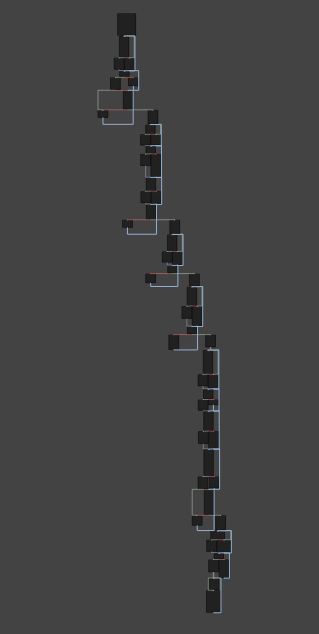 After deobfuscation
Decompiled function LOC is reduced massively
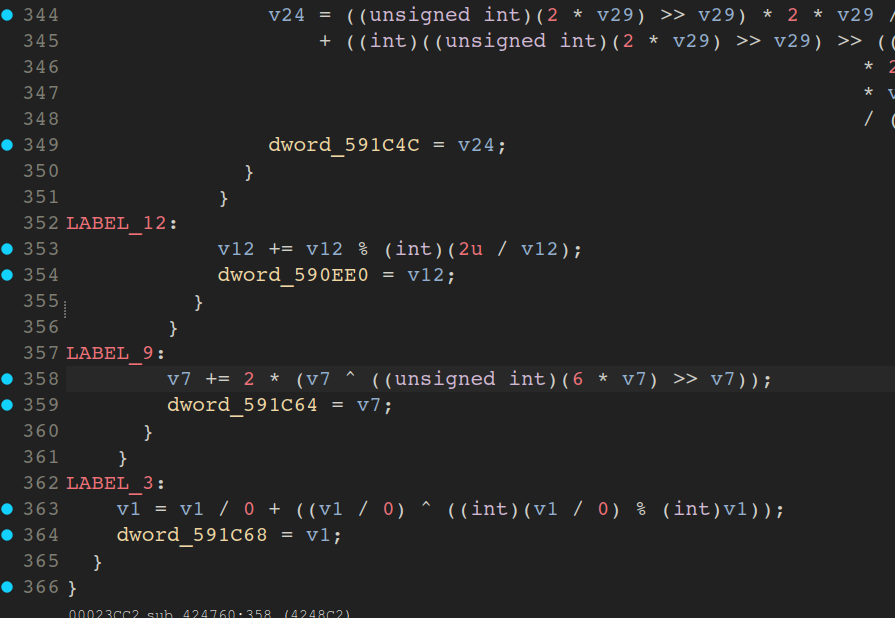 Decompiled Function
Stack VM
Its a simple stack VM. This example will is VM Obfuscation with Tigress And by this you will see how a very simple example becomes when VM obfuscation is applied to it.
Basic Example Source:
1
2
3
4
5
6
7
8
9
10
11
12
13
14
15
16
17
18
19
20
21
22
23
24
25
26
#include <stdio.h>

int target_function(int n)
{
    int a, b;

    a = 0xdeadbeef;
    b = 0x8badf00d;

    int c = a + b;
    int d = a - b;
    int e = c + d + n;

    if(e % 2 == 0){
        return 0;
    }else{
        return 1;
    }
}

int main(int argc, char* argv[])
{
  int n = target_function(argc);
  printf("n=%d\n", n);
  return n;
}
After obfuscation:
1
2
3
4
5
6
7
8
9
10
11
12
13
14
15
16
17
18
19
20
21
22
23
24
25
26
27
28
29
30
31
32
33
34
35
36
37
38
39
40
41
42
43
44
45
46
47
48
49
50
51
52
53
54
55
56
57
58
59
60
61
62
63
64
65
66
67
68
69
70
71
72
73
74
75
76
77
78
79
80
81
82
83
84
85
86
87
88
89
90
91
92
93
94
95
96
97
98
99
100
101
102
103
104
105
106
107
108
109
110
111
112
113
114
115
116
117
118
119
120
121
122
123
124
125
126
127
128
129
130
131
132
133
134
135
136
137
138
139
140
141
142
143
144
145
146
147
148
149
150
151
152
153
154
155
156
157
158
159
160
161
162
163
164
165
166
167
168
169
170
171
172
173
174
175
176
177
178
179
180
181
182
183
184
185
186
187
188
189
190
191
192
193
194
195
196
197
198
199
200
201
202
203
204
205
206
207
208
209
210
211
212
213
214
215
216
217
218
219
220
221
222
223
224
225
226
227
228
229
230
231
232
233
234
235
236
237
238
239
240
241
242
243
244
245
246
247
248
249
250
251
252
253
254
255
256
257
258
259
/* Generated by CIL v. 1.7.0 */
/* print_CIL_Input is false */

union _1_target_function_$node;
struct _IO_FILE;
enum _1_target_function_$op;
struct timeval;
extern int gettimeofday(struct timeval *tv , void *tz ) ;
extern int pthread_cond_broadcast(int *cond ) ;
char **_global_argv  =    (char **)0;
extern int posix_memalign(void **memptr , unsigned long alignment , unsigned long size ) ;
extern int getpagesize() ;
extern int pthread_join(void *thread , void **value_ptr ) ;
extern unsigned long strlen(char const   *s ) ;
extern int open(char const   *filename , int oflag  , ...) ;
extern int pthread_barrier_destroy(int *barrier ) ;
extern int pthread_mutex_init(int *mutex , int *attr ) ;
extern int strncmp(char const   *s1 , char const   *s2 , unsigned long maxlen ) ;
extern int printf(char const   * __restrict  __format  , ...) ;
int _global_argc  =    0;
extern int pthread_cond_signal(int *cond ) ;
extern int pthread_barrier_init(int *barrier , int *attr , unsigned int count ) ;
extern int raise(int sig ) ;
extern int scanf(char const   *format  , ...) ;
char **_global_envp  =    (char **)0;
extern int unlink(char const   *filename ) ;
extern double difftime(long tv1 , long tv0 ) ;
extern int pthread_barrier_wait(int *barrier ) ;
extern int pthread_mutex_lock(int *mutex ) ;
extern void *memcpy(void *s1 , void const   *s2 , unsigned long size ) ;
extern int gethostname(char *name , unsigned long namelen ) ;
extern void *dlsym(void *handle , char *symbol ) ;
char const   *_1_target_function_$strings  =    "";
extern void abort() ;
extern unsigned long strtoul(char const   *str , char const   *endptr , int base ) ;
extern void free(void *ptr ) ;
extern int fprintf(struct _IO_FILE *stream , char const   *format  , ...) ;
int main(int argc , char **argv , char **_formal_envp ) ;
extern void exit(int status ) ;
extern void signal(int sig , void *func ) ;
typedef struct _IO_FILE FILE;
extern int mprotect(void *addr , unsigned long len , int prot ) ;
extern int close(int filedes ) ;
extern double strtod(char const   *str , char const   *endptr ) ;
extern double log(double x ) ;
extern double ceil(double x ) ;
union _1_target_function_$node {
   char _char ;
   unsigned int _unsigned_int ;
   unsigned char _unsigned_char ;
   long _long ;
   unsigned long _unsigned_long ;
   void *_void_star ;
   unsigned short _unsigned_short ;
   unsigned long long _unsigned_long_long ;
   signed char _signed_char ;
   long long _long_long ;
   int _int ;
   short _short ;
};
extern int fclose(void *stream ) ;
extern int fcntl(int filedes , int cmd  , ...) ;
enum _1_target_function_$op {
    _1_target_function__return_int$expr_STA_0 = 11,
    _1_target_function__local$result_STA_0$value_LIT_0 = 181,
    _1_target_function__PlusA_int_int2int$right_STA_0$result_STA_0$left_STA_1 = 242,
    _1_target_function__store_int$right_STA_0$left_STA_1 = 161,
    _1_target_function__constant_int$result_STA_0$value_LIT_0 = 175,
    _1_target_function__load_int$left_STA_0$result_STA_0 = 254,
    _1_target_function__formal$result_STA_0$value_LIT_0 = 32,
    _1_target_function__goto$label_LAB_0 = 9,
    _1_target_function__Mod_int_int2int$left_STA_0$result_STA_0$right_STA_1 = 184,
    _1_target_function__MinusA_int_int2int$left_STA_0$result_STA_0$right_STA_1 = 150,
    _1_target_function__Eq_int_int2int$left_STA_0$result_STA_0$right_STA_1 = 194,
    _1_target_function__branchIfTrue$expr_STA_0$label_LAB_0 = 42
} ;
unsigned char _1_target_function_$array[1][168]  = { {        _1_target_function__local$result_STA_0$value_LIT_0,        (unsigned char)4,        (unsigned char)0,        (unsigned char)0,
            (unsigned char)0,        _1_target_function__constant_int$result_STA_0$value_LIT_0,        (unsigned char)239,        (unsigned char)190,
            (unsigned char)173,        (unsigned char)222,        _1_target_function__store_int$right_STA_0$left_STA_1,        _1_target_function__local$result_STA_0$value_LIT_0,
            (unsigned char)8,        (unsigned char)0,        (unsigned char)0,        (unsigned char)0,
            _1_target_function__constant_int$result_STA_0$value_LIT_0,        (unsigned char)13,        (unsigned char)240,        (unsigned char)173,
            (unsigned char)139,        _1_target_function__store_int$right_STA_0$left_STA_1,        _1_target_function__local$result_STA_0$value_LIT_0,        (unsigned char)12,
            (unsigned char)0,        (unsigned char)0,        (unsigned char)0,        _1_target_function__local$result_STA_0$value_LIT_0,
            (unsigned char)4,        (unsigned char)0,        (unsigned char)0,        (unsigned char)0,
            _1_target_function__load_int$left_STA_0$result_STA_0,        _1_target_function__local$result_STA_0$value_LIT_0,        (unsigned char)8,        (unsigned char)0,
            (unsigned char)0,        (unsigned char)0,        _1_target_function__load_int$left_STA_0$result_STA_0,        _1_target_function__PlusA_int_int2int$right_STA_0$result_STA_0$left_STA_1,
            _1_target_function__store_int$right_STA_0$left_STA_1,        _1_target_function__local$result_STA_0$value_LIT_0,        (unsigned char)16,        (unsigned char)0,
            (unsigned char)0,        (unsigned char)0,        _1_target_function__local$result_STA_0$value_LIT_0,        (unsigned char)8,
            (unsigned char)0,        (unsigned char)0,        (unsigned char)0,        _1_target_function__load_int$left_STA_0$result_STA_0,
            _1_target_function__local$result_STA_0$value_LIT_0,        (unsigned char)4,        (unsigned char)0,        (unsigned char)0,
            (unsigned char)0,        _1_target_function__load_int$left_STA_0$result_STA_0,        _1_target_function__MinusA_int_int2int$left_STA_0$result_STA_0$right_STA_1,        _1_target_function__store_int$right_STA_0$left_STA_1,
            _1_target_function__local$result_STA_0$value_LIT_0,        (unsigned char)20,        (unsigned char)0,        (unsigned char)0,
            (unsigned char)0,        _1_target_function__local$result_STA_0$value_LIT_0,        (unsigned char)12,        (unsigned char)0,
            (unsigned char)0,        (unsigned char)0,        _1_target_function__load_int$left_STA_0$result_STA_0,        _1_target_function__local$result_STA_0$value_LIT_0,
            (unsigned char)16,        (unsigned char)0,        (unsigned char)0,        (unsigned char)0,
            _1_target_function__load_int$left_STA_0$result_STA_0,        _1_target_function__PlusA_int_int2int$right_STA_0$result_STA_0$left_STA_1,        _1_target_function__formal$result_STA_0$value_LIT_0,        (unsigned char)0,
            (unsigned char)0,        (unsigned char)0,        (unsigned char)0,        _1_target_function__load_int$left_STA_0$result_STA_0,
            _1_target_function__PlusA_int_int2int$right_STA_0$result_STA_0$left_STA_1,        _1_target_function__store_int$right_STA_0$left_STA_1,        _1_target_function__goto$label_LAB_0,        (unsigned char)4,
            (unsigned char)0,        (unsigned char)0,        (unsigned char)0,        _1_target_function__constant_int$result_STA_0$value_LIT_0,
            (unsigned char)0,        (unsigned char)0,        (unsigned char)0,        (unsigned char)0,
            _1_target_function__constant_int$result_STA_0$value_LIT_0,        (unsigned char)2,        (unsigned char)0,        (unsigned char)0,
            (unsigned char)0,        _1_target_function__local$result_STA_0$value_LIT_0,        (unsigned char)20,        (unsigned char)0,
            (unsigned char)0,        (unsigned char)0,        _1_target_function__load_int$left_STA_0$result_STA_0,        _1_target_function__Mod_int_int2int$left_STA_0$result_STA_0$right_STA_1,
            _1_target_function__Eq_int_int2int$left_STA_0$result_STA_0$right_STA_1,        _1_target_function__branchIfTrue$expr_STA_0$label_LAB_0,        (unsigned char)9,        (unsigned char)0,
            (unsigned char)0,        (unsigned char)0,        _1_target_function__goto$label_LAB_0,        (unsigned char)25,
            (unsigned char)0,        (unsigned char)0,        (unsigned char)0,        _1_target_function__local$result_STA_0$value_LIT_0,
            (unsigned char)24,        (unsigned char)0,        (unsigned char)0,        (unsigned char)0,
            _1_target_function__constant_int$result_STA_0$value_LIT_0,        (unsigned char)0,        (unsigned char)0,        (unsigned char)0,
            (unsigned char)0,        _1_target_function__store_int$right_STA_0$left_STA_1,        _1_target_function__goto$label_LAB_0,        (unsigned char)4,
            (unsigned char)0,        (unsigned char)0,        (unsigned char)0,        _1_target_function__goto$label_LAB_0,
            (unsigned char)25,        (unsigned char)0,        (unsigned char)0,        (unsigned char)0,
            _1_target_function__local$result_STA_0$value_LIT_0,        (unsigned char)24,        (unsigned char)0,        (unsigned char)0,
            (unsigned char)0,        _1_target_function__constant_int$result_STA_0$value_LIT_0,        (unsigned char)1,        (unsigned char)0,
            (unsigned char)0,        (unsigned char)0,        _1_target_function__store_int$right_STA_0$left_STA_1,        _1_target_function__goto$label_LAB_0,
            (unsigned char)4,        (unsigned char)0,        (unsigned char)0,        (unsigned char)0,
            _1_target_function__goto$label_LAB_0,        (unsigned char)4,        (unsigned char)0,        (unsigned char)0,
            (unsigned char)0,        _1_target_function__local$result_STA_0$value_LIT_0,        (unsigned char)24,        (unsigned char)0,
            (unsigned char)0,        (unsigned char)0,        _1_target_function__load_int$left_STA_0$result_STA_0,        _1_target_function__return_int$expr_STA_0}};
int target_function(int n ) ;
extern int pthread_cond_wait(int *cond , int *mutex ) ;
extern void perror(char const   *str ) ;
extern int pthread_cond_init(int *cond , int *attr ) ;
extern long write(int filedes , void *buf , unsigned long nbyte ) ;
extern int ptrace(int request , void *pid , void *addr , int data ) ;
extern float strtof(char const   *str , char const   *endptr ) ;
extern unsigned long strnlen(char const   *s , unsigned long maxlen ) ;
struct timeval {
   long tv_sec ;
   int tv_usec ;
};
extern void qsort(void *base , unsigned long nel , unsigned long width , int (*compar)(void *a ,
                                                                                       void *b ) ) ;
extern long clock(void) ;
extern long time(long *tloc ) ;
extern long read(int filedes , void *buf , unsigned long nbyte ) ;
extern int rand() ;
extern int strcmp(char const   *a , char const   *b ) ;
extern void *fopen(char const   *filename , char const   *mode ) ;
extern double sqrt(double x ) ;
extern long strtol(char const   *str , char const   *endptr , int base ) ;
extern int snprintf(char *str , unsigned long size , char const   *format  , ...) ;
extern void *malloc(unsigned long size ) ;
extern int nanosleep(int *rqtp , int *rmtp ) ;
extern int pthread_mutex_unlock(int *mutex ) ;
extern int atoi(char const   *s ) ;
extern int pthread_create(void *thread , void *attr , void *start_routine , void *arg ) ;
extern int fscanf(struct _IO_FILE *stream , char const   *format  , ...) ;
extern int fseek(struct _IO_FILE *stream , long offs , int whence ) ;
void megaInit(void) ;
void megaInit(void)
{


  {

}
}
int main(int argc , char **argv , char **_formal_envp )
{
  int n ;
  int tmp ;
  int _BARRIER_0 ;

  {
  megaInit();
  _global_argc = argc;
  _global_argv = argv;
  _global_envp = _formal_envp;
  _BARRIER_0 = 1;
  tmp = target_function(argc);
  n = tmp;
  printf((char const   */* __restrict  */)"n=%d\n", n);
  return (n);
}
}
int target_function(int n )
{
  char _1_target_function_$locals[28] ;
  union _1_target_function_$node _1_target_function_$stack[1][32] ;
  union _1_target_function_$node *_1_target_function_$sp[1] ;
  unsigned char *_1_target_function_$pc[1] ;

  {
  _1_target_function_$sp[0] = _1_target_function_$stack[0];
  _1_target_function_$pc[0] = _1_target_function_$array[0];
  while (1) {
    switch (*(_1_target_function_$pc[0])) {
    case _1_target_function__Mod_int_int2int$left_STA_0$result_STA_0$right_STA_1:
    (_1_target_function_$pc[0]) ++;
    (_1_target_function_$sp[0] + -1)->_int = (_1_target_function_$sp[0] + 0)->_int % (_1_target_function_$sp[0] + -1)->_int;
    (_1_target_function_$sp[0]) --;
    break;
    case _1_target_function__PlusA_int_int2int$right_STA_0$result_STA_0$left_STA_1:
    (_1_target_function_$pc[0]) ++;
    (_1_target_function_$sp[0] + -1)->_int = (_1_target_function_$sp[0] + -1)->_int + (_1_target_function_$sp[0] + 0)->_int;
    (_1_target_function_$sp[0]) --;
    break;
    case _1_target_function__load_int$left_STA_0$result_STA_0:
    (_1_target_function_$pc[0]) ++;
    (_1_target_function_$sp[0] + 0)->_int = *((int *)(_1_target_function_$sp[0] + 0)->_void_star);
    break;
    case _1_target_function__return_int$expr_STA_0:
    (_1_target_function_$pc[0]) ++;
    return ((_1_target_function_$sp[0] + 0)->_int);
    break;
    case _1_target_function__local$result_STA_0$value_LIT_0:
    (_1_target_function_$pc[0]) ++;
    (_1_target_function_$sp[0] + 1)->_void_star = (void *)(_1_target_function_$locals + *((int *)_1_target_function_$pc[0]));
    (_1_target_function_$sp[0]) ++;
    _1_target_function_$pc[0] += 4;
    break;
    case _1_target_function__formal$result_STA_0$value_LIT_0:
    (_1_target_function_$pc[0]) ++;
    switch (*((int *)_1_target_function_$pc[0])) {
    case 0:
    (_1_target_function_$sp[0] + 1)->_void_star = (void *)(& n);
    break;
    }
    (_1_target_function_$sp[0]) ++;
    _1_target_function_$pc[0] += 4;
    break;
    case _1_target_function__Eq_int_int2int$left_STA_0$result_STA_0$right_STA_1:
    (_1_target_function_$pc[0]) ++;
    (_1_target_function_$sp[0] + -1)->_int = (_1_target_function_$sp[0] + 0)->_int == (_1_target_function_$sp[0] + -1)->_int;
    (_1_target_function_$sp[0]) --;
    break;
    case _1_target_function__MinusA_int_int2int$left_STA_0$result_STA_0$right_STA_1:
    (_1_target_function_$pc[0]) ++;
    (_1_target_function_$sp[0] + -1)->_int = (_1_target_function_$sp[0] + 0)->_int - (_1_target_function_$sp[0] + -1)->_int;
    (_1_target_function_$sp[0]) --;
    break;
    case _1_target_function__constant_int$result_STA_0$value_LIT_0:
    (_1_target_function_$pc[0]) ++;
    (_1_target_function_$sp[0] + 1)->_int = *((int *)_1_target_function_$pc[0]);
    (_1_target_function_$sp[0]) ++;
    _1_target_function_$pc[0] += 4;
    break;
    case _1_target_function__goto$label_LAB_0:
    (_1_target_function_$pc[0]) ++;
    _1_target_function_$pc[0] += *((int *)_1_target_function_$pc[0]);
    break;
    case _1_target_function__store_int$right_STA_0$left_STA_1:
    (_1_target_function_$pc[0]) ++;
    *((int *)(_1_target_function_$sp[0] + -1)->_void_star) = (_1_target_function_$sp[0] + 0)->_int;
    _1_target_function_$sp[0] += -2;
    break;
    case _1_target_function__branchIfTrue$expr_STA_0$label_LAB_0:
    (_1_target_function_$pc[0]) ++;
    if ((_1_target_function_$sp[0] + 0)->_int) {
      _1_target_function_$pc[0] += *((int *)_1_target_function_$pc[0]);
    } else {
      _1_target_function_$pc[0] += 4;
    }
    (_1_target_function_$sp[0]) --;
    break;
    }
  }
}
}
So now we are starting to deal with something interesting, Opening it to IDA:
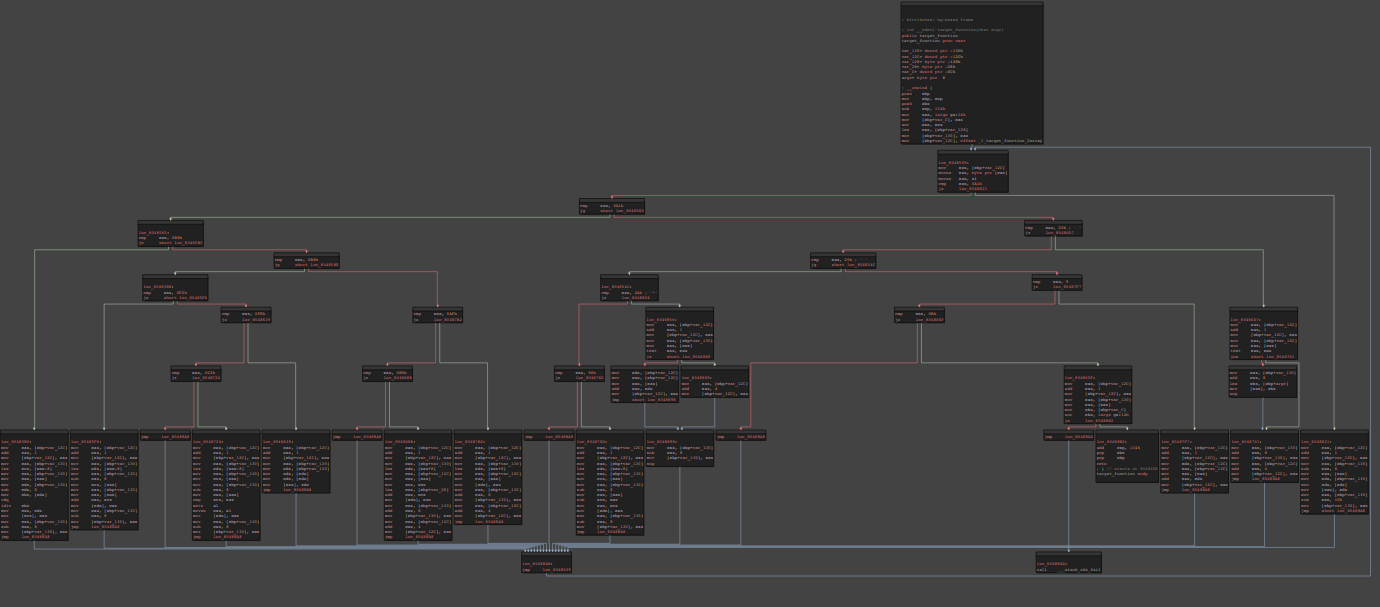 VM Function
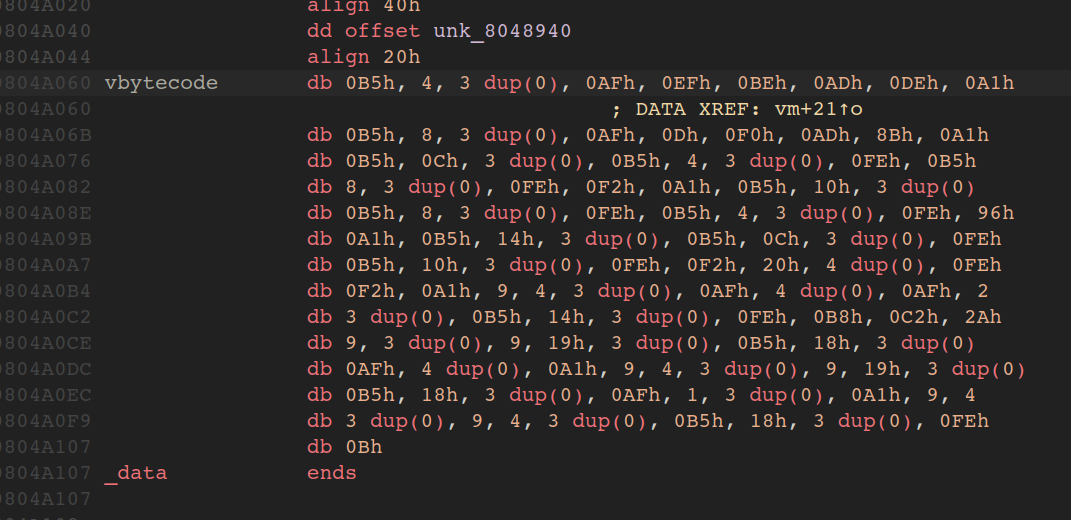 VM Bytecode
IDA decompilation results:
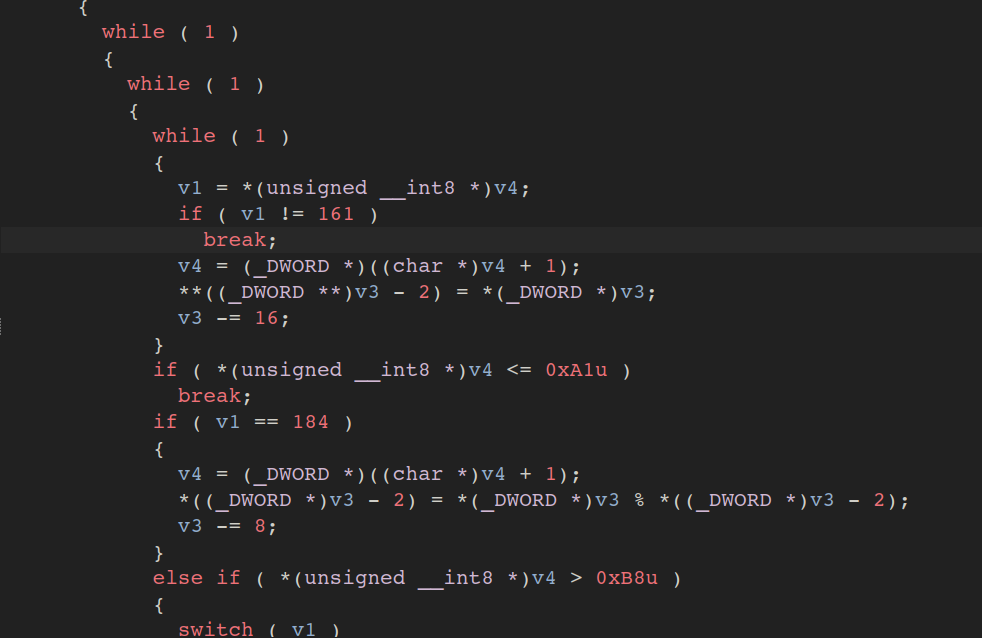
VM Tracing
Our first step is to make a working Symbolic Execution Engine which traces the vm with concerete bytecode values. for that we can insert the vm bytecode into the sybolic execution symbols dictonary.
1
2
3
4
5
6
7
8
9
10
11
12
13
[...]
def read_bytecode():
    # here i have embedded the address of the bytecode and its size
    bytecode_addr = 0x804A060; sz = 0x804A107 - 0x804A060 + 1 # is 0xA8
    sym_bytecode_addr = ExprMem(ExprInt(bytecode_addr, 32), sz * 8) # symbolic memory
    byte_code = container.bin_stream.getbytes(bytecode_addr, sz) # bytecode from the file
    sym_bytecode = ExprInt(int.from_bytes(byte_code, byteorder='little'), sz * 8)
    return sym_bytecode_addr, sym_bytecode

sb = SymbolicExecutionEngine(lifter=lifter)
sym_bytecode_addr, sym_bytecode = read_bytecode()
sb.symbols[sym_bytecode_addr] = sym_bytecode # fixed the bytecode in the symbolic symbols
[...]
when ever Symbolic execution is performed than bytecode will be treated as concerete value instead of symbolic.
1
2
3
4
5
6
7
8
9
10
11
12
13
[...]

sb.run_block_at(ircfg=ircfg, addr=vm_entry) # initialized all the stack varible etc


q = deque([ExprInt(vm_dispatcher, 32)])
while q:
    bb = q.popleft()
    # print(f'current: {block}')
    r = sb.run_block_at(ircfg=ircfg, addr=bb)
    print(r)
    if r.is_loc() or r.is_int():
        q.append(r)
After some tracing it stopped !
1
2
3
4
5
6
7
8
9
10
11
12
13
14
[...]
0x804856C
0x804858E
0x8048595
0x80485A0
0x8048724
0x80488A8
0x8048509
0x8048520
0x8048527
0x8048530
0x804854C
0x8048856
smod((@32[ESP + 0x4] + 0xBD5B7DDE)[31:32]?({@32[ESP + 0x4] + 0xBD5B7DDE 0 32, 0xFFFFFFFF 32 64},{@32[ESP + 0x4] + 0xBD5B7DDE 0 32, 0x0 32 64}), 0x2)[0:32]?(0x8048889,0x8048871)
The last basic block was 0x8048856 so we analyze that and see why the next didn’t resolved.
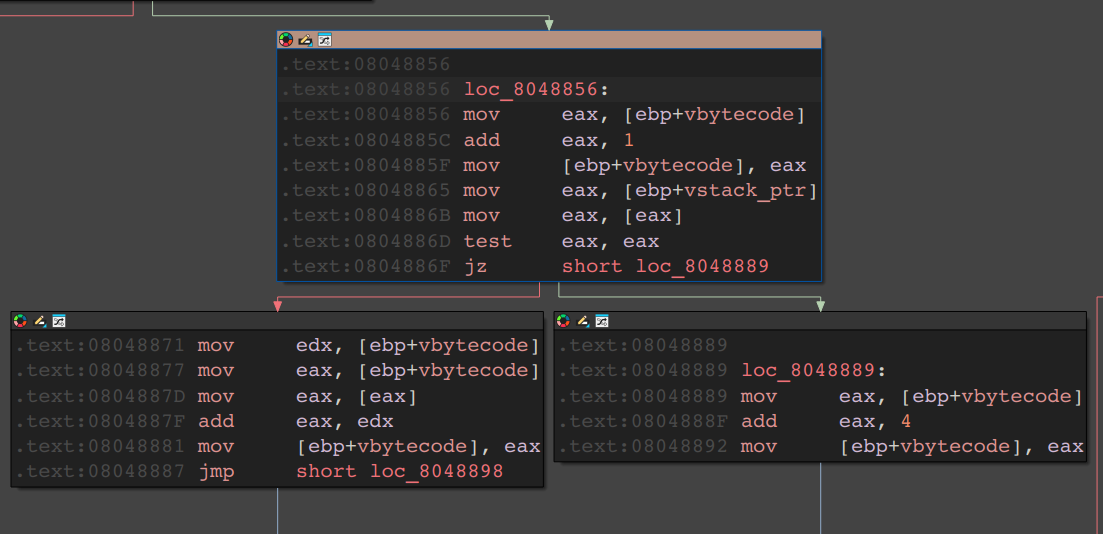
We can see that it reads an address from the virtual stack pointer and dereference it and check if its zero or not, so it takes a path depending on the vstack_ptr. if we look at the miasm expression condition @32[ESP + 0x4] + 0xBD5B7DDE)[31:32]? [ESP + 0x4] is a symbolic value which we haven’t defined in the symbolic execution symbols dictonary.
the arg variable is [EBP-0x8] which is basically [ESP + 0x4] its the function argument. So we just have to make the function argument concerete.
1
2
3
4
5
6
7
8
# initiallizing before running the symbolic exectution of vm entry
sb.symbols[ExprId('ESP', 32)] = ExprInt(0x1000, 32) # arbitrary address

arg = ExprMem(expr_simp(sb.symbols[ExprId('ESP', 32)] + ExprInt(4, 32)), 32) # the stack address where the argument resides
sb.symbols[arg] = ExprInt(0, 32) # set concrete value for arg

sb.run_block_at(ircfg=ircfg, addr=vm_entry)
[...]
1
2
3
4
5
6
7
8
9
10
11
[...]
0x80488A8
0x8048509
0x8048520
0x8048527
0x8048530
0x8048535
0x804853E
0x804865F
0x80488B2
@32[0x1000]
Thats it, as it was a simple vm our tracer is complete :)
1
2
3
4
5
6
7
8
9
10
11
12
13
14
15
16
17
18
19
20
21
22
23
24
25
26
27
28
29
30
31
32
33
34
35
36
37
38
39
40
# tracer
file = 'test-mod2-add-virtualized.bin'
addr = 0x80484DE

loc_db = LocationDB()
container = Container.from_stream(open(file, 'rb'), loc_db=loc_db)
machine = Machine(container.arch)
mdis = machine.dis_engine(container.bin_stream, loc_db=loc_db)
lifter = machine.lifter_model_call(loc_db=loc_db)
sb = SymbolicExecutionEngine(lifter=lifter)
asmcfg = mdis.dis_multiblock(addr)
ircfg = lifter.new_ircfg_from_asmcfg(asmcfg=asmcfg)
vm_entry = addr; vm_dispatcher = 0x8048509

def read_bytecode():
    bytecode_addr = 0x804A060; sz = 0x804A107 - 0x804A060 + 1
    sym_bytecode_addr = ExprMem(ExprInt(bytecode_addr, 32), sz * 8) # symbolic memory
    byte_code = container.bin_stream.getbytes(bytecode_addr, sz) # bytecode from the file
    sym_bytecode = ExprInt(int.from_bytes(byte_code, byteorder='little'), sz * 8)
    return sym_bytecode_addr, sym_bytecode

sym_bytecode_addr, sym_bytecode = read_bytecode()
sb.symbols[sym_bytecode_addr] = sym_bytecode # fixed the bytecode in the symbolic symbols

sb.symbols[ExprId('ESP', 32)] = ExprInt(0x1000, 32)

arg = ExprMem(expr_simp(sb.symbols[ExprId('ESP', 32)] + ExprInt(4, 32)), 32)
sb.symbols[arg] = ExprInt(0, 32) # set concrete value for arg

sb.run_block_at(ircfg=ircfg, addr=vm_entry)

q = deque([ExprInt(vm_dispatcher, 32)])
while q:
    bb = q.popleft()
    # print(f'current: {block}')
    r = sb.run_block_at(ircfg=ircfg, addr=bb)
    print(r)
    if r.is_loc() or r.is_int():
        q.append(r)
VM Disassembler
When the tracer is ready, We are ready to write a disassembler. As its just a simple VM its handlers are only 1 liner, so you can just analyze it in 5 mins, because to write a full disasembler of this VM we do need to understand the handlers semantics a little bit so we can add information in our disassembler the symbolic execution just helps us to avoid writing each handler semantic implementation but still we should know what each handler.
1
2
3
4
5
6
7
8
9
10
11
12
13
14
15
16
17
18
19
20
21
22
23
24
25
26
27
28
29
30
31
32
33
34
35
36
37
38
39
40
41
42
43
44
45
46
47
48
49
50
51
52
53
54
55
56
57
58
59
60
61
62
63
64
65
66
67
68
69
70
71
72
73
74
75
76
77
78
79
80
81
82
83
84
85
86
87
88
89
90
91
92
93
94
95
96
97
98
99
100
101
102
103
104
105
106
107
// Short manaual analysis of the simple stack base vm, i have renamed variables and commented what handler does
int __cdecl vm(char arg)
{
  int vip; // eax
  _DWORD *vstack_ptr; // [esp+8h] [ebp-130h]
  char *vbytecode; // [esp+Ch] [ebp-12Ch]
  _BYTE vstack[284]; // [esp+10h] [ebp-128h] BYREF
  unsigned int canary; // [esp+12Ch] [ebp-Ch]

  canary = __readgsdword(0x14u);
  vstack_ptr = vstack;
  vbytecode = ::vbytecode;
  do
  {
    while ( 1 )
    {
      while ( 1 )
      {
        while ( 1 )
        {
          while ( 1 )
          {
            while ( 1 )
            {
              vip = (unsigned __int8)*vbytecode;
              if ( vip != 0xA1 )
                break;
              ++vbytecode;
              *(_DWORD *)vstack_ptr[-2u] = *vstack_ptr;// store
              vstack_ptr -= 4;
            }
            if ( (unsigned __int8)*vbytecode <= 0xA1u )
              break;
            if ( vip == 0xB8 )
            {
              ++vbytecode;
              *(vstack_ptr - 2) = *vstack_ptr % *(vstack_ptr - 2);// mod and load
              vstack_ptr -= 2;
            }
            else if ( (unsigned __int8)*vbytecode > 0xB8u )
            {
              switch ( vip )
              {
                case 0xF2:
                  ++vbytecode;
                  *(vstack_ptr - 2) += *vstack_ptr;// add
                  vstack_ptr -= 2;
                  break;
                case 0xFE:
                  ++vbytecode;
                  *vstack_ptr = *(_DWORD *)*vstack_ptr;// store
                  break;
                case 0xC2:
                  ++vbytecode;
                  *(vstack_ptr - 2) = *vstack_ptr == *(vstack_ptr - 2);// sete
                  vstack_ptr -= 2;
                  break;
              }
            }
            else if ( vip == 0xAF )
            {
              vstack_ptr[2] = *(_DWORD *)++vbytecode;// push imm
              vstack_ptr += 2;
              vbytecode += 4;
            }
            else if ( vip == 0xB5 )
            {
              vstack_ptr[2] = &vstack[*(_DWORD *)++vbytecode + 0x100];// mov vtack, [mem]
              vstack_ptr += 2;
              vbytecode += 4;
            }
          }
          if ( vip != 0x20 )
            break;
          if ( !*(_DWORD *)++vbytecode )
            vstack_ptr[2] = &arg;               // mov stack, value (load)
          vstack_ptr += 2;
          vbytecode += 4;
        }
        if ( (unsigned __int8)*vbytecode <= 0x20u )
          break;
        if ( vip == 0x2A )
        {
          ++vbytecode;
          if ( *vstack_ptr )                    // jnz
            vbytecode += *(_DWORD *)vbytecode;
          else
            vbytecode += 4;
          vstack_ptr -= 2;
        }
        else if ( vip == 0x96 )
        {
          ++vbytecode;
          *(vstack_ptr - 2) = *vstack_ptr - *(vstack_ptr - 2);// sub
          vstack_ptr -= 2;
        }
      }
      if ( vip != 9 )
        break;
      ++vbytecode;
      vbytecode += *(_DWORD *)vbytecode;        // jmp
    }
  }
  while ( vip != 0xB );
  ++vbytecode;
  return *vstack_ptr;
}
So we will just now symbolically execute the vm and check after each block that if this address is one of the vm handlers, and if it is, we will print the what ever the semantics of that handler are, and thats how we get out vm disassembler.
1
2
3
4
5
6
7
8
9
10
11
12
13
14
15
16
17
18
19
20
21
22
23
24
25
26
27
28
29
30
31
32
33
34
35
36
37
38
39
40
41
42
43
44
45
46
47
48
49
50
51
52
53
54
55
56
57
58
59
60
61
62
63
64
65
66
67
68
69
70
71
72
73
74
75
76
77
78
79
80
81
82
83
84
85
86
87
88
89
90
91
92
93
94
95
96
97
98
99
100
101
102
103
104
105
106
107
108
109
110
111
112
113
114
115
116
117
118
119
120
121
from miasm.core.locationdb import LocationDB
from miasm.analysis.binary import Container
from miasm.analysis.machine import Machine
from miasm.analysis.simplifier import expr_simp
from miasm.ir.symbexec import SymbolicExecutionEngine
from miasm.expression.expression import ExprMem, ExprInt, ExprId
from collections import deque

file = 'test-mod2-add-virtualized.bin'
addr = 0x80484DE

loc_db = LocationDB()
container = Container.from_stream(open(file, 'rb'), loc_db=loc_db)
machine = Machine(container.arch)
mdis = machine.dis_engine(container.bin_stream, loc_db=loc_db)
lifter = machine.lifter_model_call(loc_db=loc_db)
sb = SymbolicExecutionEngine(lifter=lifter)
asmcfg = mdis.dis_multiblock(addr)
ircfg = lifter.new_ircfg_from_asmcfg(asmcfg=asmcfg)
vm_entry = addr; vm_dispatcher = 0x8048509

def read_bytecode():
    bytecode_addr = 0x804A060; sz = 0x804A107 - 0x804A060 + 1 # is 0xA8
    sym_bytecode_addr = ExprMem(ExprInt(bytecode_addr, 32), sz * 8) # symbolic memory
    byte_code = container.bin_stream.getbytes(bytecode_addr, sz) # bytecode from the file
    sym_bytecode = ExprInt(int.from_bytes(byte_code, byteorder='little'), sz * 8)
    return sym_bytecode_addr, sym_bytecode

def resolve_addr(r):
    if r.is_int():
        return int(r)
    if r.is_loc():
        return loc_db.get_location_offset(r.loc_key)
    return None

HANDLERS = {
    0x8048821: 'STORE',
    0x80485B0: 'MOD',
    0x80485F6: 'ADD',
    0x8048639: 'DEREF',
    0x8048724: 'SETE',
    0x80487B2: 'PUSH',
    0x804868B: 'LOAD, [MEM]',
    0x80486D7: 'LOAD INPUT',
    0x8048856: 'JNZ',
    0x804876D: 'SUB',
    0x80487F7: 'JMP',
    0x804865F: 'HALT'
}

# the disassembler (this vm is so simple that we don't need miasm, but to give you the idea that all the internals of vm like pushing/popping stack values are all done by miasm)
def disassemble(sb, r, vstack, vstack_addr, vip):
    global EBP
    mnem = HANDLERS[r]
    # always expr_simp the address before building the ExprMem key
    mem = lambda addr:expr_simp(sb.eval_expr(ExprMem(expr_simp(addr), 32)))

    tos    = vstack                             # @32[P]      top of vstack
    second = mem(vstack_addr - ExprInt(8, 32))  # @32[P - 8]  next slot down
    imm    = mem(vip + ExprInt(1, 32))          # imm32 of the 5-byte opcodes

    if mnem == 'STORE':          # *(vstack[-2]) = vstack[0]; vsp -= 4 dwords
        print(f'{vip}  {mnem} [{second}] = {tos}')
    elif mnem == 'MOD':          # vstack[-2] = vstack[0] % vstack[-2]; vsp -= 2
        print(f'{vip}  {mnem}   {tos} % {second}')
    elif mnem == 'ADD':          # vstack[-2] += vstack[0]; vsp -= 2
        print(f'{vip}  {mnem}   {second}, {tos}')
    elif mnem == 'SUB':          # vstack[-2] = vstack[0] - vstack[-2]; vsp -= 2
        print(f'{vip}  {mnem}   {tos} - {second}')
    elif mnem == 'SETE':         # vstack[-2] = (vstack[0] == vstack[-2]); vsp -= 2
        print(f'{vip}  {mnem}  {tos} == {second}')
    elif mnem == 'DEREF':          # vstack[0] = *(vstack[0])   -- deref in place
        print(f'{vip}  {mnem} [{tos}] -> {mem(tos)}')
    elif mnem == 'PUSH':         # push imm32
        print(f'{vip}  {mnem}  {imm}')
    elif mnem == 'LOAD, [MEM]':   # push &vstack[imm + 0x100]
        slot = expr_simp(ExprInt(0x100, 32) + imm + expr_simp(EBP - ExprInt(0x128, 32))) # &vstack= byte ptr -128h
        print(f'{vip}  LOAD  &vstack[{imm} + 0x100]  (= {slot})')
    elif mnem == 'LOAD INPUT':   # if (imm == 0) push &arg    (arg is at EBP+8)
        if imm.is_int() and int(imm) == 0:
            print(f'{vip}  CMOVZ {mnem}  input={sb.eval_expr(ExprMem(expr_simp(EBP + ExprInt(8, 32)), 32))}; !zf:{imm}')
    elif mnem == 'JNZ':       # ++vip; if (vstack[0]) vip += disp else vip += 4; vsp -= 2
        print(f'{vip}  {mnem}  {expr_simp(vip + ExprInt(1, 32) + imm)}  ; !zf = {tos}')
    elif mnem == 'JMP':          # ++vip; vip += disp
        print(f'{vip}  {mnem}   {expr_simp(vip + ExprInt(1, 32) + imm)}')
    elif mnem == 'HALT':
        print(f'{vip}  {mnem}  ; ret = {tos}')


sym_bytecode_addr, sym_bytecode = read_bytecode()
sb.symbols[sym_bytecode_addr] = sym_bytecode # fixed the bytecode in the symbolic symbols

sb.symbols[ExprId('ESP', 32)] = ExprInt(0x1000, 32) # arbitrary address
arg = ExprMem(expr_simp(sb.symbols[ExprId('ESP', 32)] + ExprInt(4, 32)), 32)
sb.symbols[arg] = ExprInt(0, 32) # set concrete value for arg

sb.run_block_at(ircfg=ircfg, addr=vm_entry) # initialized all the stack varible etc

EBP = sb.symbols[ExprId('EBP', 32)]
arg = ExprMem(expr_simp(EBP + ExprInt(8, 32)), 32)
sb.symbols[arg] = ExprInt(0, 32) # set concrete value for arg

# we needed vip and vstack to print the information we needed for each handler
vip_local = sb.symbols[ExprMem(EBP - ExprInt(0x12C, 32), 32)]
vstack_local = sb.symbols[ExprMem(EBP - ExprInt(0x130, 32), 32)] # local variables

q = deque([ExprInt(vm_dispatcher, 32)])
while q:
    bb = q.popleft()
    r = sb.run_block_at(ircfg=ircfg, addr=bb)

    vstack_addr = sb.eval_expr(vstack_local); vstack = sb.eval_expr(ExprMem(vstack_local, 32))
    hd = resolve_addr(r)
    if hd in HANDLERS:
        disassemble(sb, hd, vstack=vstack, vstack_addr=vstack_addr, vip=sb.eval_expr(vip_local))


    if r.is_loc() or r.is_int():
        q.append(r)
    # print(r) # tracer
This gives us clean disassembly which you can see here
Tigress CFF
This example has Control Flow Flattening. I thought to change the dummy/simple src to a little bit larget dummy example. Its nothing serious its just 180 LOC and its obfuscated version is 520 LOC
 Flattened function CFG
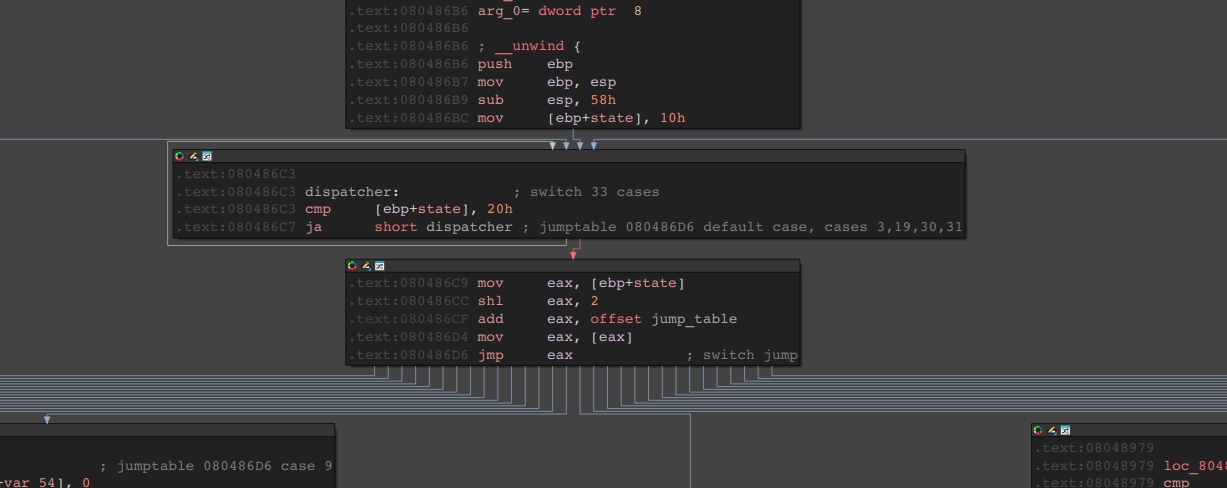 Dispatcher
Its a jump table based CFF obfuscator. if we disassemble it via miasm asmcfg then the view is:
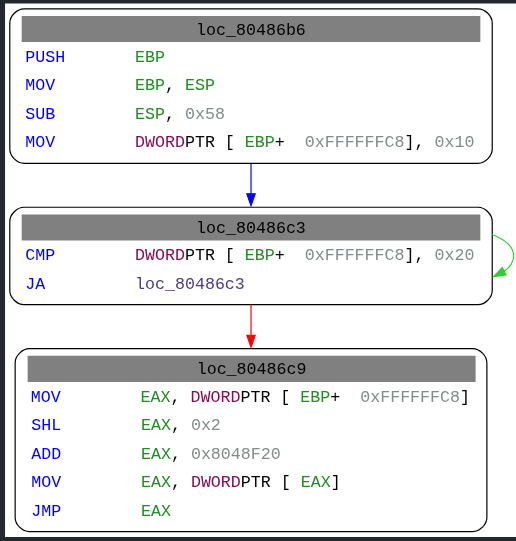
We can only see the entry and the dispatcher, it just ends on indirect jump, So we merge the asmcfg with the addresses in jmp table, and we will get the whole asmcfg.
1
2
3
4
5
6
7
8
9
10
11
12
13
14
15

jt = {}
for s in range(jt_count):
    idx = va(jt_base + 4 * s) # va is a helper function which uses lief to convert address to raw offset
    jt[s] = struct.unpack('<I', raw[idx:idx+4])[0]

state_and_addr = {s: h for s, h in jt.items() if h != disp_addr} # to avoid the loopback branches

asmcfg = mdis.dis_multiblock(target_addr) # incomplete asmcfg (just the dispatcher)

for h in set(state_and_addr.values()): # getting all the state addreses
    asmcfg.merge(mdis.dis_multiblock(h)) # merging them on existing incomplete AsmCFG

open('asmcfg.dot', 'w').write(asmcfg.dot()) # we have a full asm cfg now
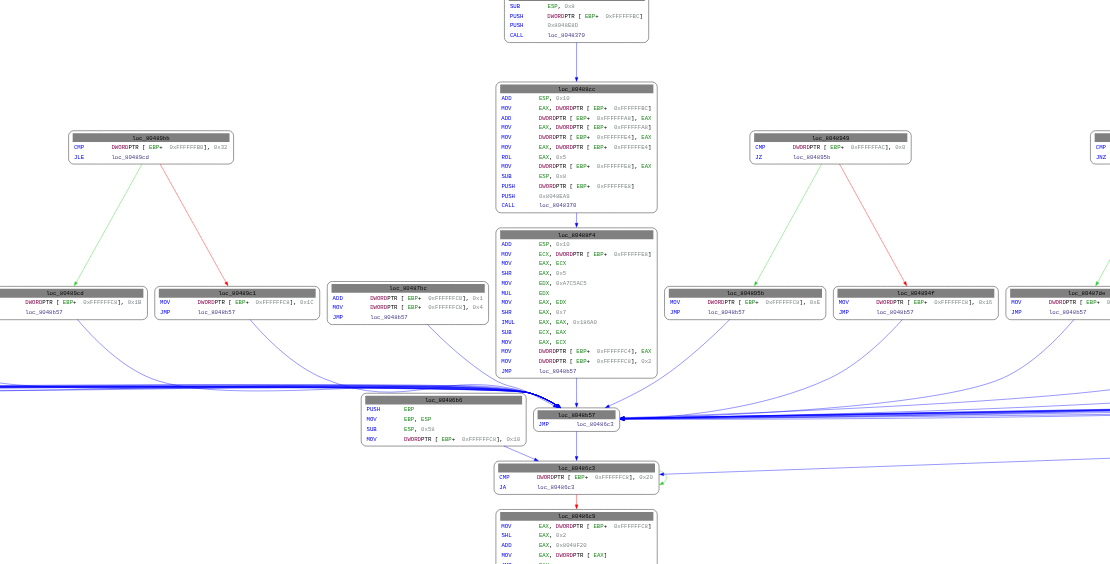 Final AsmCFG
One thing to note about miasm asm blocks that they split on calls, Forexample:
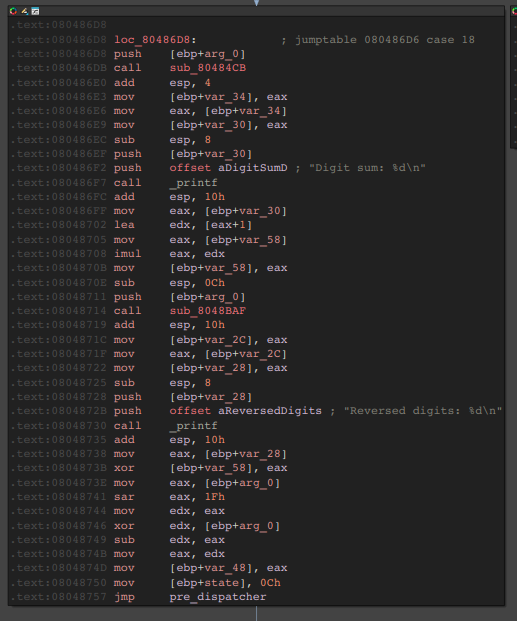 Basic Block of a case
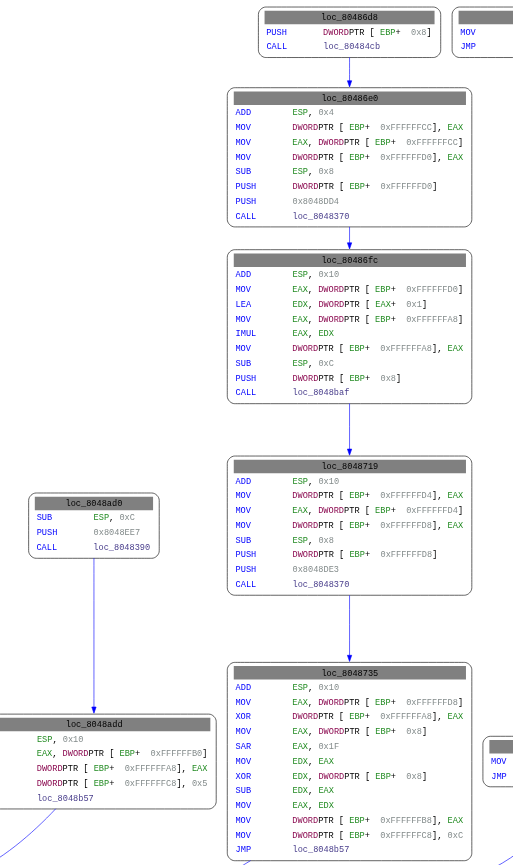 Same Basic Block in miasm. Its split on each call
General Approach
So we have an initial state at the start of dispatcher block, that state determines which jump to perform from the jump table. After each case execution at the tail state value is updated, but some cases have conditional jumps which can have two distinct state values. Thus effecting the execution flow via a condition.
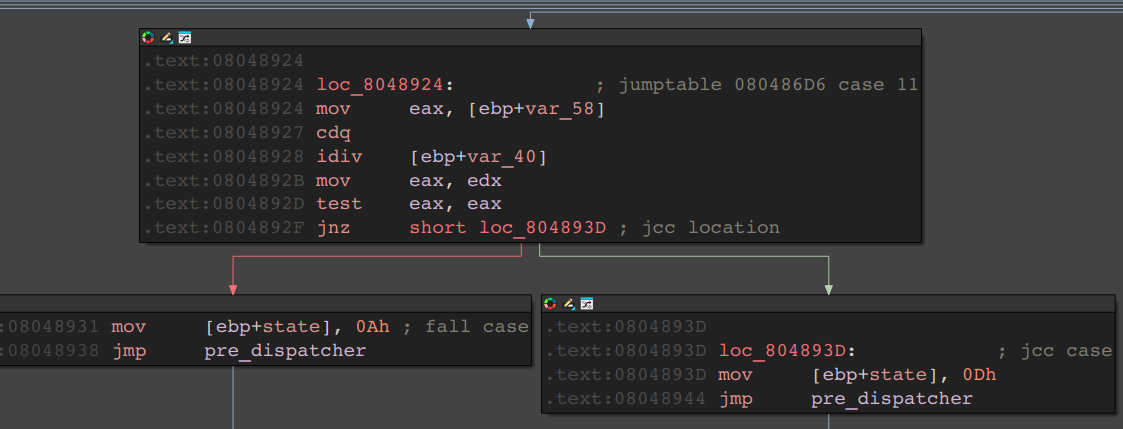 A simple example of how a single case determines the other state by jcc, fall through will get executed which will have fall state
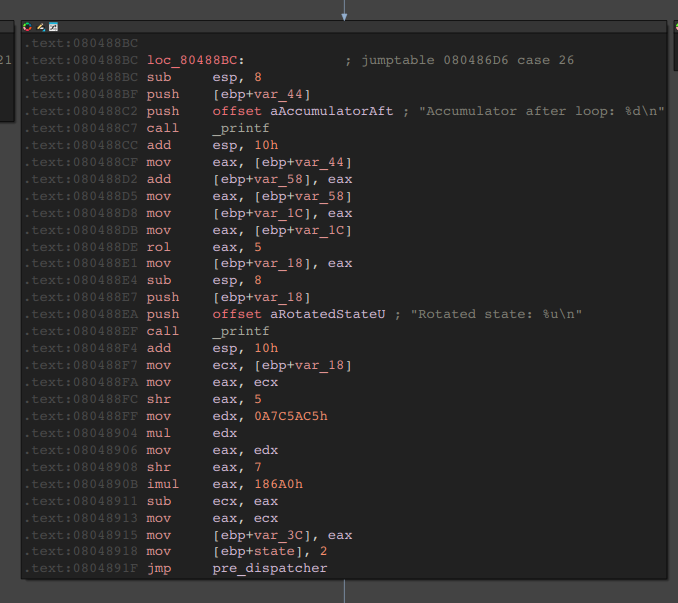 This is simple case, one state corresponds the other state. Just the whole OBB chain as its unconditional
To deobfuscate this, We will again use the power of Symbolic execution engine. We will extract all splited basic blocks (as miasm basic blocks are splited on call instruction too) as single original basic block. If we encounter any jcc at the any of the case block it means that there is a conditional control flow here, to extract the info we will chain the fall case leaving the jcc case for later recovery. After that we have the full chain of the case statement (if its a jcc then last chain block is the fall case). We iterate through each of the cases and perform symbolic exection on each case by extracting there jcc case too and the last chain value (which is the fall case). So by this we will have the entire chain of execution in uncondtional jmp blocks and both jcc state and fall state if it was an conditional jump block, Which we store as state to state mapping where we know this state can have two possible further states depending upon the jcc and then we do have state to address mapping too.
As miasm treats global data reads as symbolic, We do need to set the jump table to be concerete so that, it resolves to some jump address rather than some symbolic vector.
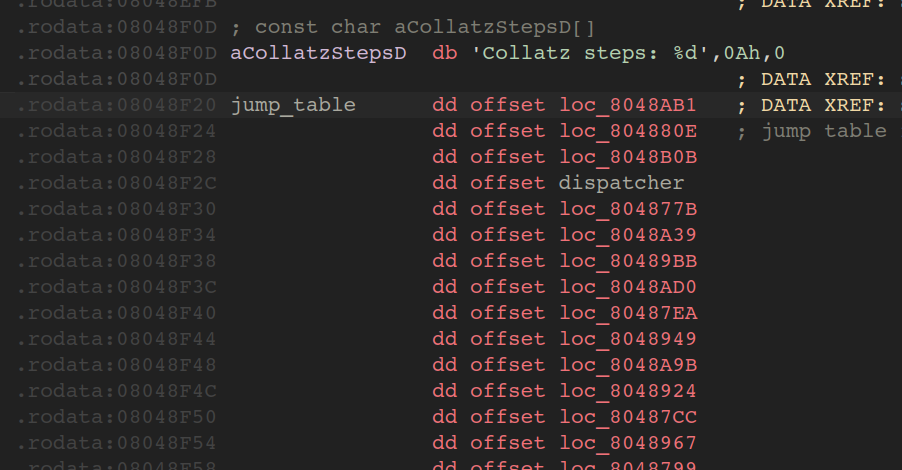 Jump Table
The jump table lives in the .rodata, We can also just read the jump table directly from binary but i opted lief as it will work for whole sections in the binary.
1
2
3
4
5
6
7
8
9
10
11
12
13
14
15
16
17
18
19
concreteSymbols = {} # we will use that as the argument of add_data

def add_data(concrete, offset, data):
    # fill every overlapping qword/dword with concrete values from data
    for i in range(0, len(data)-7, 8):
        concrete[ExprMem(ExprInt(offset + i, 64), 64)] = ExprInt(u64(data, i), 64)
    for i in range(0, len(data)-3, 4):
        concrete[ExprMem(ExprInt(offset + i, 32), 32)] = ExprInt(u32(data, i), 32)

def simpExprMemCallBack(expr):
    if isinstance(expr, ExprMem):
        if expr in concreteSymbols:
            return expr.replace_expr({expr: concreteSymbols[expr]})
    return None

def simpExprMem(_, expr):
    # https://github.com/cea-sec/miasm/blob/master/miasm/expression/expression.py#L614
    visitor = ExprVisitorCallbackTopToBottom(simpExprMemCallBack)
    return visitor.visit(expr)
The functions that we want, that initialize the data.
1
2
3
4
5
6
7
8
9
10
11
12

rodata = elf.get_section('.rodata') # getting the .rodata of the binary via lief

# This function initilizes all the .rodata in concreteSymbols dict. (tho we need just the jmp table)
add_data(concreteSymbols, rodata.virtual_address, bytes(rodata.content)) # rodata virtuall address as offset

# Custom simplification pass
custom_simp = ExpressionSimplifier()
custom_simp.enable_passes(ExpressionSimplifier.PASS_COMMONS)
custom_simp.enable_passes(ExpressionSimplifier.PASS_HIGH_TO_EXPLICIT)
custom_simp.enable_passes({ExprMem: [simpExprMem]})
Custom simplification pass which contains the concerete data we need, we just need to pass it to symbolic execution engine
1
2
3
4
5
6
7
8
9
10
11
12
13
14
15
16
17
18
19
20
21
22
23
24
25
26
27
def case_chain(case_loc):
    chain = [case_loc]
    cur = case_loc
    while True:
        bb = asmcfg.loc_key_to_block(cur)
        if bb.lines[-1].name in ('JMP', 'RET'):
            break
        succs = asmcfg.successors(cur)
        if bb.lines[-1].name.startswith('J') and len(succs) == 2: # if we get a jcc (then we have 2 successors)
            cur = fall_through(bb, succs) # than we append the fall case in our chain.
        else:
            cur = succs[0]

        if cur in DISPATCHER_LOCS:
            break

        chain.append(cur) # append all the block in the chain (and fall in case of jcc)
    return chain

def fall_through(bb, succs): # succ is a lockey
    tgt = bb.lines[-1].args[0] # getting path to jcc location
    if isinstance(tgt, ExprLoc): tgt_loc = tgt.loc_key
    else: tgt_loc = tgt
    others = [s for s in succs if s != tgt_loc] # the successors which isn't the jcc
    assert len(others) == 1
    return others[0] # returning the fall case
Now as we have discussed how we will connect the OBB via chaining and how to fall through works, Now we will just pick the state variable and see how we will perform symbolic execution on each case.
1
2
3
.text:080486C3 dispatcher:             ; switch 33 cases
.text:080486C3 cmp     [ebp+state], 20h ; [ebp - 0x38]
.text:080486C7 ja      short dispatcher
1
2
3
4
5
6
disp_addr = 0x80486C3

dispatch_loc = loc_db.get_offset_location(disp_addr) # our state variable read is from this block is in this block
disp_block = asmcfg.loc_key_to_block(dispatch_loc)
state_variable = disp_block.lines[0].get_args_expr()[0] # as the state cmp is at first line of dispatcher, and its first expr
print('STATE VAR:', state_variable)
We get the correct state
1
STATE VAR: @32[EBP + 0xFFFFFFC8]
1
2
3
4
5
6
7
8
9
10
11
12
13
14
15
16
17
18
19
20
21
22
23
24
25
26
27
28
29
# performed on each case
def discover_case(case_loc, chain):
    case_block = asmcfg.loc_key_to_block(case_loc)
    last = case_block.lines[-1]
    if last.name.startswith('J') and len(chain) == 2: # as the jcc cases only had 2 chains.
        # passing our custom simplification pass for concerete data
        sb = SymbolicExecutionEngine(lifter, init_symbols, sb_expr_simp=custom_simp)
        jcc_target_loc = to_loc_key(last.args[0]) # getting the jcc target location
        side_state = symb_exe_to_state(sb, jcc_target_loc) # next state value after the jcc case
        fall_state = symb_exe_to_state(sb, chain[-1]) # next state value after the fall case
        return [fall_state], {jcc_target_loc: side_state} # the fall state is the next state and along side we have also calculated the jcc

    sb = SymbolicExecutionEngine(lifter, init_symbols, sb_expr_simp=custom_simp)  # if the case was simple unconditional jmp (fixed state conversion)
    nxt = symb_exe_to_state(sb, chain[-1]) # direct unconditional state update
    if nxt is not None:
        return [nxt], {} # just the nxt because it has no jcc case
    else:
        return [], {} # no next as its a return block

def symb_exe_to_state(sb, loc):
    r = sb.run_block_at(ircfg=ircfg, addr=loc) # perform symbolic execution of the a basic block of location
    r = to_loc_key(r)
    if r in DISPATCHER_LOCS: # if dispatcher and pre-dispathcer
        v = sb.eval_expr(state_variable) # get the state value which is updated during symbolic execution
        return int(v) if isinstance(v, ExprInt) else None
    if r == ret_loc: # whent he next basic block is the return block
        return None
    return symb_exe_to_state(sb, r) # repeat the process to process multichain blocks
These are peformed on each jump table location getting information on each of the case block on where it falls and where it jumps. Then we do have all necessary information to delete the irrelevant basic block and only keep the Original Basic Blocks which is union of only the prologue block, case blocks and return block. All the irrelevant Basic blocks will be removed
1
2
3
4
5
6
7
def remove_irrelevant_BB(original_BB):
    irrelevant_locations = []
    for bb in asmcfg.blocks:
        if bb.loc_key not in original_BB:
            irrelevant_locations.append(bb.loc_key)
    for loc in irrelevant_locations:
        asmcfg.del_block(asmcfg.loc_key_to_block(loc))
Each iteration of the symbolic execution on each individial case block stores the info in three python dictonary, I have modified the ollvm-unflattener binrewriter to make this tigress cff unflattener work which you can see here, Now if we just run our deobfuscator we get a fully unflattened function
 CFG Before Deobfuscation
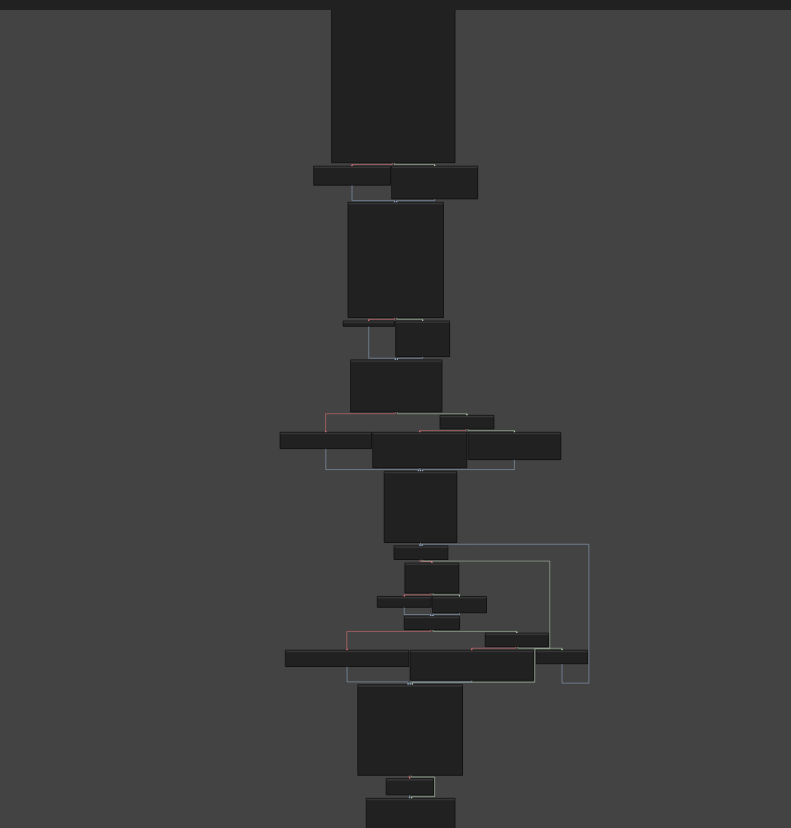 CFG After Deobfuscation
This is the whole deobfuscation script
1
2
3
4
5
6
7
8
9
10
11
12
13
14
15
16
17
18
19
20
21
22
23
24
25
26
27
28
29
30
31
32
33
34
35
36
37
38
39
40
41
42
43
44
45
46
47
48
49
50
51
52
53
54
55
56
57
58
59
60
61
62
63
64
65
66
67
68
69
70
71
72
73
74
75
76
77
78
79
80
81
82
83
84
85
86
87
88
89
90
91
92
93
94
95
96
97
98
99
100
101
102
103
104
105
106
107
108
109
110
111
112
113
114
115
116
117
118
119
120
121
122
123
124
125
126
127
128
129
130
131
132
133
134
135
136
137
138
139
140
141
142
143
144
145
146
147
148
149
150
151
152
153
154
155
156
157
158
159
160
161
162
163
164
165
166
167
168
169
170
171
172
173
174
175
176
177
178
179
180
181
182
183
184
185
186
187
188
189
190
191
192
193
194
195
196
197
198
199
200
201
202
203
204
205
206
207
208
209
210
from miasm.core.locationdb import LocationDB, LocKey
from miasm.analysis.binary import Container
from miasm.analysis.machine import Machine
from miasm.expression.simplifications import ExpressionSimplifier, expr_simp
from miasm.expression.expression import ExprInt, ExprMem, ExprLoc, ExprVisitorCallbackTopToBottom
from miasm.ir.symbexec import SymbolicExecutionEngine
from miasm.arch.x86.regs import all_regs_ids, all_regs_ids_init
from collections import defaultdict
from binrewrite_t import TBinaryRewriter
import struct
import lief

file = 'testing-flatten.bin'
target_addr = 0x80486B6
disp_addr = 0x80486C3
pre_disp_addr = 0x8048B57
ret_addr = 0x8048B5C
jt_base = 0x8048F20
jt_count =  0x21

ENTRY_STATE = -2
EXIT_STATE = -1

elf = lief.ELF.parse(file)
loc_db = LocationDB()
container = Container.from_stream(open(file, 'rb'), loc_db=loc_db)
machine = Machine(container.arch)
mdis = machine.dis_engine(container.bin_stream, loc_db=loc_db)
lifter = machine.lifter_model_call(loc_db=loc_db)

va = lambda addr: elf.virtual_address_to_offset(addr)

raw = open(file, 'rb').read()
jt = {}
for s in range(jt_count):
    idx = va(jt_base + 4 * s)
    jt[s] = struct.unpack('<I', raw[idx:idx+4])[0]

state_and_addr = {s: h for s, h in jt.items() if h != disp_addr}

asmcfg = mdis.dis_multiblock(target_addr)

for h in set(state_and_addr.values()):
    asmcfg.merge(mdis.dis_multiblock(h))

ircfg = lifter.new_ircfg_from_asmcfg(asmcfg=asmcfg) # lifting the full asmcfg to full ircfg

def u64(data, i):
    return struct.unpack('<Q', data[i:i + 8])[0]
def u32(data, i):
    return struct.unpack('<I', data[i:i + 4])[0]

concreteSymbols = {}
def add_data(symb, offset, data):
    # fill every overlapping qword/dword with concrete values from data
    for i in range(0, len(data)-7, 8):
        symb[ExprMem(ExprInt(offset + i, 64), 64)] = ExprInt(u64(data, i), 64)
    for i in range(0, len(data)-3, 4):
        symb[ExprMem(ExprInt(offset + i, 32), 32)] = ExprInt(u32(data, i), 32)

def simpExprMemCallBack(expr):
    if isinstance(expr, ExprMem):
        if expr in concreteSymbols:
            return expr.replace_expr({expr: concreteSymbols[expr]})
    return None

def simpExprMem(_, expr):
    # https://github.com/cea-sec/miasm/blob/master/miasm/expression/expression.py#L614
    visitor = ExprVisitorCallbackTopToBottom(simpExprMemCallBack)
    return visitor.visit(expr)

def to_loc_key(expr):
    if isinstance(expr, LocKey):  return expr
    if isinstance(expr, ExprLoc): return expr.loc_key
    if isinstance(expr, int):     return loc_db.get_offset_location(expr)
    if isinstance(expr, ExprInt): return loc_db.get_offset_location(int(expr))
    return None

rodata = elf.get_section('.rodata')

add_data(concreteSymbols, rodata.virtual_address, bytes(rodata.content))

custom_simp = ExpressionSimplifier()
custom_simp.enable_passes(ExpressionSimplifier.PASS_COMMONS)
custom_simp.enable_passes(ExpressionSimplifier.PASS_HIGH_TO_EXPLICIT)
custom_simp.enable_passes({ExprMem: [simpExprMem]})

pre_disp_loc = loc_db.get_offset_location(pre_disp_addr)
dispatch_loc = loc_db.get_offset_location(disp_addr)
ret_loc = loc_db.get_offset_location(ret_addr)
DISPATCHER_LOCS = {dispatch_loc, pre_disp_loc}

disp_block = asmcfg.loc_key_to_block(dispatch_loc)
state_variable = disp_block.lines[0].get_args_expr()[0]
print('STATE VAR:', state_variable)

init_symbols = {}
for i, r in enumerate(all_regs_ids):
    init_symbols[r] = all_regs_ids_init[i]

def remove_irrelevant_BB(original_BB):
    irrelevant_locations = []
    for bb in asmcfg.blocks:
        if bb.loc_key not in original_BB:
            irrelevant_locations.append(bb.loc_key)
    for loc in irrelevant_locations:
        asmcfg.del_block(asmcfg.loc_key_to_block(loc))

def fall_through(bb, succs): # succ is a lockey
    tgt = bb.lines[-1].args[0] # getting path to jcc location
    if isinstance(tgt, ExprLoc): tgt_loc = tgt.loc_key
    else: tgt_loc = tgt
    others = [s for s in succs if s != tgt_loc] # the successors which isn't the jcc
    assert len(others) == 1
    return others[0] # returning the fall case

def case_chain(case_loc):
    chain = [case_loc]
    cur = case_loc
    while True:
        bb = asmcfg.loc_key_to_block(cur)
        if bb.lines[-1].name in ('JMP', 'RET'):
            break
        succs = asmcfg.successors(cur)
        if bb.lines[-1].name.startswith('J') and len(succs) == 2: # if we get a jcc (then we have 2 successors)
            cur = fall_through(bb, succs) # than we append the fall case in our chain.
        else:
            cur = succs[0]
        if cur in DISPATCHER_LOCS:
            break
        chain.append(cur) # append all the block in the chain (and fall in case of jcc)
    return chain

def symb_exe_to_state(sb, loc):
    r = sb.run_block_at(ircfg=ircfg, addr=loc)
    r = to_loc_key(r)
    if r in DISPATCHER_LOCS:
        v = sb.eval_expr(state_variable)
        return int(v) if isinstance(v, ExprInt) else None
    if r == ret_loc:
        return None
    return symb_exe_to_state(sb, r)

def discover_case(case_loc, chain):
    case_block = asmcfg.loc_key_to_block(case_loc)
    last = case_block.lines[-1]
    if last.name.startswith('J') and len(chain) == 2: # as the jcc cases only had 2 chains.
        sb = SymbolicExecutionEngine(lifter, init_symbols, sb_expr_simp=custom_simp)
        jcc_target_loc = to_loc_key(last.args[0]) # getting the jcc target location
        side_state = symb_exe_to_state(sb, jcc_target_loc) # jcc state
        fall_state = symb_exe_to_state(sb, chain[-1]) # fall state from the last chain
        return [fall_state], {jcc_target_loc: side_state} # the fall state is the next state and along side we have also calculated the jcc

    sb = SymbolicExecutionEngine(lifter, init_symbols, sb_expr_simp=custom_simp)  # if the case was simple unconditional jmp (fixed state conversion)
    nxt = symb_exe_to_state(sb, chain[-1]) # direct unconditional state update
    if nxt is not None:
        return [nxt], {} # just the nxt because it has no jcc case
    else:
        return [], {} # no next as its a return block

state_to_state_map = defaultdict(list)
state_to_addr_map = defaultdict(list)
jcc_targets_map = defaultdict(dict)

# entry/prologue pseudo-state: run the entry block -> first dispatched state
entry_loc = loc_db.get_offset_location(target_addr)
state_to_addr_map[ENTRY_STATE] = case_chain(entry_loc)
sb0 = SymbolicExecutionEngine(lifter, init_symbols, sb_expr_simp=custom_simp)
first_state_val = symb_exe_to_state(sb0, entry_loc)

assert first_state_val is not None
state_to_state_map[ENTRY_STATE].append(first_state_val)

print('entry chain:', [hex(loc_db.get_location_offset(x)) for x in state_to_addr_map[ENTRY_STATE]], '-> first state', hex(first_state_val))

for state_val, case_addr in sorted(state_and_addr.items()):
    case_loc = loc_db.get_offset_location(case_addr)
    chain = case_chain(case_loc)
    state_to_addr_map[state_val] = chain # containes a whole block and only fall if the the block splits into conditional
    nexts, jcc = discover_case(case_loc, chain)
    state_to_state_map[state_val] = nexts
    if jcc:
        jcc_targets_map[state_val] = jcc
    print('state {:2d} chain={} -> fall={} jcc={}'.format( # debug/info print
        state_val,
        [hex(loc_db.get_location_offset(x)) for x in chain],
        nexts,
        {hex(loc_db.get_location_offset(k)): v for k, v in jcc.items()} if jcc else None))

# exit pseudo-state: the ret block.  Terminal cases jump straight to it
# (no state store involved), so it cannot be a jump-table state.
state_to_addr_map[EXIT_STATE] = [ret_loc]
state_to_state_map[EXIT_STATE] = [] # as there is no next state

for s, ns in state_to_state_map.items():
    if not ns and s != EXIT_STATE: # if there is no next state and current state is not an exit state, make that state and exit state.
        state_to_state_map[s] = [EXIT_STATE]

# OBB = union of all case chains (+ prologue, + ret block)
OBB = []
for locations in state_to_addr_map.values():
    OBB.extend(locations)
print('OBB blocks:', len(OBB), 'of', len(asmcfg.blocks))

remove_irrelevant_BB(original_BB=OBB)

# Patch
rewriter = TBinaryRewriter(container.arch, file, va_function_lief=va)
rewriter.patch_binary(asmcfg, target_addr, state_to_state_map,state_to_addr_map, jcc_targets_map,ENTRY_STATE, EXIT_STATE, sb0, file + '.deob',state_variable=state_variable)
Range Dividers
Sometimes to increase the function size and the CFG, There is range-dividers obfuscations. which is basically replicating the basic block functionality. Hence we perform Equivalence checking.
A method to determine if two given BB have the same behavior via Syntactically-equivalent & Semantically-equivalent.
Approach
We will iterate through each basic block, And for each basic block we will check all the other basic block of that function that are they Syntactically-equivalent or Semantically-equivalent Hence the Basic blocks are equivalent.
First check the Syntax-equivalence
1
2
3
4
5
6
7
8
9
10
11
12
def syntax_cmp(src_asmbb, dst_asmbb):
    if len(src_asmbb.lines) != len(dst_asmbb.lines):
        return False
    for src_l, dst_l in zip(src_asmbb.lines, dst_asmbb.lines):

        if str(src_l).startswith('J') and str(dst_l).startswith('J'): # if its jmp instruction
            if str(src_l).split(' ')[0] != str(dst_l).split(' ')[0]: # don't care about the jmp location
                return False

        elif str(src_l) != str(dst_l): # if the instructions are not jmp or jcc and they are not same
            return False
    return True # all passed hence same instructions
If the syntax_cmp returns False, We check semantic equivalence, We will have two lifter to lift each block, because we want two different IRCFG. We will perform symbolic execution on each IR Block. and check if they are sat.
1
2
3
4
5
6
7
8
9
10
11
12
13
14
15
16
17
18
19
20
21
22
23
24
25
26
27
28
29
30
31
32
33
34
35
36
37
38
39
40
41
42
43
44
45
46
47
48
49
50
51
52
53
54
55
56
57
58
59
60
61
62
63
64
65
def semantic_cmp(src_asmbb, dst_asmbb, lifter_s, lifter_d):
    src_ircfg = IRCFG(None, src_asmbb.loc_key)
    lifter_s.add_asmblock_to_ircfg(block=src_asmbb, ircfg=src_ircfg)
    dst_ircfg = IRCFG(None, dst_asmbb.loc_key)
    lifter_d.add_asmblock_to_ircfg(block=dst_asmbb, ircfg=dst_ircfg)
    src_irbb = src_ircfg.blocks[next(iter(src_ircfg.blocks))] # get the source IR basic block
    dst_irbb = dst_ircfg.blocks[next(iter(dst_ircfg.blocks))] # get the destination IR basic block

    # Ready for Symbolic Execution
    src_symbols = {}; dst_symbols = {}

    # regs
    for i, r in enumerate(all_regs_ids):
        src_symbols[r] = all_regs_ids_init[i]; dst_symbols[r] = all_regs_ids_init[i] # init symbols for both blocks

    src_sb = SymbolicExecutionEngine(lifter_s, src_symbols)

    for assignblk in src_irbb:
        assign = True
        for dst in assignblk:
            if str(dst) in ['EIP', 'IRDst']:
                assign = False
        if assign:
            src_sb.eval_updt_assignblk(assignblk)

    dst_sb = SymbolicExecutionEngine(lifter_d, dst_symbols)

    for assignblk in dst_irbb:
        assign = True
        for dst in assignblk:
            if str(dst) in ['EIP', 'IRDst']:
                assign = False
        if assign:
            dst_sb.eval_updt_assignblk(assignblk)

    src_sb.del_mem_above_stack(lifter_s.sp)
    dst_sb.del_mem_above_stack(lifter_d.sp)

    all_memory_ids  = [k for k, v in dst_sb.symbols.memory()] + [k for k, v in src_sb.symbols.memory()]

    for k in all_regs_ids + all_memory_ids:

        if str(k) == 'EIP' or k in [zf, nf, pf, of, cf, af, df, tf]:
            continue

        v0 = src_sb.symbols[k] # source symbol value
        v1 = dst_sb.symbols[k] # destination symbol value

        if v0 == v1:
            continue

        s = z3.Solver()
        t = TranslatorZ3()
        try:
            r = t.from_expr(v0); l = t.from_expr(v1)
        except NotImplementedError:
            return False

        s.add(z3.Not(r == l)) # in no such case r == l
        if s.check() == z3.unsat: # means that r == l in all cases not only one
            continue
        else:
            return False
    # all symbols and memory has been iterated and every case was unsat for r != l, it means that both are equal in both cases.
    return True
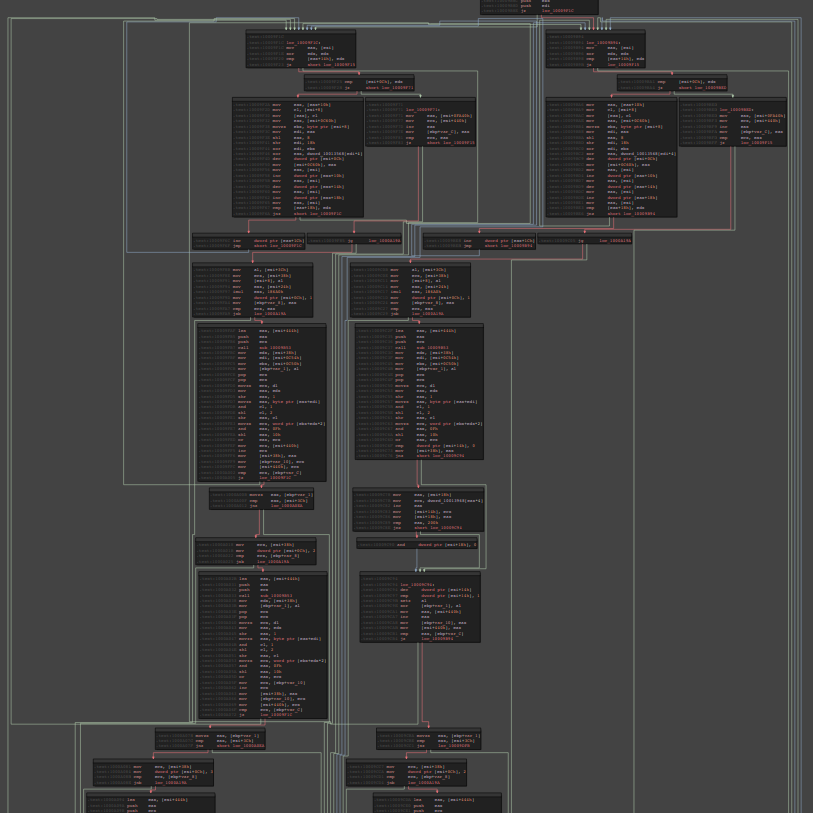 Before Equivalence checking
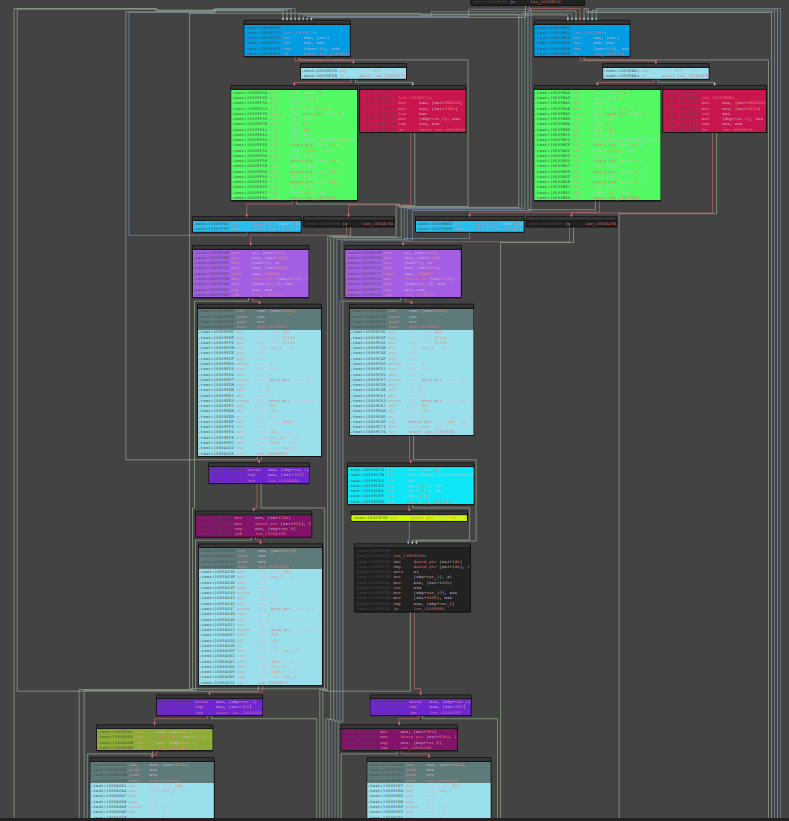 After Equivalence checking
Zeus VM Devirtualization
I picked this sample because it was used in miasm blog in 2016. But that post uses old depreciated miasm2 API and also that is more focused on recovery of handler semantics via symbolic execution and getting result of each handler in miasm IR instead of a de-virtualizer.
We will cover its string deobfuscation and write a functional disassembler which yields some usefull information. Which is compelete different approach from that blog :)
String Decryption
during analysis we see this function frequently
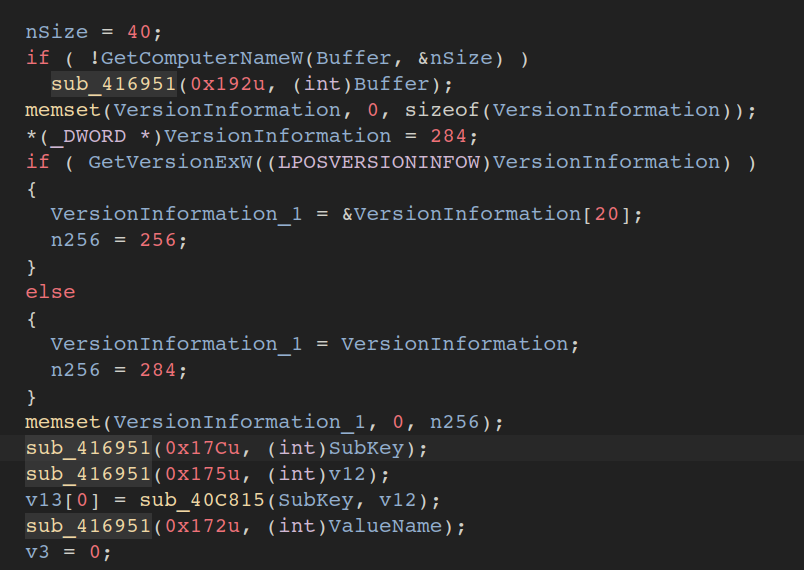
If we look inside
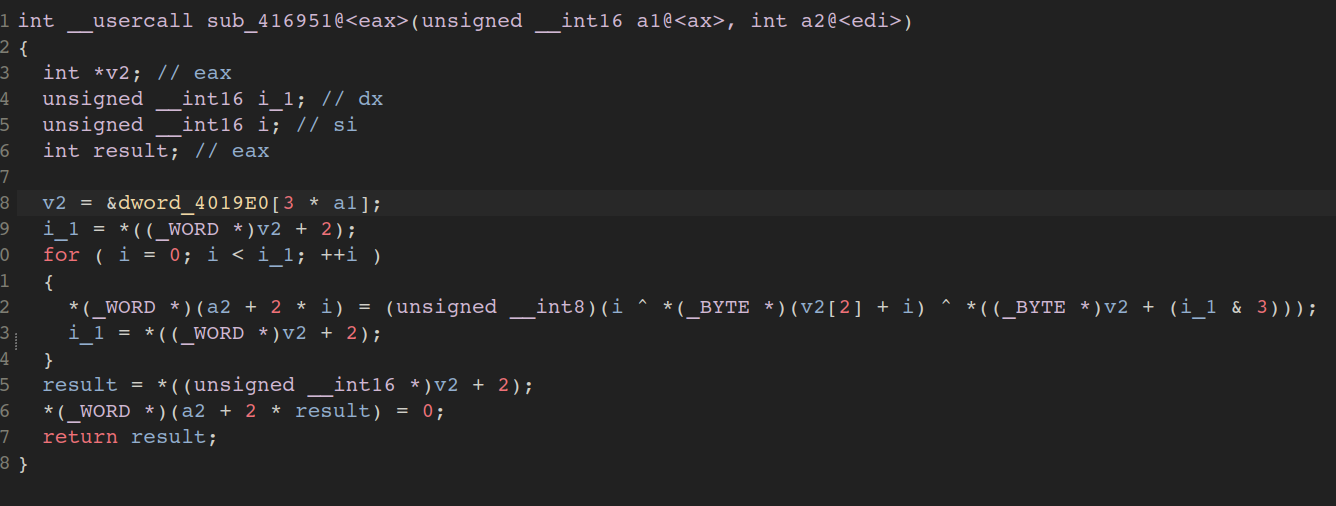 String decryption function
The string encrypted table has 4 bytes of key, size of the encrypted string and the address to the encrypted string bytes.
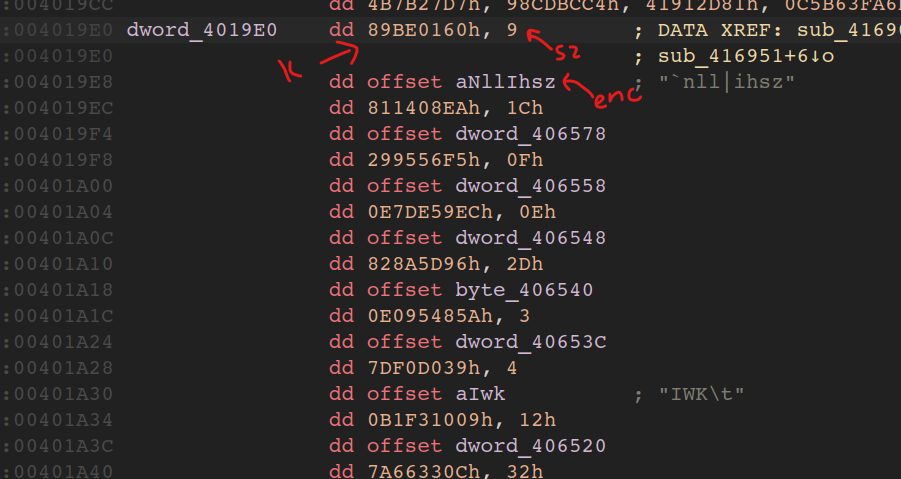 encrypted string table
Setting the struct in IDA
1
2
3
4
5
6
struct enc
{
  _DWORD key;
  _DWORD size;
  _BYTE *string;
};
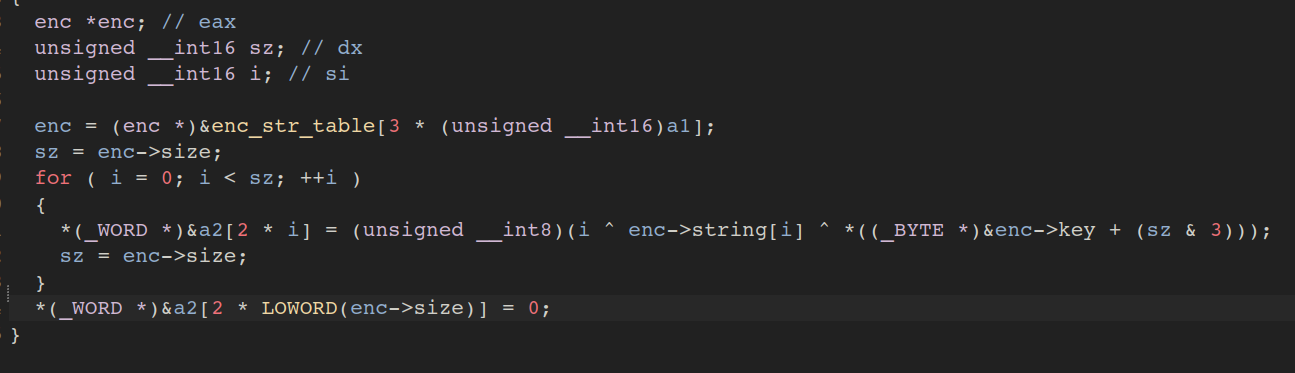 after applying the enc struct
For testing that it works i did the first manually.
1
2
3
4
5
6
7
8
k = bytes.fromhex('6001BE89')
sz = 9
enc = bytes.fromhex('606E6C6C7C6968737A00')

dec = []
for i in range(sz):
    dec.append(i ^ enc[i] ^ k[sz & 3])
print(''.join(map(chr, dec)))
1
2
$ python string_dec.py
anonymous
1
2
3
4
5
6
7
8
9
10
# translation in ida python

def decrypt_string(off):
    enc_struct = 0x4019E0 + 12 * off
    k = ida_bytes.get_bytes(enc_struct, 4); size = idc.get_wide_dword(enc_struct+4); enc_addr = idc.get_wide_dword(enc_struct+8)
    enc = ida_bytes.get_bytes(enc_addr, size=size)
    key = k[size & 3]; dec = []
    for i in range(size):
        dec.append(i ^ enc[i] ^ key)
    return bytes(dec).decode()
as the encrypted string table is referenced in two function means both are string decryption functions, we will use ida python and get the first argument from all of the xrefs and after that we can perform string decryption in ida and convert them into a enum, So we will have the decrypted string at each function argument.
Full string decryption to enum script
1
2
3
4
5
6
7
8
9
10
11
12
13
14
15
16
17
18
19
20
21
22
23
24
25
26
27
28
29
30
31
32
33
34
35
36
37
38
39
40
41
42
43
44
45
46
47
48
49
50
51
52
53
54
55
56
57
58
59
60
61
62
63
64
65
66
67
68
69
70
71
72
73
74
75
76
77
78
79
80
81
82
83
84
85
86
87
88
89
90
91
92
93
94
95
96
97
98
99
100
101
102
103
104
105
106
107
108
109
110
111
112
113
114
115
116
117
118
119
120
121
122
123
124
125
126
127
128
129

import idc
import ida_bytes
import ida_funcs
import idautils
import ida_hexrays
import re

def get_first_arg(call_ea):
    func = ida_funcs.get_func(call_ea)
    cfunc = ida_hexrays.decompile(func)
    class ArgFinder(ida_hexrays.ctree_visitor_t):  # custom visitor to walk the ctree
        def __init__(self):
            ida_hexrays.ctree_visitor_t.init(self, ida_hexrays.CV_FAST)  # faster traversal
            self.result = None                    # will hold the first arg's value if found

        def visit_expr(self, e):
            # look for a call expression whose address matches our target call_ea
            if e.op == ida_hexrays.cot_call and e.ea == call_ea:
                if e.a.size() > 0:                # e.a is the call's argument list (carglist_t)
                    arg0 = e.a[0]                  # first arg
                    if arg0.op == ida_hexrays.cot_num:  # if its a constant
                        self.result = arg0.numval()
                return 1   # stop traversal
            return 0       # continue traversal

    af = ArgFinder()
    af.apply_to(cfunc.body, None)   # run the visitor over the whole function body
    return af.result                 # return the found constant, or None if not found/not a constant

xrefs = [ref.frm for ref in idautils.XrefsTo(0x416951)] + [ref.frm for ref in idautils.XrefsTo(0x416901)]

def decrypt_string(off, xref):
    if xref == 0x41c73d: return None # some junk byte
    # print(hex(xref)) # debug print
    enc_struct = 0x4019E0 + 12 * off
    k = ida_bytes.get_bytes(enc_struct, 4); size = idc.get_wide_dword(enc_struct+4); enc_addr = idc.get_wide_dword(enc_struct+8)
    enc = ida_bytes.get_bytes(enc_addr, size=size)
    key = k[size & 3]; dec = []
    for i in range(size):
        dec.append(i ^ enc[i] ^ key)
    return bytes(dec).decode()

enum_dict = {}
def string_decryptor():
    for xref in xrefs:
        offset = get_first_arg(xref)
        if not offset or offset in enum_dict:
            # print(hex(xref), offset)
            continue
        decrypted = decrypt_string(offset, xref)
        if decrypted:
            enum_dict[offset] = decrypted

    dict_to_enum(enum_dict)

def dict_to_enum(d, enum_name="zeus_string_dec"):

    used = set()
    lines = [f"enum {enum_name}", "{"]

    for key in sorted(d):
        s = d[key]
        # Uppercase
        name = s.upper()
        # Common replacements
        replacements = {
            "%S": "FMT_S",
            "%U": "FMT_U",
            "%D": "FMT_D",
            "%X": "FMT_X",
            "%08X": "FMT_08X",
            "%02X": "FMT_02X",
            "%C": "FMT_C",
            "%P": "FMT_P",
            "*": "STAR",
            "\\": "_",
            "/": "_",
            ".": "_",
            ":": "_",
            "-": "_",
            " ": "_",
            "\t": "_",
            "\r": "_",
            "\n": "_",
            '"': "",
            "'": "",
            "(": "",
            ")": "",
            "[": "",
            "]": "",
            "{": "",
            "}": "",
            ",": "_",
            ";": "_",
            "=": "_",
            "+": "_",
            "&": "_AND_",
            "|": "_OR_",
            "?": "_",
            "!": "_",
            "@": "AT",
        }

        for old, new in replacements.items():
            name = name.replace(old, new)
        # Remove anything still invalid
        name = re.sub(r'[^A-Z0-9_]', '_', name)
        # Collapse repeated underscores
        name = re.sub(r'_+', '_', name).strip("_")
        # Cannot start with digit
        if name[0].isdigit():
            name = "_" + name

        # Ensure uniqueness
        base = name
        i = 2
        while name in used:
            name = f"{base}_{i}"
            i += 1
        used.add(name)
        lines.append(f"    {name} = 0x{key:X},")

    lines.append("};")

    with open(enum_name+'.c', 'w') as f:
        f.write("\n".join(lines))

string_decryptor()
After setting the first argument type to the decrypted enum, we will have all the string decrypted in the argument :)
De-Virt
After some analysis we encounter the vm function.
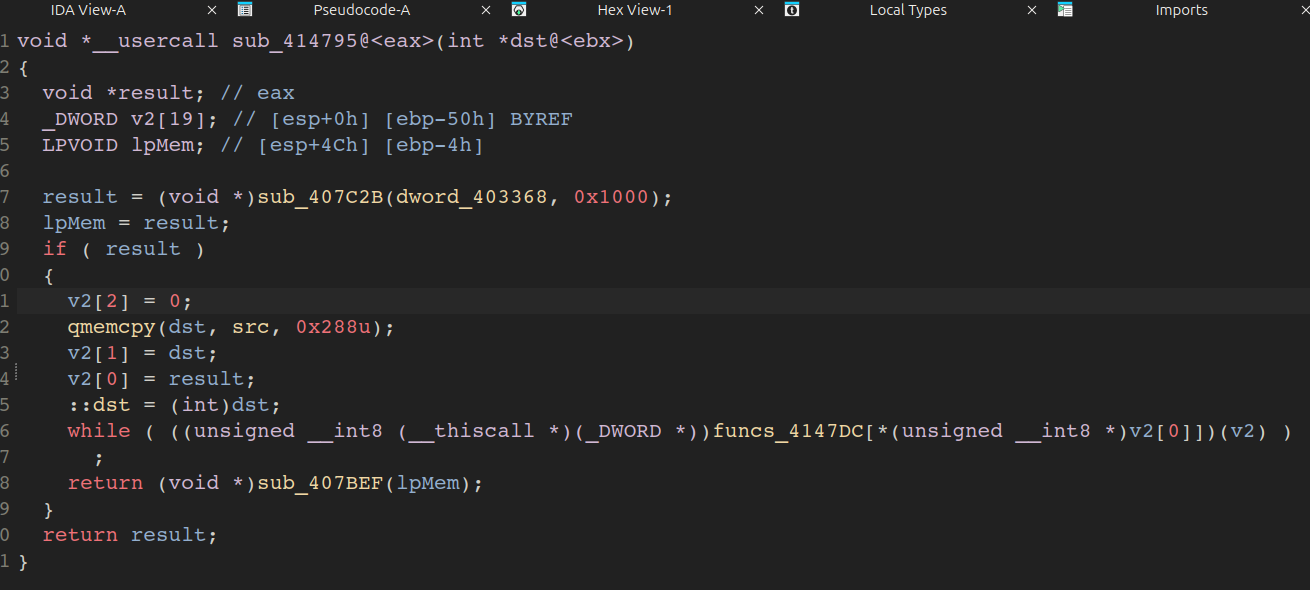 vm function
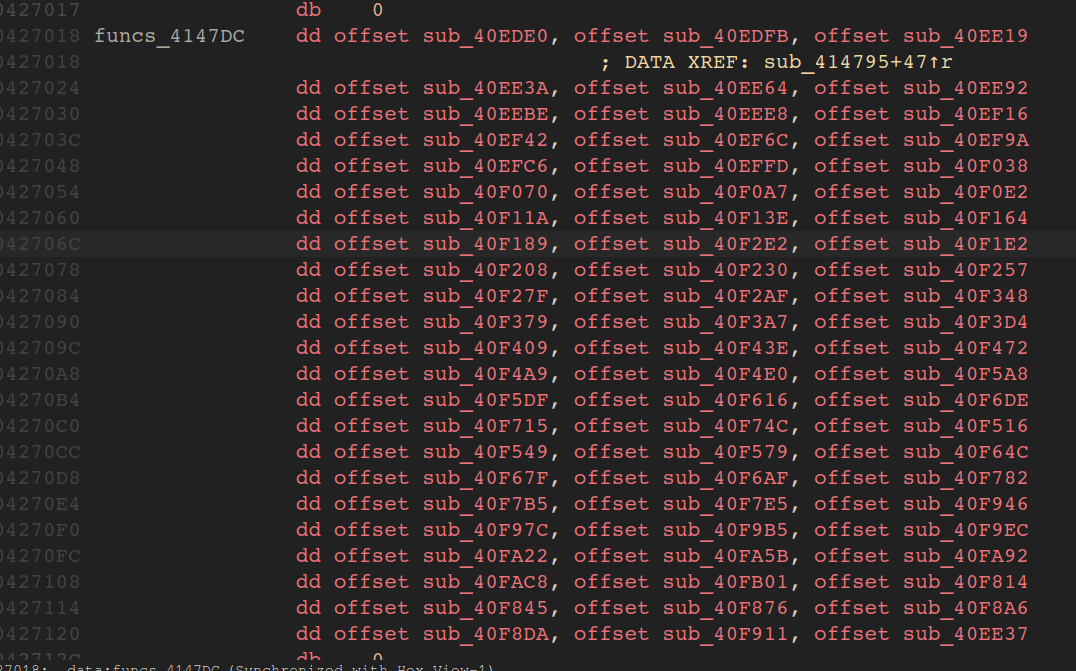 function table as vm handlers
some analysis yields the vm struct
1
2
3
4
5
6
7
struct vm
{
  _BYTE *vpc;
  _BYTE *mem;
  _DWORD flag;
  _DWORD reg[16];
};
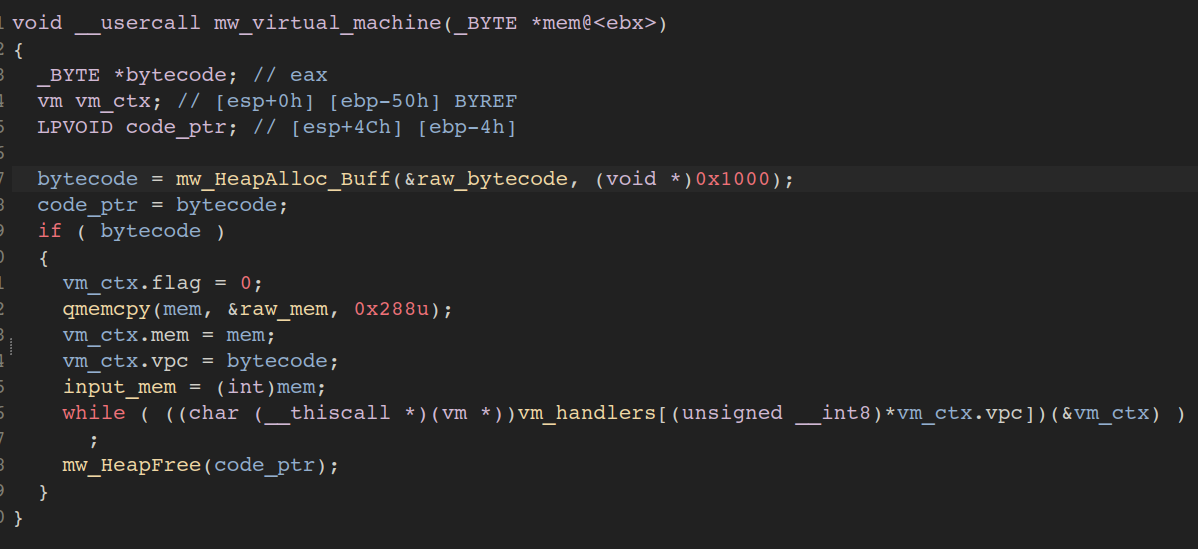 After applying vm struct
As the vm context is going to the function argument of the dispatcher hence all the handlers function arg should be the vm ctx
1
2
3
4
5
6
7
import idc

table = 0x427018
functions = [idc.get_wide_dword(table + i * 4) for i in range(69)] # getting all the handlers

for f in functions:
    idc.SetType(f, 'char __thiscall function(vm *this)') # set a function type
The handlers are simple, nothing complicated, each handler decryptes the bytecode at runtime with a custom key, So symbolic execution is our way to go. We need to set the bytecode and memcode as concerete values. As all of the handlers access the bytecode and memcode via the vm struct, so we will set struct in miasm at a arbitrary address, and initialize the member of struct as they were initialized in the vm entry.
This is the basic miasm setup we need for zeus vm.
1
2
3
4
5
6
7
8
9
10
11
12
13
14
15
16
17
18
19
20
21
22
23
24
25
26
27
28
29
30
31

VM_CTX = 0x10000000      # arbitrary address
VIP, MEM, FLAG, REG = 0x00, 0x04, 0x08, 0x0C # struct offsets
BYTECODE = 0x403368
MEMCODE = 0x4030E0

sb = SymbolicExecutionEngine(lifter=lifter)


def write_address(addr, val, size=32): # write address on a member of struct
    sb.symbols[ExprMem(ExprInt(addr, 32), size)] = ExprInt(val, size)

ctx = lambda off: expr_simp(sb.eval_expr(ExprMem(ExprInt(VM_CTX + off, 32), 32))) # access the member address of the vm context
read_value_n = lambda addr_expr, size=8: expr_simp(sb.eval_expr(ExprMem(expr_simp(addr_expr), size))) # derence the member

# init bytecode, memcode, flags in the vm ctx
write_address(VM_CTX + VIP,  BYTECODE); write_address(VM_CTX + MEM,  MEMCODE); write_address(VM_CTX + FLAG, 0)
# 16 flags
for i in range(16):
    write_address(VM_CTX + REG + i * 4, 0, size=32)

# populating the bytecode addr with concerete bytecode
data = container.bin_stream.getbytes(BYTECODE, 0x1000)
for i, b in enumerate(data):
    sb.symbols[ExprMem(ExprInt(BYTECODE + i, 32), 8)] = ExprInt(b, 8)

# populating the memcode addr with concerete memcode
data = container.bin_stream.getbytes(MEMCODE, 0x288)
for i, b in enumerate(data):
    sb.symbols[ExprMem(ExprInt(MEMCODE + i, 32), 8)] = ExprInt(b, 8)
The reason why we initialize this at a byte granularity because miasm will read the dword/word or any reference automatically as long each address should have concerete byte value, also we didn’t use the tigress CFF method of concerete values because we will use only one Symbolic execution engine through out. If we had multiple symbolic execution engines this would fail.
While analysis of handlers to understand some semantics of handlers so we can write a disassembler. All the handlers are simple/simmilar enough, one handler was a little of so lets see that that is.
1
2
3
4
5
6
7
8
9
10
11
12
13
14
15
16
17
18
19
20
21
22
23
24
25
26
27
28
29
30
31
32
33
34
char __thiscall sub_40F2E2(vm *this)
{
  char v2; // bl
  unsigned __int8 op; // al
  _BYTE *vpc; // ecx
  unsigned __int8 n_op; // dl
  char v6; // bl
  int init_buffer; // eax
  int v8; // edi
  int v9; // eax
  char *v10; // esi
  int buffer[65]; // [esp+Ch] [ebp-108h] BYREF
  unsigned __int8 next_op; // [esp+112h] [ebp-2h]
  unsigned __int8 v14; // [esp+113h] [ebp-1h]

  v2 = this->vpc[3];
  op = this->vpc[1];
  vpc = this->vpc;
  n_op = vpc[2];
  v14 = op;
  v6 = v2 ^ 0xCC;
  next_op = n_op;
  init_buffer = sub_409281((int)buffer, vpc + 3, op);
  v8 = next_op;
  sub_4092E4(init_buffer, (int)this->mem, next_op);
  v9 = v14;
  this->mem += v8;
  this->vpc += v9 + 3;
  v10 = this->vpc;
  if ( *v10 < 0 )
    *v10 = (v6 ^ *v10) & 0x7F;
  return 1;
}
And these two inside functions are:
1
2
3
4
5
6
7
8
9
10
11
12
13
14
15
16
17
18
19
20
21
22
23
24
25
26
27
28
29
30
31
32
33
34
35
36
37
38
39
40
41
42
43
44
45
46
47
48
49
50
51
52
53
54
55
56
57
int __userpurge sub_409281@<eax>(int result@<eax>, int a2, __int16 a3)
{
  int n0x100; // ecx
  _BYTE *v4; // esi
  char *v5; // esi
  int n256; // edi
  char v7; // dl
  unsigned __int8 v8; // [esp+Eh] [ebp-2h]
  unsigned __int8 v9; // [esp+Fh] [ebp-1h]

  n0x100 = 0;
  v9 = 0;
  v8 = 0;
  *(_WORD *)(result + 256) = 0;
  v4 = (_BYTE *)result;
  do
    *v4++ = n0x100++;
  while ( (unsigned __int16)n0x100 < 0x100u );
  v5 = (char *)result;
  n256 = 256;
  do
  {
    v7 = *v5;
    v8 += *v5 + *(_BYTE *)(v9++ + a2);
    *v5 = *(_BYTE *)(v8 + result);
    *(_BYTE *)(v8 + result) = v7;
    if ( v9 == a3 )
      v9 = 0;
    ++v5;
    --n256;
  }
  while ( n256 );
  return result;
}

int __userpurge sub_4092E4@<eax>(int result@<eax>, int a2, unsigned int a3)
{
  unsigned int v3; // edi
  char v4; // dl
  unsigned __int8 i; // [esp+6h] [ebp-2h]
  unsigned __int8 v6; // [esp+7h] [ebp-1h]

  v6 = *(_BYTE *)(result + 256);
  v3 = 0;
  for ( i = *(_BYTE *)(result + 257); v3 < a3; ++v3 )
  {
    v4 = *(_BYTE *)(++v6 + result);
    i += v4;
    *(_BYTE *)(v6 + result) = *(_BYTE *)(i + result);
    *(_BYTE *)(i + result) = v4;
    *(_BYTE *)(a2 + v3) ^= *(_BYTE *)((unsigned __int8)(v4 + *(_BYTE *)(v6 + result)) + result);
  }
  *(_BYTE *)(result + 256) = v6;
  *(_BYTE *)(result + 257) = i;
  return result;
}
After analyzing them we know its RC4 handler:
1
2
3
4
5
6
7
8
9
10
11
12
13
14
15
16
17
18
19
20
21
22
23
24
25
26
27
28
29
30
31
32
33
char __thiscall h_rc4_handler(vm *this)
{
  char v2; // bl
  unsigned __int8 op; // al
  _BYTE *vpc; // ecx
  unsigned __int8 n_op; // dl
  char v6; // bl
  int init_buffer; // eax
  int v8; // edi
  int v9; // eax
  char *v10; // esi
  int buffer[65]; // [esp+Ch] [ebp-108h] BYREF
  unsigned __int8 next_op; // [esp+112h] [ebp-2h]
  unsigned __int8 v14; // [esp+113h] [ebp-1h]

  v2 = this->vpc[3];
  op = this->vpc[1];
  vpc = this->vpc;
  n_op = vpc[2];
  v14 = op;
  v6 = v2 ^ 0xCC;
  next_op = n_op;
  init_buffer = mw_rc4_KSA((int)buffer, vpc + 3, op);
  v8 = next_op;
  mw_rc4_decrypt(init_buffer, (int)this->mem, next_op);
  v9 = v14;
  this->mem += v8;
  this->vpc += v9 + 3;
  v10 = this->vpc;
  if ( *v10 < 0 )
    *v10 = (v6 ^ *v10) & 0x7F;
  return 1;
}
RC4 Key Scheduling algorithm
1
2
3
4
5
6
7
8
9
10
11
12
13
14
15
16
17
18
19
20
21
22
23
24
25
26
27
28
29
30
31
32
33
34
int __userpurge mw_rc4_KSA@<eax>(_BYTE *buffer@<eax>, _BYTE *nn_op_key, __int16 op_ksz)
{
  int ii; // ecx
  _BYTE *buffer_ptr; // esi
  char *buff_ptr; // esi
  int size; // edi
  char idx; // dl
  unsigned __int8 value; // [esp+Eh] [ebp-2h]
  unsigned __int8 k_idx; // [esp+Fh] [ebp-1h]

  ii = 0;
  k_idx = 0;
  value = 0;
  *((_WORD *)buffer + 128) = 0;
  buffer_ptr = buffer;
  do
    *buffer_ptr++ = ii++;
  while ( (unsigned __int16)ii < 256u );
  buff_ptr = buffer;
  size = 256;
  do
  {
    idx = *buff_ptr;
    value += *buff_ptr + nn_op_key[k_idx++];
    *buff_ptr = buffer[value];
    buffer[value] = idx;
    if ( k_idx == op_ksz )
      k_idx = 0;
    ++buff_ptr;
    --size;
  }
  while ( size );
  return (int)buffer;
}
RC4 Decrypt
1
2
3
4
5
6
7
8
9
10
11
12
13
14
15
16
17
18
19
20
void __userpurge mw_rc4_decrypt(_BYTE *init_buffer@<eax>, _BYTE *mem, unsigned int n_op_sz)
{
  unsigned int idx; // edi
  char v4; // dl
  unsigned __int8 i; // [esp+6h] [ebp-2h]
  unsigned __int8 v6; // [esp+7h] [ebp-1h]

  v6 = init_buffer[256];
  idx = 0;
  for ( i = init_buffer[257]; idx < n_op_sz; ++idx )
  {
    v4 = init_buffer[++v6];
    i += v4;
    init_buffer[v6] = init_buffer[i];
    init_buffer[i] = v4;
    mem[idx] ^= init_buffer[(unsigned __int8)(v4 + init_buffer[v6])];
  }
  init_buffer[256] = v6;
  init_buffer[257] = i;
}
Its decrypting the memory in place, so we have to execute the sun function in the handler. But when we lift the ircfg from asmcfg, the calls are not followed, So when we run symbolic execution, that call is not executed symbolically. But in this case we do need to execute the whole handler end to end including the function as KSA and Decrypt used in here. So we will use a dictonary which will contains the ircfg of each handler, We will prelift the RC4 Handler with follow call so the ircfg can follow its callee too, and the decryption will happen in the Symbolic Execution Engine memory, this will save the time as the disassembler will only have to lift each handler once and then reuse it. when ever the virtual machine symbolic execution needs.
1
2
3
4
5
6
7
8
9
10
11
12
13
14
15
16
17
18
19
RC4_H = 0x40F2E2
LIFTED = {}

# prelifting rc4 handler
mdis.follow_call = True
rc4asmcfg = mdis.dis_multiblock(RC4_H)
rc4ircfg = unmod_lifter.new_ircfg_from_asmcfg(rc4asmcfg)
mdis.follow_call = False
LIFTED[RC4_H] = rc4ircfg

# lifted will be called on each handler
def lifted(addr):
    if addr in LIFTED:
        return LIFTED[addr] # if that particular handler is pre-lifted
    asmcfg = mdis.dis_multiblock(addr)
    ircfg = lifter.new_ircfg_from_asmcfg(asmcfg=asmcfg)
    LIFTED[addr] = ircfg # if not than lift and store for future
    return ircfg
Now we will simulate the vm loop, starting from the vm bytecode, and each loop will perform symbolic execution on each of the handler and on each iteration we will call the disassemble function, which will check which handler is next pick its mnemonic from the VM Handler dictonary. This will log the handler semantic in the form of the instruction, I am not including the analysis of handlers as they are 69 and its left for the reader as exercise xD.
Simulation of the vm loop
1
2
3
4
5
6
7
8
9
10
11
12
13
14
15
16
17
18
19
20
21
22
23
24
25


HALT = False
while not HALT: # vm dispatcher
    idx = int(read_value_n(ctx(VIP))) # reads Virtual Instruction pointer and derefrence 8 bits (1st byte which is at the start of symbolic execution engine)
    disassemble(idx) # log the handler semantics in a text file
    handler_addr = HANDLERS[idx][0]
    ircfg = lifted(handler_addr)
    if handler_addr == 0x40EE37: HALT = True # halt handler
    sb.symbols[lifter.arch.regs.ECX] = ExprInt(VM_CTX, 32) # each handler has vm context in the first argument as its a __thiscall we store it in ecx
    sb.symbols[lifter.arch.regs.ESP] = ExprInt(STACK_TOP - 4, 32) # set a flag constant so symbolic execution exits cleanly on handler return
    q = deque([ExprInt(handler_addr, 32)]) # adding the handler to be executed
    symbolic_execution(q, ircfg)


def symbolic_execution(q, ircfg):
    while q: # symbolically execute all the BB of the handlers
        handler_bb = q.popleft()
        r = sb.run_block_at(ircfg=ircfg, addr=handler_bb)
        # print(r)
        if r.is_int() and int(r) == RETN: # handler ended
            break
        elif r.is_int() or r.is_loc():
            q.append(r)
C2 config download URL
After executing our script we have compelete disassembly (3k LOC) of the zeus VM which you can see here,
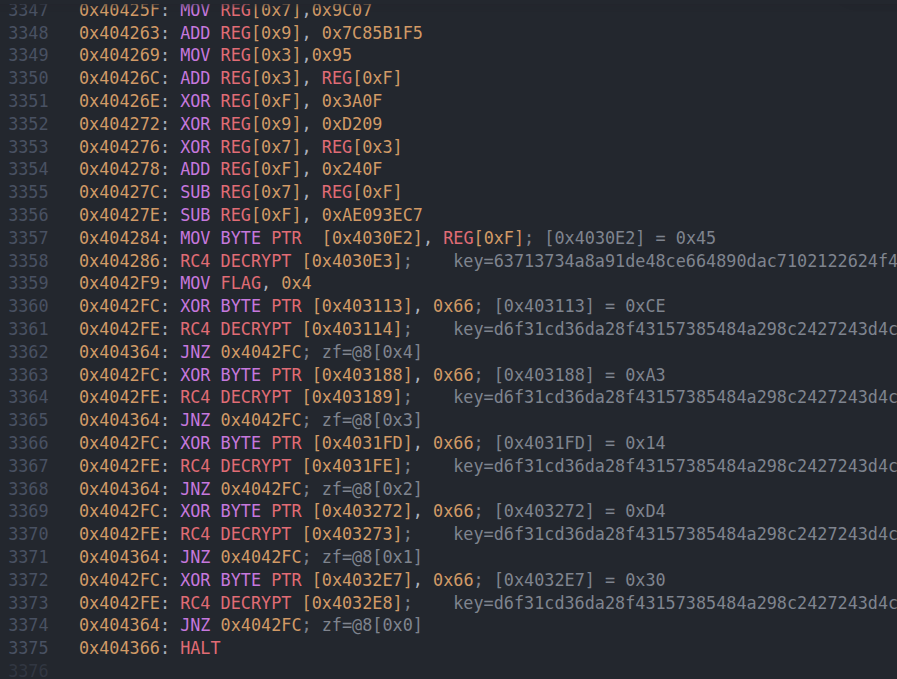 clean disassembly
There are many RC4 decrytion on the memory, So lets read the memory and see what decrypted inside.
1
2
3
4
5
data = bytearray()
for i in range(0x288):
    v = read_value_n(ExprInt(MEMCODE + i, 32), 8)
    data.append(int(v))
open('mem_dec.bin', 'wb').write(data) # writes the decrypted MEMCODE
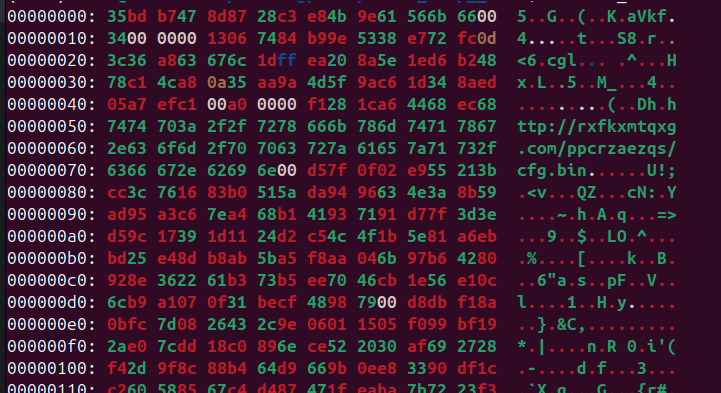 Decrypted Memcode
Indeed we get something usefull in the memory. its .cfg http://rxfkxmtqxg.com/ppcrzaezqs/cfg.bin We have succesfully extrated the zeus C2 config download URL
Here is the complete zeus vm deobfuscation script
1
2
3
4
5
6
7
8
9
10
11
12
13
14
15
16
17
18
19
20
21
22
23
24
25
26
27
28
29
30
31
32
33
34
35
36
37
38
39
40
41
42
43
44
45
46
47
48
49
50
51
52
53
54
55
56
57
58
59
60
61
62
63
64
65
66
67
68
69
70
71
72
73
74
75
76
77
78
79
80
81
82
83
84
85
86
87
88
89
90
91
92
93
94
95
96
97
98
99
100
101
102
103
104
105
106
107
108
109
110
111
112
113
114
115
116
117
118
119
120
121
122
123
124
125
126
127
128
129
130
131
132
133
134
135
136
137
138
139
140
141
142
143
144
145
146
147
148
149
150
151
152
153
154
155
156
157
158
159
160
161
162
163
164
165
166
167
168
169
170
171
172
173
174
175
176
177
178
179
180
181
182
183
184
185
186
187
188
189
190
191
192
193
194
195
196
197
198
199
200
201
202
203
204
205
206
207
208
209
210
211
212
213
214
215
216
217
218
219
220
221
222
223
224
225
226
227
228
229
230
231
232
233
234
235
236
237
238
239
240
241
242
243
244
245
246
247
248
249
250
251
252
253
254
255
256
257
258
259
260
261
262
263
264
265
266
267
268
269
270
271
272
273
274
275
276
277
278
279
280
281
282
283
284
285
286
287
288
289
290
291
292
293
294
295
296
297
298
299
300
301
302
303
304
305
306
307
308
309
310
311
312
313
314
315
316
317
318
319
320
321
322
323
324
325
326
327
328
329
330
331
332
333
334
335
336
337
338
339
340
341
342
343
344
345
346
347
348
349
350
351
352
353
354
355
356
357
358
359
360
361
from miasm.core.locationdb import LocationDB
from miasm.analysis.binary import Container
from miasm.analysis.machine import Machine
from miasm.expression.simplifications import expr_simp
from miasm.ir.symbexec import SymbolicExecutionEngine
from miasm.expression.expression import ExprId, ExprMem, ExprInt
from collections import deque

VM_CTX = 0x10000000      # arbitrary address
VIP, MEM, FLAG, REG = 0x00, 0x04, 0x08, 0x0C # struct offsets
BYTECODE = 0x403368
MEMCODE = 0x4030E0
STACK_TOP = 0x1000
RETN = 0xDEADBEEF
RC4_H = 0x40F2E2
LIFTED = {}

loc_db = LocationDB()
container = Container.from_stream(open('zeusvm.bin', 'rb'), loc_db=loc_db)
machine = Machine(container.arch)
lifter = machine.lifter_model_call(loc_db=loc_db)
unmod_lifter = machine.lifter(loc_db=loc_db)
sb = SymbolicExecutionEngine(lifter=lifter)
mdis = machine.dis_engine(container.bin_stream, loc_db=loc_db)

# prelifting rc4 handler
mdis.follow_call = True
rc4asmcfg = mdis.dis_multiblock(RC4_H)
rc4ircfg = unmod_lifter.new_ircfg_from_asmcfg(rc4asmcfg)
mdis.follow_call = False
LIFTED[RC4_H] = rc4ircfg

def write_address(addr, val, size=32):
    sb.symbols[ExprMem(ExprInt(addr, 32), size)] = ExprInt(val, size)

def lifted(addr):
    if addr in LIFTED:
        return LIFTED[addr]
    asmcfg = mdis.dis_multiblock(addr)
    ircfg = lifter.new_ircfg_from_asmcfg(asmcfg=asmcfg)
    LIFTED[addr] = ircfg
    return ircfg

def symbolic_execution(q, ircfg):
    while q: # symbolically execute all the BB of the handlers
        handler_bb = q.popleft()
        r = sb.run_block_at(ircfg=ircfg, addr=handler_bb)
        # print(r)
        if r.is_int() and int(r) == RETN: # handler ended
            break
        elif r.is_int() or r.is_loc():
            q.append(r)

ctx = lambda off: expr_simp(sb.eval_expr(ExprMem(ExprInt(VM_CTX + off, 32), 32)))
read_value_n = lambda addr_expr, size=8: expr_simp(sb.eval_expr(ExprMem(expr_simp(addr_expr), size)))

# just included the mnemonics (i don't know why, i could have written them in the disassemble function too lol)
HANDLERS = {
    0x0:  (0x40ede0, 'NOP1'),
    0x1:  (0x40edfb, 'NOP2'),
    0x2:  (0x40ee19, 'NOP3'),
    0x3:  (0x40ee3a, 'XOR BYTE PTR'),
    0x4:  (0x40ee64, 'XOR WORD PTR'),
    0x5:  (0x40ee92, 'XOR DWORD PTR'),
    0x6:  (0x40eebe, 'ADD BYTE PTR'),
    0x7:  (0x40eee8, 'ADD WORD PTR'),
    0x8:  (0x40ef16, 'ADD DWORD PTR'),
    0x9:  (0x40ef42, 'SUB BYTE PTR'),
    0xa:  (0x40ef6c, 'SUB WORD PTR'),
    0xb:  (0x40ef9a, 'SUB DWORD PTR'),
    0xc:  (0x40efc6, 'ROL BYTE PTR'),
    0xd:  (0x40effd, 'ROL WORD PTR'),
    0xe:  (0x40f038, 'ROL DWORD PTR'),
    0xf:  (0x40f070, 'ROR BYTE PTR'),
    0x10: (0x40f0a7, 'ROR WORD PTR'),
    0x11: (0x40f0e2, 'ROR DWORD PTR'),
    0x12: (0x40f11a, 'NOT BYTE PTR'),
    0x13: (0x40f13e, 'NOT WORD PTR'),
    0x14: (0x40f164, 'NOT DWORD PTR'),
    0x15: (0x40f189, 'SHUFFLE MEM[0-4]'),
    0x16: (0x40f2e2, 'RC4 DECRYPT'),
    0x17: (0x40f1e2, 'MOV FLAG'),
    0x18: (0x40f208, 'MOV FLAG'),
    0x19: (0x40f230, 'MOV FLAG'),
    0x1a: (0x40f257, 'ADD WORD MEM'),
    0x1b: (0x40f27f, 'JNZ'),
    0x1c: (0x40f2af, 'JNZ'),
    0x1d: (0x40f348, 'MOV REG'),
    0x1e: (0x40f379, 'MOV REG'),
    0x1f: (0x40f3a7, 'MOV REG'),
    0x20: (0x40f3d4, 'MOV REG'),
    0x21: (0x40f409, 'MOV REG'),
    0x22: (0x40f43e, 'MOV REG'),
    0x23: (0x40f472, 'ADD REG'),
    0x24: (0x40f4a9, 'ADD REG'),
    0x25: (0x40f4e0, 'ADD REG'),
    0x26: (0x40f5a8, 'SUB REG'),
    0x27: (0x40f5df, 'SUB REG'),
    0x28: (0x40f616, 'SUB REG'),
    0x29: (0x40f6de, 'XOR REG'),
    0x2a: (0x40f715, 'XOR REG'),
    0x2b: (0x40f74c, 'XOR REG'),
    0x2c: (0x40f516, 'ADD REG'),
    0x2d: (0x40f549, 'ADD REG'),
    0x2e: (0x40f579, 'ADD REG'),
    0x2f: (0x40f64c, 'SUB REG'),
    0x30: (0x40f67f, 'SUB REG'),
    0x31: (0x40f6af, 'SUB REG'),
    0x32: (0x40f782, 'XOR REG'),
    0x33: (0x40f7b5, 'XOR REG'),
    0x34: (0x40f7e5, 'XOR REG'),
    0x35: (0x40f946, 'ADD BYTE PTR'),
    0x36: (0x40f97c, 'ADD WORD PTR'),
    0x37: (0x40f9b5, 'ADD DWORD PTR'),
    0x38: (0x40f9ec, 'ADD BYTE PTR'),
    0x39: (0x40fa22, 'ADD WORD PTR'),
    0x3a: (0x40fa5b, 'ADD DWORD PTR'),
    0x3b: (0x40fa92, 'XOR BYTE PTR'),
    0x3c: (0x40fac8, 'XOR WORD PTR'),
    0x3d: (0x40fb01, 'XOR DWORD PTR'),
    0x3e: (0x40f814, 'MOV REG'),
    0x3f: (0x40f845, 'MOV REG'),
    0x40: (0x40f876, 'MOV REG'),
    0x41: (0x40f8a6, 'MOV BYTE PTR'),
    0x42: (0x40f8da, 'MOV WORD PTR'),
    0x43: (0x40f911, 'MOV DWORD PTR'),
    0x44: (0x40ee37, 'HALT')
}

dis = open('dis_vm.asm', 'w')
def disassemble(idx):
    vip = ctx(VIP); mem = ctx(MEM); flag = ctx(FLAG); op = vip + ExprInt(1, 32); imm = vip + ExprInt(2, 32)
    op8 = read_value_n(op); op16 = read_value_n(op, 16); op32 = read_value_n(op, 32)
    imm8 = read_value_n(imm); imm16 = read_value_n(imm, 16); imm32 = read_value_n(imm, 32)
    m8 = read_value_n(mem); m16 = read_value_n(mem, 16); m32 = read_value_n(mem, 32)

    mnem = HANDLERS[idx][1]; hd_addr = HANDLERS[idx][0]; loc = f'0x{int(vip):X}: '
    if mnem.startswith('NOP'):
        dis.write(loc+f'{mnem}\n')
    elif hd_addr == 0x40ee3a: #  XOR BYTE PTR [MEM], OP
        dis.write(loc+f'{mnem} [{mem}], {op8}; [{mem}] = {m8}\n')
    elif  hd_addr == 0x40ee64: # XOR WORD PTR [MEM], OP
        dis.write(loc+f'{mnem} [{mem}], {op16}; [{mem}] = {m16}\n')
    elif hd_addr == 0x40ee92: # XOR DWORD PTR [MEM], OP
        dis.write(loc+f'{mnem} [{mem}], {op32}; [{mem}] = {m32}\n')
    elif hd_addr == 0x40eebe: # ADD BYTE PTR [MEM], OP
        dis.write(loc+f'{mnem} [{mem}], {op8}; [{mem}] = {m8}\n')
    elif hd_addr == 0x40eee8: # ADD WORD PTR [MEM], OP
        dis.write(loc+f'{mnem} [{mem}], {op16}; [{mem}] = {m16}\n')
    elif hd_addr == 0x40ef16: # ADD DWORD PTR [MEM], OP
        dis.write(loc+f'{mnem} [{mem}], {op32}; [{mem}] = {m32}\n')
    elif hd_addr == 0x40ef42: # ADD BYTE PTR [MEM], OP
        dis.write(loc+f'{mnem} [{mem}], {op8}; [{mem}] = {m8}\n')
    elif hd_addr == 0x40ef6c: # ADD WORD PTR [MEM], OP
        dis.write(loc+f'{mnem} [{mem}], {op16}; [{mem}] = {m16}\n')
    elif hd_addr == 0x40ef9a: # ADD DWORD PTR [MEM], OP
        dis.write(loc+f'{mnem} [{mem}], {op32}; [{mem}] = {m32}\n')
    elif hd_addr == 0x40efc6: # ROL BYTE PTR [MEM], OP
        dis.write(loc+f'{mnem} [{mem}],0x{int(op8) & 7}; [{mem}] = {m8}\n')
    elif hd_addr == 0x40effd: # ROL WORD PTR [MEM], OP
        dis.write(loc+f'{mnem} [{mem}],0x{int(op8) & 0xF}; [{mem}] = {m16}\n')
    elif hd_addr == 0x40f038: # ROL DWORD PTR [MEM], OP
        dis.write(loc+f'{mnem} [{mem}],0x{int(op8) & 0x1F}; [{mem}] = {m32}\n')
    elif hd_addr == 0x40f070: # ROR BYTE PTR [MEM]
        dis.write(loc+f'{mnem} [{mem}],0x{int(op8) & 7}; [{mem}] = {m8}\n')
    elif hd_addr == 0x40f0a7: # ROR WORD PTR [MEM]
        dis.write(loc+f'{mnem} [{mem}],0x{int(op8) & 0xF}; [{mem}] = {m16}\n')
    elif hd_addr == 0x40f0e2: # ROR DWORD PTR [MEM]
        dis.write(loc+f'{mnem} [{mem}],0x{int(op8) & 0x1F}; [{mem}] = {m32}\n')
    elif hd_addr == 0x40f11a: # NOT BYTE PTR [MEM]
        dis.write(loc+f'{mnem} [{mem}] = {m8}\n')
    elif hd_addr == 0x40f13e: # NOT WORD PTR [MEM]
        dis.write(loc+f'{mnem} [{mem}] = {m16}\n')
    elif hd_addr == 0x40f164: # NOT DWORD PTR [MEM]
        dis.write(loc+f'{mnem} [{mem}] = {m32}\n')
    elif hd_addr == 0x40f189: # shuffle mem
        ctrl = int(op8)
        slots = [(ctrl >> (2 * i)) & 3 for i in range(4)]
        dis.write(loc+f'{mnem} ctrl={ctrl:#04x} -> slots {slots}\n')
    elif hd_addr == 0x40f2e2: # RC4 Decrypt
        keylen  = int(op8)                              # vpc[1]
        datalen = int(read_value_n(vip + ExprInt(2, 32), 8))   # vpc[2]
        key = bytes(int(read_value_n(vip + ExprInt(3 + i, 32), 8)) for i in range(keylen))
        enc_mem = bytes(int(read_value_n(mem + ExprInt(i, 32), 8)) for i in range(datalen))
        dis.write(loc+ f'{mnem} [{mem}];\t key={key.hex()}\tenc_mem={enc_mem.hex()}\n')
    elif hd_addr == 0x40f1e2: # MOV BYTE FLAG
        dis.write(loc+f'{mnem}, {op8}\n')
    elif hd_addr == 0x40f208: # MOV WORD FLAG
        dis.write(loc+f'{mnem}, {op16}\n')
    elif hd_addr == 0x40f230: # MOV DWORD FLAG
        dis.write(loc+f'{mnem}, {op32}\n')
    elif hd_addr == 0x40f257: # ADD WORD MEM
        dis.write(loc+f'{mnem}, {op16}\n')
    elif hd_addr == 0x40f27f:                       # JNZ byte disp
        disp   = int(read_value_n(vip + ExprInt(1, 32), 8))
        jaddr = int(vip) + 2 - disp
        dis.write(loc+f'{mnem} 0x{jaddr:02X}; zf={read_value_n(flag)}\n')
    elif hd_addr == 0x40f2af: # JNZ
        disp   = int(read_value_n(vip + ExprInt(1, 32), 16))
        jaddr = int(vip) + 3 - disp
        dis.write(loc+f'{mnem} 0x{jaddr:02X}; zf={read_value_n(flag)}\n')
    elif hd_addr == 0x40f348: # MOV BYTE REG
        i = int((int(op8) & 0xF))
        dis.write(loc+f'{mnem}[0x{i:0X}],0x{int(imm8):0X}\n')
    elif hd_addr == 0x40f379: # MOV WORD REG
        i = int((int(op8) & 0xF))
        dis.write(loc+f'{mnem}[0x{i:0X}],0x{int(op16):0X}\n')
    elif hd_addr == 0x40f3a7: # MOV DWORD REG
        i = int((int(op8) & 0xF))
        dis.write(loc+f'{mnem}[0x{i:0X}],0x{int(imm32):0X}\n')
    elif hd_addr == 0x40f3d4:
        i = int((int(op8) & 0xF)); j = int((int(op8) >> 4))
        dis.write(loc+f'{mnem}[0x{i:0X}], REG[0x{j:0X}]\n')
    elif hd_addr == 0x40f409:
        i = int((int(op8) & 0xF)); j = int((int(op8) >> 4))
        dis.write(loc+f'{mnem}[0x{i:0X}], REG[0x{j:0X}]\n')
    elif hd_addr == 0x40f43e:
        i = int((int(op8) & 0xF)); j = int((int(op8) >> 4))
        dis.write(loc+f'{mnem}[0x{i:0X}], REG[0x{j:0X}]\n')
    elif hd_addr == 0x40f472:
        i = int((int(op8) & 0xF)); j = int((int(op8) >> 4))
        dis.write(loc+f'{mnem}[0x{i:0X}], REG[0x{j:0X}]\n')
    elif hd_addr == 0x40f4a9:
        i = int((int(op8) & 0xF)); j = int((int(op8) >> 4))
        dis.write(loc+f'{mnem}[0x{i:0X}], REG[0x{j:0X}]\n')
    elif hd_addr == 0x40f4e0:
        i = int((int(op8) & 0xF)); j = int((int(op8) >> 4))
        dis.write(loc+f'{mnem}[0x{i:0X}], REG[0x{j:0X}]\n')
    elif hd_addr == 0x40f5a8:
        i = int((int(op8) & 0xF)); j = int((int(op8) >> 4))
        dis.write(loc+f'{mnem}[0x{i:0X}], REG[0x{j:0X}]\n')
    elif hd_addr == 0x40f5df:
        i = int((int(op8) & 0xF)); j = int((int(op8) >> 4))
        dis.write(loc+f'{mnem}[0x{i:0X}], REG[0x{j:0X}]\n')
    elif hd_addr == 0x40f616:
        i = int((int(op8) & 0xF)); j = int((int(op8) >> 4))
        dis.write(loc+f'{mnem}[0x{i:0X}], REG[0x{j:0X}]\n')
    elif hd_addr == 0x40f6de:
        i = int((int(op8) & 0xF)); j = int((int(op8) >> 4))
        dis.write(loc+f'{mnem}[0x{i:0X}], REG[0x{j:0X}]\n')
    elif hd_addr == 0x40f715:
        i = int((int(op8) & 0xF)); j = int((int(op8) >> 4))
        dis.write(loc+f'{mnem}[0x{i:0X}], REG[0x{j:0X}]\n')
    elif hd_addr == 0x40f74c:
        i = int((int(op8) & 0xF)); j = int((int(op8) >> 4))
        dis.write(loc+f'{mnem}[0x{i:0X}], REG[0x{j:0X}]\n')
    elif hd_addr == 0x40f516:
        i = int(op8) & 0xf
        dis.write(loc+f'{mnem}[0x{i:0X}], {imm8}\n')
    elif hd_addr == 0x40f549:
        i = int(op8) & 0xf
        dis.write(loc+f'{mnem}[0x{i:0X}], {op16}\n')
    elif hd_addr == 0x40f579:
        i = int(op8) & 0xf
        dis.write(loc+f'{mnem}[0x{i:0X}], {imm32}\n')
    elif hd_addr == 0x40f64c:
        i = int(op8) & 0xf
        dis.write(loc+f'{mnem}[0x{i:0X}], {imm8}\n')
    elif hd_addr == 0x40f67f:
        i = int(op8) & 0xf
        dis.write(loc+f'{mnem}[0x{i:0X}], {op16}\n')
    elif hd_addr == 0x40f6af:
        i = int(op8) & 0xf
        dis.write(loc+f'{mnem}[0x{i:0X}], {imm32}\n')
    elif hd_addr == 0x40f782:
        i = int(op8) & 0xf
        dis.write(loc+f'{mnem}[0x{i:0X}], {imm8}\n')
    elif hd_addr == 0x40f7b5:
        i = int(op8) & 0xf
        dis.write(loc+f'{mnem}[0x{i:0X}], {op16}\n')
    elif hd_addr == 0x40f7e5:
        i = int(op8) & 0xf
        dis.write(loc+f'{mnem}[0x{i:0X}], {imm32}\n')
    elif hd_addr == 0x40f946: # this
        i = int((int(op8) & 0xF));
        dis.write(loc+f'{mnem} [{mem}], REG[0x{i:0X}]; [{mem}] = {m8}\n')
    elif hd_addr == 0x40f97c:
        i = int(op8) & 0xf
        dis.write(loc+f'{mnem} [{mem}], REG[0x{i:0X}]; [{mem}] = {m16}\n')
    elif hd_addr == 0x40f9b5:
        i = int((int(op8) & 0xF));
        dis.write(loc+f'{mnem} [{mem}], REG[0x{i:0X}]; [{mem}] = {m32}\n')
    elif hd_addr == 0x40f9ec:
        i = int((int(op8) & 0xF));
        dis.write(loc+f'{mnem} [{mem}], REG[0x{i:0X}]; [{mem}] = {m8}\n')
    elif hd_addr == 0x40fa22:
        i = int(op8) & 0xf
        dis.write(loc+f'{mnem} [{mem}], REG[0x{i:0X}]; [{mem}] = {m16}\n')
    elif hd_addr == 0x40fa5b:
        i = int(op8) & 0xf
        dis.write(loc+f'{mnem} [{mem}], REG[0x{i:0X}]; [{mem}] = {m32}\n')
    elif hd_addr == 0x40fa92:
        i = int(op8) & 0xf
        dis.write(loc+f'{mnem} [{mem}], REG[0x{i:0X}]; [{mem}] = {m8}\n')
    elif hd_addr == 0x40fac8:
        i = int(op8) & 0xf
        dis.write(loc+f'{mnem} [{mem}], REG[0x{i:0X}]; [{mem}] = {m16}\n')
    elif hd_addr == 0x40fb01:
        i = int(op8) & 0xf
        dis.write(loc+f'{mnem} [{mem}], REG[0x{i:0X}]; [{mem}] = {m32}\n')
    elif hd_addr == 0x40f814:
        i = int(op8) & 0xf
        dis.write(loc+f'{mnem}[0x{i:0X}], [{mem}] ; {m8}\n')
    elif hd_addr == 0x40f845:
        i = int(op8) & 0xf
        dis.write(loc+f'{mnem}[0x{i:0X}], [{mem}] ; {m16}\n')
    elif hd_addr == 0x40f876:
        i = int(op8) & 0xf
        dis.write(loc+f'{mnem}[0x{i:0X}], [{mem}] ; {m32}\n')
    elif hd_addr == 0x40f8a6:
        i = int(op8) & 0xf
        dis.write(loc+f'{mnem}  [{mem}], REG[0x{i:0X}]; [{mem}] = {m8}\n')
    elif hd_addr == 0x40f8da:
        i = int(op8) & 0xf
        dis.write(loc+f'{mnem}  [{mem}], REG[0x{i:0X}]; [{mem}] = {m8}\n')
    elif hd_addr == 0x40f911:
        i = int((int(op8) & 0xF))
        dis.write(loc+f'{mnem}  [{mem}], REG[0x{i:0X}]; [{mem}] = {m8}\n')
    elif hd_addr == 0x40ee37:
        dis.write(loc+f'{mnem}\n')
    return

write_address(VM_CTX + VIP,  BYTECODE); write_address(VM_CTX + MEM,  MEMCODE); write_address(VM_CTX + FLAG, 0)

for i in range(16):
    write_address(VM_CTX + REG + i * 4, 0, size=32)

# populating the bytecode addr
data = container.bin_stream.getbytes(BYTECODE, 0x1000)
for i, b in enumerate(data):
    sb.symbols[ExprMem(ExprInt(BYTECODE + i, 32), 8)] = ExprInt(b, 8)

# populating the memcode addr
data = container.bin_stream.getbytes(MEMCODE, 0x288)
for i, b in enumerate(data):
    sb.symbols[ExprMem(ExprInt(MEMCODE + i, 32), 8)] = ExprInt(b, 8)

sb.symbols[ExprMem(ExprInt(STACK_TOP - 4, 32), 32)] = ExprInt(RETN, 32)

HALT = False
while not HALT: # vm dispatcher
    idx = int(read_value_n(ctx(VIP))) # reads Virtual Instruction pointer and derefrence 8 bits (1st byte which is at the start of symbolic execution engine)
    disassemble(idx)
    handler_addr = HANDLERS[idx][0]
    ircfg = lifted(handler_addr)
    if handler_addr == 0x40EE37: HALT = True # halt handler
    sb.symbols[lifter.arch.regs.ECX] = ExprInt(VM_CTX, 32)
    sb.symbols[lifter.arch.regs.ESP] = ExprInt(STACK_TOP - 4, 32)
    q = deque([ExprInt(handler_addr, 32)]) # adding the handler to be executed
    symbolic_execution(q, ircfg)


dis.close() # closing the disassembly file log

data = bytearray()
for i in range(0x288):
    v = read_value_n(ExprInt(MEMCODE + i, 32), 8)
    data.append(int(v))
open('mem_dec.bin', 'wb').write(data) # http://rxfkxmtqxg.com/ppcrzaezqs/cfg.bin -- zeus C2 config download URL
Slow Tempest Campaign
Slow Tempest is a covert cyber espionage campaign that first emerged in 2024, primarily targeting organizations and Chinese-speaking users in East Asia. The threat actors are known for advanced persistent threats
The sample we are deobfuscating can be downloaded here
It has Multiple Layers of Obfuscations:
Indirest Jump Obfuscation
 A very frequent pattern in whole binary
 indirect jumps
Even the function is large enough but the flow is broken due to indirect jumps.
 CFG
There are many indirect jumps in the whole binary. To check the exact indirect jump i wrote a simple ida script
1
2
3
4
5
6
7
8
9
import idc

ea = 0x140001000 # start of text section
ind = []
while ea < 0x140057495: # end of text section
    if idc.print_insn_mnem(ea) == 'jmp' and idc.get_operand_type(ea, 0) is idc.o_reg: # jmp reg
        print(hex(ea)); ind.append(ea)
    ea = idc.next_head(ea)
print('indirect jmps: ', len(ind))
1
indirect jmps:  2788
thats alot, so lets see how we can deobfuscate it.
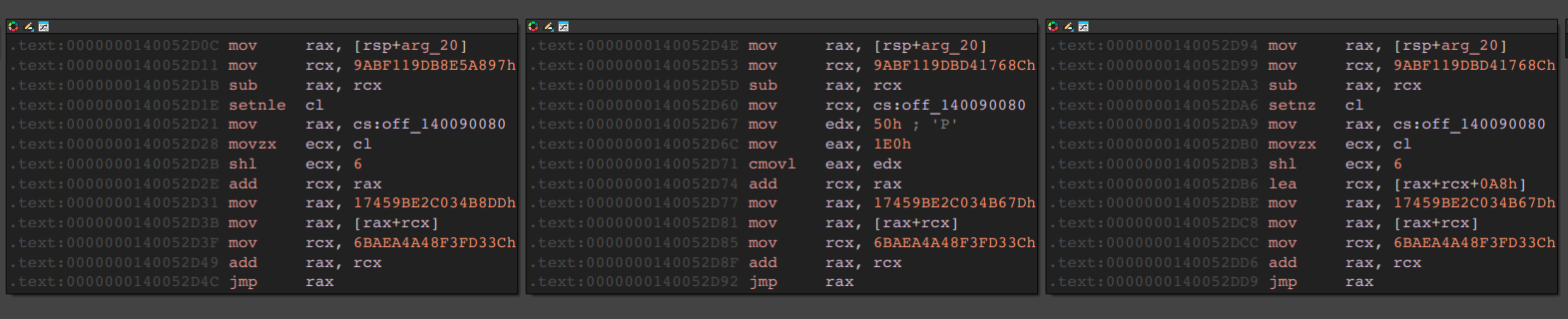 conditional indirect jumps
We see a very similar pattern here, before indirect jump we do have cmovcc and set instruction, which is deciding either a value can be moved to the register or not which effects the control flow. As i saw in many indirect jump blocks the pattern is consistent accross majority. Hence we can pattern match the basic blocks which have indirect jumps and extract the information that what is the cmovcc or set instruction is on which register. Then we can perform symbolic execution two times on the block one with cmovcc/set true and the other with false. Hence we will have both final address inform of jcc and fall, and we can just replace the cmovcc with the jcc instruction proceeding with the fall instruction. We also see global data reads in the calculation of indirect jumps so we will set the .data section as concerete value so symbolic execution evaluates jump addresses.
First we will create a class to store all our pattern matching info
1
2
3
4
5
6
7
8
9
10
11
12
13
14
15
16
17

class ConditionalJump:
    def __init__(self, jtype=None, before_cond=None, cond_addr=None, after_cond=None, condition=None, regs=None,trueTarget=None,falseTarget=None,jmpAddr=False):
        self.jtype = jtype  # set/cmovcc
        self.before_cond = before_cond # block start
        self.cond_addr = cond_addr  # cmovcc/set address
        self.after_cond = after_cond # next address after cmovcc
        self.condition = condition # cc (condition from cmovcc)
        self.regs = regs  # src, dst (from cmovcc)
        self.trueTarget = trueTarget
        self.falseTarget = falseTarget
        self.jmpAddr = jmpAddr # indirect jmp address

class Jump:
    def __init__(self, start_addr=None,jmpAddr=False):
        self.start_addr = start_addr
        self.jmpAddr = jmpAddr
1
2
3
4
5
6
7
8
9
10
11
12
13
14
15
16
17
18
19
20
21
22
23
24
25
26
27
28
29
30
31
32
33
34
35
36
37
38
39
40
41
42
43
44
45
46
47
48
49
50
51
52
53
54
55
56
57
58
59
60
61
62
63
64
65
66
from capstone import *

[...]

md = Cs(CS_ARCH_X86, CS_MODE_64)
md.detail = True
jumps = []
disassembly = {}

prevSize = None
for insn in md.disasm(textData, textVA):
    if insn.mnemonic == "jmp" and insn.operands[0].type == X86_OP_REG:
        jumps.append(insn.address)
    disassembly[insn.address] = [insn.mnemonic,insn.op_str,insn.size,prevSize]
    prevSize = insn.size

jumpsInfo = []
for jump in jumps:
    n = getStartJump(jump)
    if n != None:
        jumpsInfo.append(n)


def getStartJump(addr):
    jumpAddress = addr
    _, _,_, prevSize = disassembly[addr]
    prevAddr = addr
    if prevSize == None: return None
    addr -= prevSize # address of the previous instruciton
    condAddr = None
    condition = ""
    regs = None
    type = None
    while addr in disassembly:
        mnemonic, op_str, size, prevSize = disassembly[addr]
        # the instructions that split the miasm IR block
        if mnemonic in ["call","jmp","ret","int3","div,","idiv"] or mnemonic.startswith("j") or (mnemonic == "sub" and "rsp" in op_str):
            if type != None: #cmov
                if type == 'cmovcc':
                    return ConditionalJump(jtype='cmovcc',before_cond=prevAddr,cond_addr=condAddr,after_cond=afterAddr,condition=condition,regs=regs,jmpAddr=jumpAddress)

                elif type == 'setcc':
                    return ConditionalJump(jtype='setcc',before_cond=prevAddr,cond_addr=condAddr,after_cond=afterAddr,condition=condition,regs=regs,jmpAddr=jumpAddress)
            else:
                return Jump(start_addr=prevAddr,jmpAddr=jumpAddress)
                            # miasm block start addr, jmp instruction addr
        elif mnemonic.startswith("cmov") and type == None:
            type = 'cmovcc'
            condAddr = addr
            afterAddr = addr+size
            reg1,reg2 = op_str.replace(" ","").split(",")
            regs = [reg_map[reg1.lower()],reg_map[reg2.lower()]] #convert to the 64 bit reg
            condition = mnemonic[4:]
        elif mnemonic.startswith("set") and type == None:
            type = 'setcc'
            condAddr = addr
            afterAddr = addr+size
            condition = mnemonic[3:]
            regs = reg_map[op_str.lower()]
        prevAddr = addr
        if prevSize == None: return None
        addr -= prevSize
    return None

[...]
By this we have complete info of each conditional and unconditional jump. Now we can perform symbolic execution till the condition and then pause, and then continue with true and false value and hence we will have jcc and jmp, then we can patch them starting from the cmovcc
1
2
3
4
5
6
7
8
9
10
11
12
13
14
15
16
17
18
19
20
21
22
23
24
25
26
27
28
29
30
31
32
33
34
35
36
37
38
for jump in jumpsInfo: # iterate through each function
    if isinstance(jump,ConditionalJump): # if its a conditional indirect jmp
        if jump.jtype == 'cmovcc': #type = cmov          # before_cond=block start
            symbols,falseVal,trueVal = symbolic_execution(jump.before_cond,cmovRegs=jump.regs, cond_addr=jump.cond_addr)
            # copying the symbols so both can be used seprately on true false condition
            symbolsFalse = symbols.copy(); symbolsTrue = symbols.copy()
            symbolsFalse[ExprId(jump.regs[1],64)] = falseVal
            symbolsTrue[ExprId(jump.regs[0],64)] = trueVal
            # symbolic execution if cmovcc is true
            trueTarget = symbolic_execution(jump.after_cond,symbols=symbolsTrue,initSymbols=False)
            # symbolic execution if cmovcc is false
            falseTarget = symbolic_execution(jump.after_cond,symbols=symbolsFalse,initSymbols=False)
        elif jump.jtype == 'setcc':
            reg = jump.regs
            symbols = symbolic_execution(jump.before_cond,cond_addr=jump.cond_addr)
            symbolsFalse = symbols.copy(); symbolsTrue = symbols.copy()
            symbolsTrue[ExprId(reg,64)] = ExprInt(1,64) # setcc is true
            symbolsFalse[ExprId(reg,64)] = ExprInt(0,64) # setcc is false
            # symbolic exection on both set and unset to see what is the jcc and fall
            falseTarget = symbolic_execution(jump.after_cond,symbols=symbolsFalse, initSymbols=False)
            trueTarget = symbolic_execution(jump.after_cond,symbols=symbolsTrue, initSymbols=False)

        jump.trueTarget = int(trueTarget); jump.falseTarget = int(falseTarget)

        patchData = assembleJump(jump.trueTarget,jump.cond_addr,cond=jump.condition)
        patchData += assembleJump(jump.falseTarget,jump.cond_addr+6)

        patchSize = jump.jmpAddr+2-jump.cond_addr
        patchData = patchData + ((patchSize - len(patchData)) * b"\x90")
        patch(jump.cond_addr,patchData)
        print(hex(jump.jmpAddr), trueTarget, falseTarget)
    else:
        r = symbolic_execution(jump.start_addr) # its a unconditional indirect jmp
        if not isinstance(r,ExprInt): #false positive OR a missed conditional jmp
            print('unconditional jmp missed ExprInt: ', r,hex(jump.start_addr))
            continue
        else:
            print(f"patch unconditional indirect jmp {hex(jump.jmpAddr)}, {r}")
Running the deobfuscator.
before indirect jmp resolution
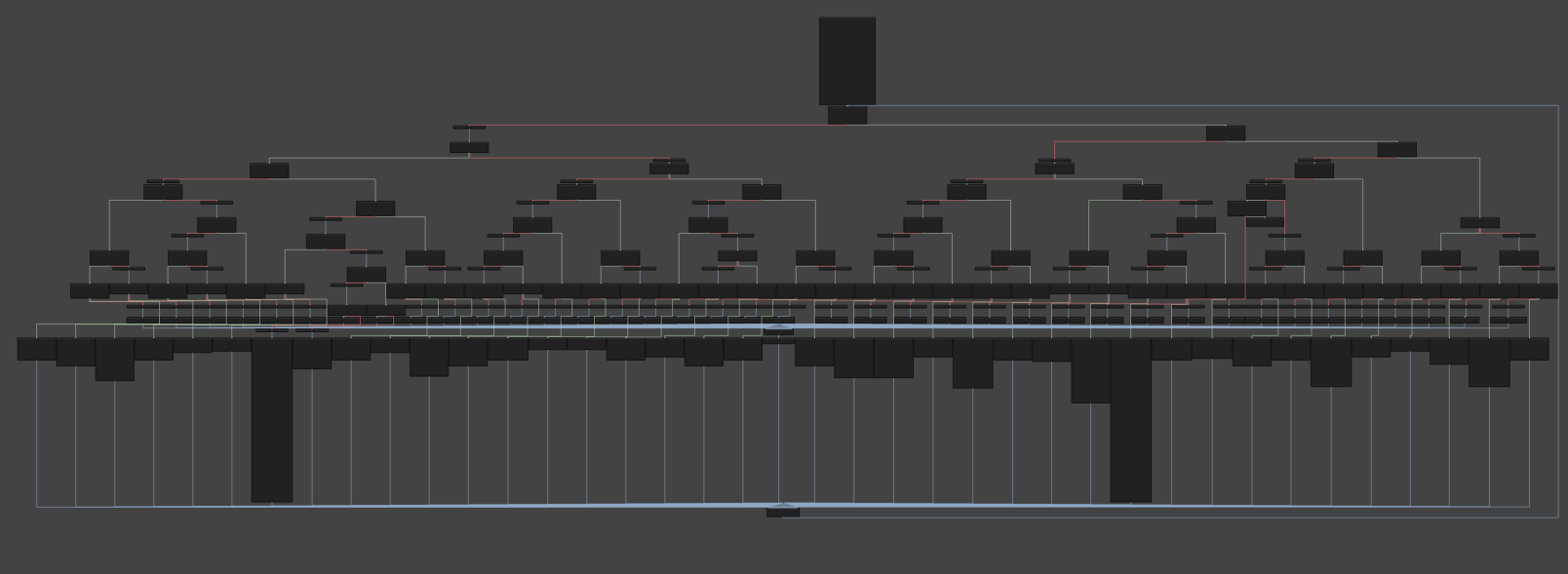 After indirect jmp resolution
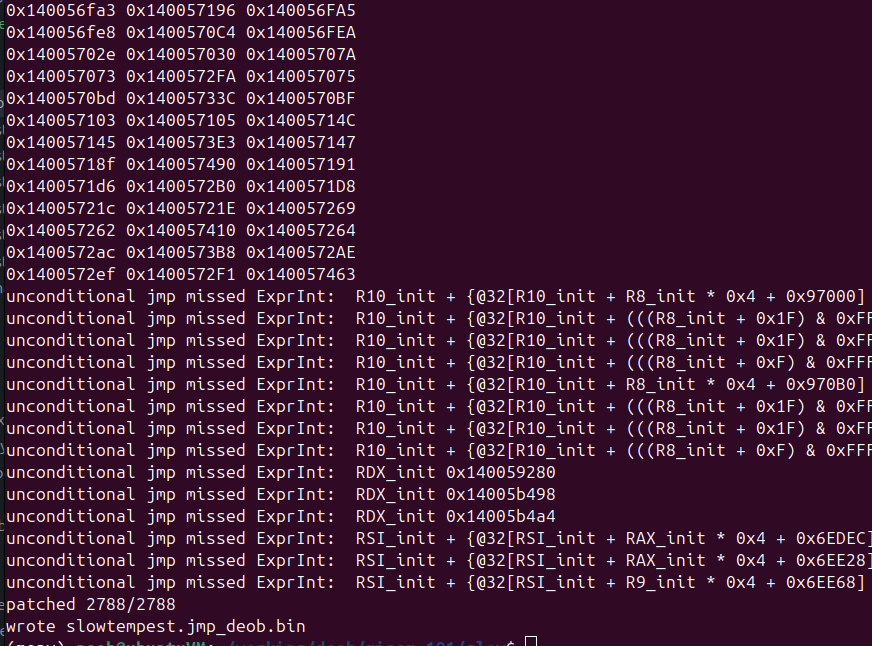
This number matches by the idapython script we wrote. It successfully deobfuscated all 2788 indirect jumps.
The whole indirect jump deobfuscation script
1
2
3
4
5
6
7
8
9
10
11
12
13
14
15
16
17
18
19
20
21
22
23
24
25
26
27
28
29
30
31
32
33
34
35
36
37
38
39
40
41
42
43
44
45
46
47
48
49
50
51
52
53
54
55
56
57
58
59
60
61
62
63
64
65
66
67
68
69
70
71
72
73
74
75
76
77
78
79
80
81
82
83
84
85
86
87
88
89
90
91
92
93
94
95
96
97
98
99
100
101
102
103
104
105
106
107
108
109
110
111
112
113
114
115
116
117
118
119
120
121
122
123
124
125
126
127
128
129
130
131
132
133
134
135
136
137
138
139
140
141
142
143
144
145
146
147
148
149
150
151
152
153
154
155
156
157
158
159
160
161
162
163
164
165
166
167
168
169
170
171
172
173
174
175
176
177
178
179
180
181
182
183
184
185
186
187
188
189
190
191
192
193
194
195
196
197
198
199
200
201
202
203
204
205
206
207
208
209
210
211
212
213
214
215
216
217
218
219
220
221
222
223
224
225
226
227
228
229
230
231
232
233
234
235
236
237
238
239
240
241
242
243
244
245
246
247
248
249
250
251
252
253
254
255
from miasm.analysis.binary import Container
from miasm.analysis.machine import Machine
from miasm.core.locationdb import LocationDB
from miasm.core.asmblock import AsmCFG
from miasm.ir.symbexec import SymbolicExecutionEngine
from miasm.arch.x86.regs import all_regs_ids, all_regs_ids_init
from miasm.expression.simplifications import ExpressionSimplifier, expr_simp_explicit, expr_simp
from miasm.expression.expression import ExprVisitorCallbackTopToBottom, ExprMem, ExprInt, ExprId
from capstone import *
from capstone.x86 import *
import struct
import lief

file = 'slowtempest.bin'
pe = lief.PE.parse(file)
image_base = pe.imagebase
text_section = pe.get_section(".text")
textData = bytearray(text_section.content)
textVA = image_base + text_section.virtual_address
data_section = pe.get_section(".data")
rawData = bytearray(open(file,'rb').read()) #for the writeback at the end

u64 = lambda d: struct.unpack('<Q', d)[0]
u32 = lambda d: struct.unpack('<I', d)[0]
va = lambda addr: pe.va_to_offset(addr)

concreteSymbols = {}
def add_data(symb, offset, data):
    for i in range(0,len(data),8):
        symb[ExprMem(ExprInt(offset + i, 64),64)] = ExprInt(u64(data[i:i+8]), 64)
    #for the dword references
    for i in range(0,len(data),4):
        symb[ExprMem(ExprInt(offset + i, 32),32)] = ExprInt(u32(data[i:i+4]), 32)

def simpExprMemCallBack(expr):
    if isinstance(expr, ExprMem):
        if expr in concreteSymbols:
            newExpr = expr.replace_expr({expr:concreteSymbols[expr]})
            return newExpr
    return None

def simpExprMem(_,expr): # https://github.com/cea-sec/miasm/blob/master/miasm/expression/expression.py#L614
    visitor = ExprVisitorCallbackTopToBottom(lambda expr:simpExprMemCallBack(expr))
    return visitor.visit(expr)

def patch(va, data):
    rva = va - image_base
    text_rva = text_section.virtual_address
    offset = rva - text_rva
    textData[offset:offset + len(data)] = data

class ConditionalJump:
    def __init__(self, jtype=None, before_cond=None, cond_addr=None, after_cond=None, condition=None, regs=None,trueTarget=None,falseTarget=None,jmpAddr=False):
        self.jtype = jtype  # set/cmovcc
        self.before_cond = before_cond # block start
        self.cond_addr = cond_addr  # cmovcc/set address
        self.after_cond = after_cond # next address after cmovcc
        self.condition = condition # cc (condition from cmovcc)
        self.regs = regs  # src, dst (from cmovcc)
        self.trueTarget = trueTarget
        self.falseTarget = falseTarget
        self.jmpAddr = jmpAddr # indirect jmp address

class Jump:
    def __init__(self, start_addr=None,jmpAddr=False):
        self.start_addr = start_addr
        self.jmpAddr = jmpAddr

add_data(concreteSymbols, data_section.virtual_address + image_base, bytes(data_section.content))

md = Cs(CS_ARCH_X86, CS_MODE_64)
md.detail = True
jumps = []
disassembly = {}

#any spelling of a gpr -> the 64 bit one. the old 4 entry reg_map KeyErrors on
#sil/dil/r8b/... and reg.replace("e","r") turns r8d into R8D
reg_map = {}
for i,r in enumerate(["RAX","RCX","RDX","RBX","RSP","RBP","RSI","RDI","R8","R9","R10","R11","R12","R13","R14","R15"]):
    if i < 8:
        l = r[1:].lower()
        names = [r, "e"+l, l, (l[0]+"l" if l[1] == "x" else l+"l")]
        if l[1] == "x": names.append(l[0]+"h")
    else:
        names = [r, r+"D", r+"W", r+"B"]
    for n in names: reg_map[n.lower()] = r

cond_jump_insts = {'jo': bytearray(b'\x0f\x80'), 'jno': bytearray(b'\x0f\x81'), 'js': bytearray(b'\x0f\x88'), 'jns': bytearray(b'\x0f\x89'), 'je': bytearray(b'\x0f\x84'), 'jz': bytearray(b'\x0f\x84'), 'jne': bytearray(b'\x0f\x85'), 'jnz': bytearray(b'\x0f\x85'), 'jb': bytearray(b'\x0f\x82'), 'jnae': bytearray(b'\x0f\x82'), 'jc': bytearray(b'\x0f\x82'), 'jae': bytearray(b'\x0f\x83'), 'jnb': bytearray(b'\x0f\x83'), 'jnc': bytearray(b'\x0f\x83'), 'jbe': bytearray(b'\x0f\x86'), 'jna': bytearray(b'\x0f\x86'), 'ja': bytearray(b'\x0f\x87'), 'jnbe': bytearray(b'\x0f\x87'), 'jl': bytearray(b'\x0f\x8c'), 'jnge': bytearray(b'\x0f\x8c'), 'jge': bytearray(b'\x0f\x8d'), 'jnl': bytearray(b'\x0f\x8d'), 'jle': bytearray(b'\x0f\x8e'), 'jng': bytearray(b'\x0f\x8e'), 'jg': bytearray(b'\x0f\x8f'), 'jnle': bytearray(b'\x0f\x8f'), 'jp': bytearray(b'\x0f\x8a'), 'jpe': bytearray(b'\x0f\x8a'), 'jnp': bytearray(b'\x0f\x8b'), 'jpo': bytearray(b'\x0f\x8b')}

def assembleJump(target, currentAddr,cond=None):
    offset = target - currentAddr
    if offset >= 0 and cond != None: offset = offset - 6
    if offset >= 0 and cond == None: offset = offset - 5
    offset = offset.to_bytes(4,'little',signed=True)
    inst = b""
    if cond != None:
        inst += cond_jump_insts["j"+cond]
    else:
        inst += b"\xE9"
    return inst + offset

def getStartJump(addr):
    jumpAddress = addr
    _, _,_, prevSize = disassembly[addr]
    prevAddr = addr
    if prevSize == None: return None
    addr -= prevSize # address of the previous instruciton
    condAddr = None
    condition = ""
    regs = None
    type = None
    while addr in disassembly:
        mnemonic, op_str, size, prevSize = disassembly[addr]
        # the instructions that split the miasm IR block
        if mnemonic in ["call","jmp","ret","int3","div,","idiv"] or mnemonic.startswith("j") or (mnemonic == "sub" and "rsp" in op_str):
            if type != None: #cmov
                if type == 'cmovcc':
                    return ConditionalJump(jtype='cmovcc',before_cond=prevAddr,cond_addr=condAddr,after_cond=afterAddr,condition=condition,regs=regs,jmpAddr=jumpAddress)

                elif type == 'setcc':
                    return ConditionalJump(jtype='setcc',before_cond=prevAddr,cond_addr=condAddr,after_cond=afterAddr,condition=condition,regs=regs,jmpAddr=jumpAddress)
            else:

                return Jump(start_addr=prevAddr,jmpAddr=jumpAddress)
                            # miasm block start addr, jmp instruction addr
        elif mnemonic.startswith("cmov") and type == None:
            type = 'cmovcc'
            condAddr = addr
            afterAddr = addr+size
            reg1,reg2 = op_str.replace(" ","").split(",")
            regs = [reg_map[reg1.lower()],reg_map[reg2.lower()]] #convert to the 64 bit reg
            condition = mnemonic[4:]
        elif mnemonic.startswith("set") and type == None:
            type = 'setcc'
            condAddr = addr
            afterAddr = addr+size
            condition = mnemonic[3:]
            regs = reg_map[op_str.lower()]
        prevAddr = addr
        if prevSize == None: return None
        addr -= prevSize
    return None

prevSize = None
for insn in md.disasm(textData, textVA):
    if insn.mnemonic == "jmp" and insn.operands[0].type == X86_OP_REG:
        jumps.append(insn.address)
    disassembly[insn.address] = [insn.mnemonic,insn.op_str,insn.size,prevSize]
    prevSize = insn.size

jumpsInfo = []
for jump in jumps:
    n = getStartJump(jump)
    if n != None:
        jumpsInfo.append(n)

fdesc = open(file, 'rb')
loc_db = LocationDB()
cont = Container.from_stream(fdesc, loc_db)
machine = Machine(cont.arch)
mdis = machine.dis_engine(cont.bin_stream, loc_db=cont.loc_db)
lifter = machine.lifter_model_call(mdis.loc_db)

simplifier = ExpressionSimplifier()
simplifier.enable_passes(ExpressionSimplifier.PASS_COMMONS)
simplifier.enable_passes(ExpressionSimplifier.PASS_HIGH_TO_EXPLICIT)
simplifier.enable_passes({ExprMem:[simpExprMem]})


def symbolic_execution(blockAddr, symbols = {}, cond_addr=None, cmovRegs=[]):
    addr = blockAddr
    asmcfg = AsmCFG(loc_db)
    block = mdis.dis_block(addr)

    if cond_addr:
        while block.lines:
            last_instr = block.lines[-1]
            if last_instr.offset == cond_addr: # removing the lines from the block untill cmovcc or setcc
                block.lines.pop()
                break
            block.lines.pop()

    asmcfg.add_block(block) # building block before cmovcc or setcc

    ircfg = lifter.new_ircfg_from_asmcfg(asmcfg)

    if symbols == {}: # when the there are no symbols
        for i, r in enumerate(all_regs_ids):
            symbols[r] = all_regs_ids_init[i]

    sb = SymbolicExecutionEngine(lifter,symbols,sb_expr_simp=simplifier)

    r = sb.run_block_at(ircfg, addr)

    if cmovRegs != []: # false in set condition
        regs = cmovRegs
        false = sb.symbols[ExprId(regs[0],64)] #if dst is not moved to src
        true = sb.symbols[ExprId(regs[1],64)] #if dst is moved to src
        assert isinstance(false,ExprInt) and isinstance(true,ExprInt)
        return sb.symbols.copy(), false, true
    elif cond_addr:
        return sb.symbols.copy()
    else:
        return r


print(f"{file}: base {hex(image_base)}, .text {hex(text_section.virtual_address)}, {len(jumps)} jmp reg")
bad = {}
patched = 0
for jump in jumpsInfo:
    if isinstance(jump,ConditionalJump):
        if jump.jtype == 'cmovcc': #type = cmov          # before_cond=block start
            symbols,falseVal,trueVal = symbolic_execution(jump.before_cond,cmovRegs=jump.regs, cond_addr=jump.cond_addr)
            symbolsFalse = symbols.copy(); symbolsTrue = symbols.copy()
            symbolsFalse[ExprId(jump.regs[1],64)] = falseVal
            symbolsTrue[ExprId(jump.regs[0],64)] = trueVal
            trueTarget = symbolic_execution(jump.after_cond,symbols=symbolsTrue)
            falseTarget = symbolic_execution(jump.after_cond,symbols=symbolsFalse)
            assert isinstance(trueTarget,ExprInt) and isinstance(falseTarget,ExprInt)
        elif jump.jtype == 'setcc':
            reg = jump.regs
            symbols = symbolic_execution(jump.before_cond,cond_addr=jump.cond_addr)
            symbolsFalse = symbols.copy(); symbolsTrue = symbols.copy()
            symbolsFalse[ExprId(reg,64)] = ExprInt(0,64)
            symbolsTrue[ExprId(reg,64)] = ExprInt(1,64)
            falseTarget = symbolic_execution(jump.after_cond,symbols=symbolsFalse)
            trueTarget = symbolic_execution(jump.after_cond,symbols=symbolsTrue)
            assert isinstance(trueTarget,ExprInt) and isinstance(falseTarget,ExprInt)

        jump.trueTarget = int(trueTarget)
        jump.falseTarget = int(falseTarget)

        patchData = assembleJump(jump.trueTarget,jump.cond_addr,cond=jump.condition)
        patchData += assembleJump(jump.falseTarget,jump.cond_addr+6)

        patchSize = jump.jmpAddr+2-jump.cond_addr
        patchData = patchData + ((patchSize - len(patchData)) * b"\x90")
        patch(jump.cond_addr,patchData)
        patched += 1
        print(hex(jump.jmpAddr),trueTarget,falseTarget)
    else:
        r = symbolic_execution(jump.start_addr)
        if not isinstance(r,ExprInt): #false positive OR a missed conditional jmp
            print('unconditional jmp missed ExprInt: ', r,hex(jump.start_addr))
            continue
        else:
            print(f"manually patch tailcall at {hex(jump.jmpAddr)}, {r}")

print(f"patched {patched}/{len([j for j in jumpsInfo if isinstance(j,ConditionalJump)])}")


rawData[text_section.pointerto_raw_data:text_section.pointerto_raw_data+len(textData)] = textData
out = file.split('.bin')[0] + '.jmp_deob.bin'
open(out,"wb").write(rawData)
print(f"wrote {out}")
Control Flow Flattening
 Flattened CFG 🫠
This is very classic example of control flow flattening. Which is much different than the Tigress CFF we dealt with. This flattening is without the jump table, hence our will be a bit different here, as we don’t have entries of original basic blocks from the jump table. we have the identify the original basic blocks via the CFG design.
Dispatcher
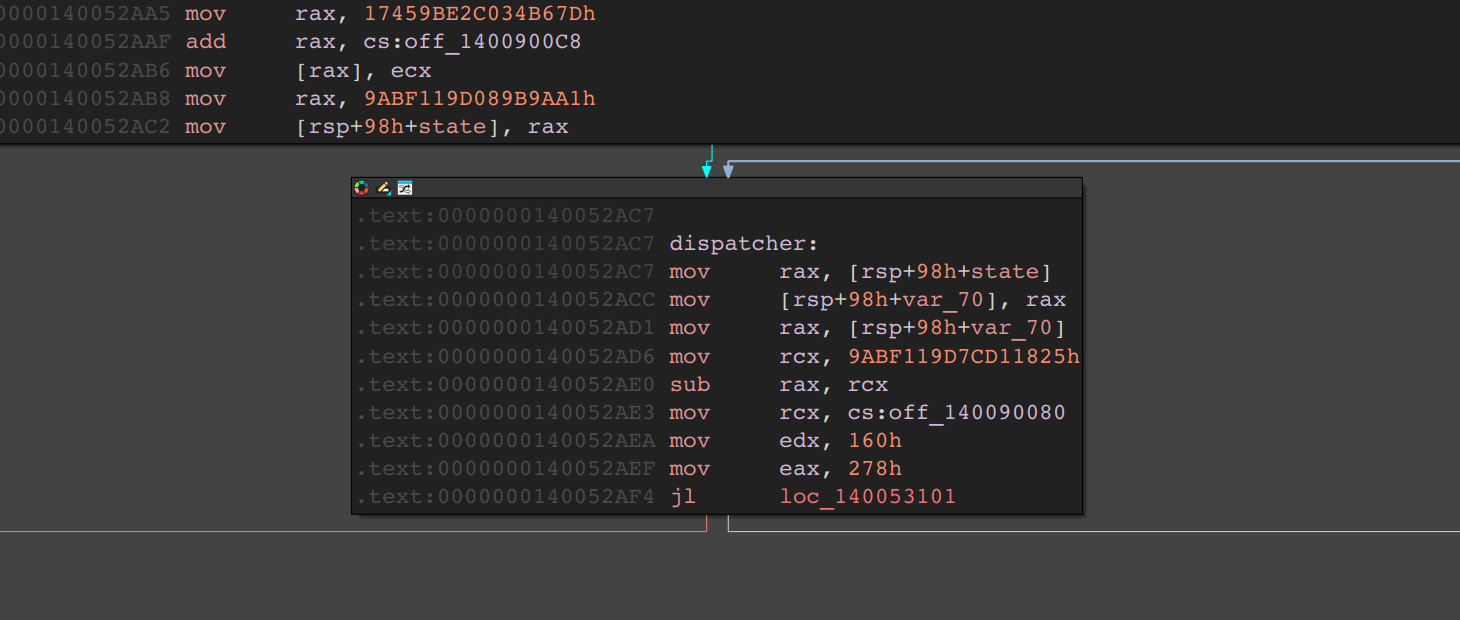 state value read in the first instruction of dispatcher
Original Basic Blocks
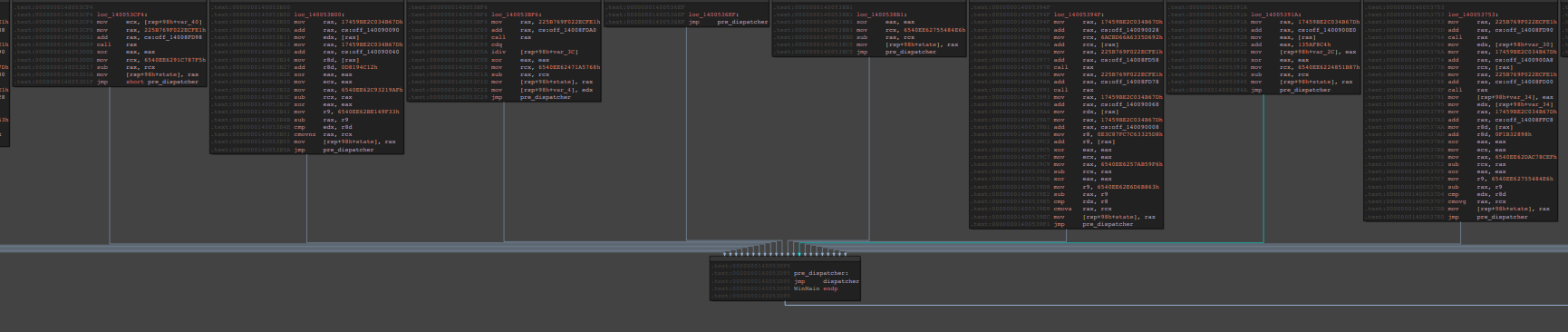 predecessors of the pre-dispatchers are original basic blocks
State update process
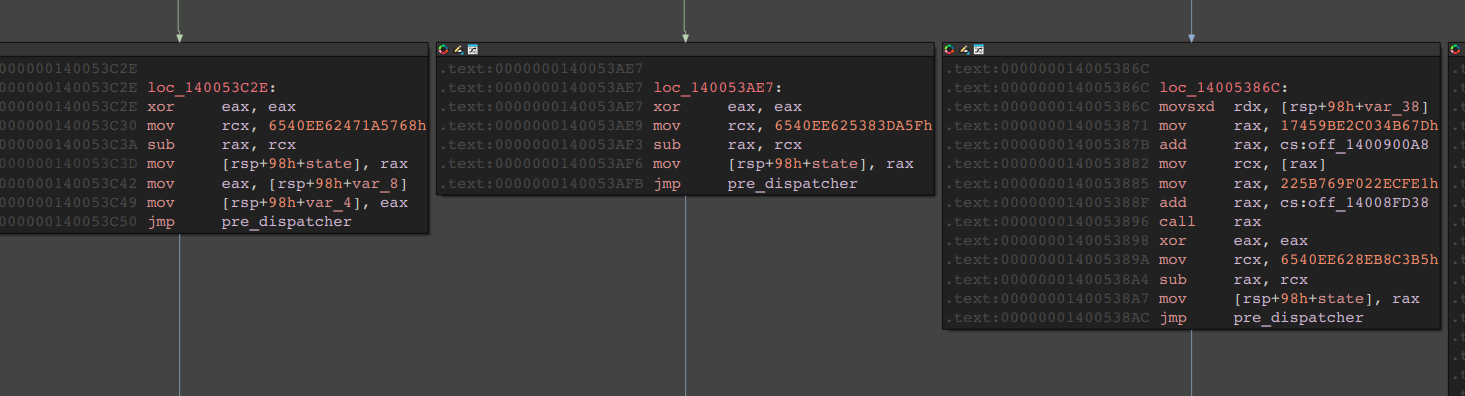 direct state update
Blocks like these just update the state (unconditionally), These are trivial as we can just build the mapping state to state mapping and state to address mapping but there is a catch 🙂
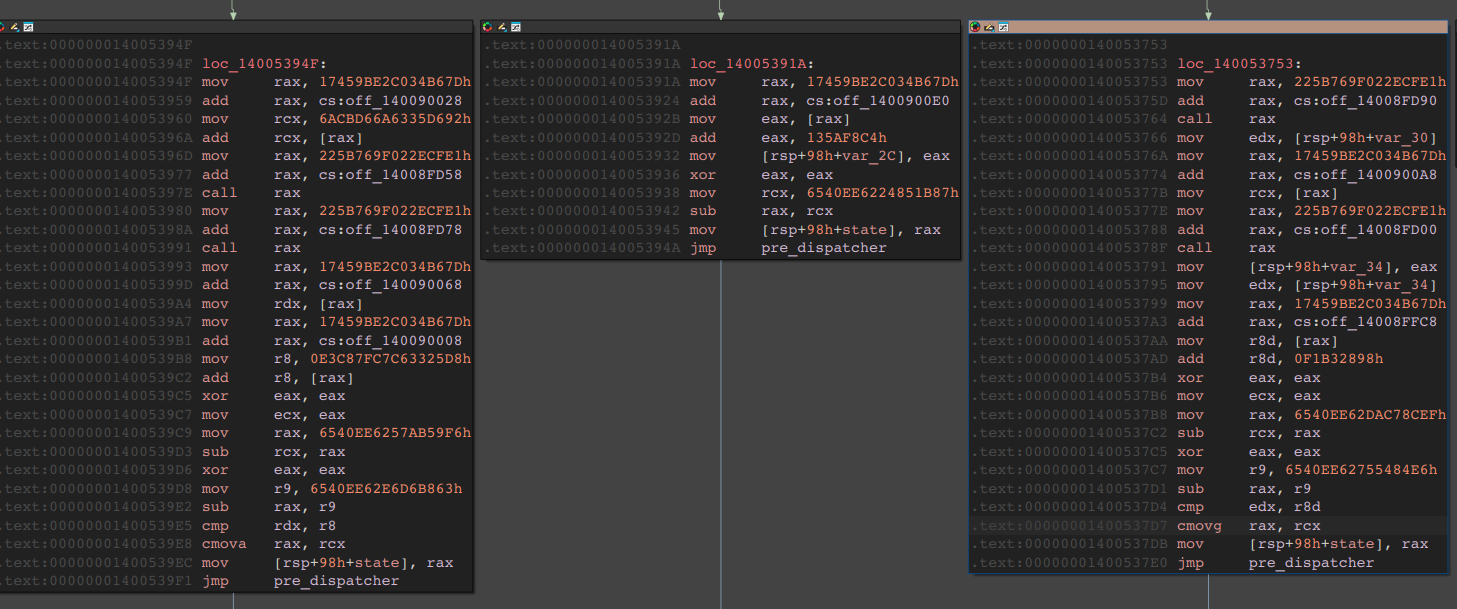 conditional state update
We can see that cmovcc is followed by a cmp is deciding the state value, so a state can determine more than two next states at two distinct time. So now we will perform symbolic execution on the CFG and build the mapping and then remove the basic block which are not original basic blocks.
Identify Original Basic Blocks
1
2
3
4
5
6
7
8
9
10
11
12
13
14
15
16
17
18
19
20
21
22
23
24
25
26
27
28
29
30
31
32
33
def findOBB(pre_disp_addr):
    OBB = []
    pre_disp_loc = loc_db.get_offset_location(pre_disp_addr)
    # for original basic blocks
    for curr_loc in asmcfg.predecessors(pre_disp_loc):
        pre_obb_loc = asmcfg.predecessors(curr_loc); OBB.append(curr_loc)
        assert len(pre_obb_loc) == 1
        while True:
            pre_obb_block = asmcfg.loc_key_to_block(pre_obb_loc[0])
            if pre_obb_block.lines[-1].name.startswith('J'): # if its a Jmp/Jcc break
                break
            curr_loc = pre_obb_loc[0]
            pre_obb_loc = asmcfg.predecessors(curr_loc)
            assert len(pre_obb_loc) == 1
            OBB.append(curr_loc) # untill then all are original basic block (they are just split because of call)

    # for ret basic blocs/tail calls
    for bb in asmcfg.blocks:
        ret_loc = bb.loc_key
        if len(asmcfg.successors(ret_loc)) == 0: # same algo just on the return as it has no successors
            ret_pre_loc = asmcfg.predecessors(ret_loc); OBB.append(ret_loc)
            assert len(ret_pre_loc) == 1
            while True:
                ret_pre_block = asmcfg.loc_key_to_block(ret_pre_loc[0])
                if ret_pre_block.lines[-1].name.startswith('J'):
                    break
                ret_loc = ret_pre_loc[0]
                ret_pre_loc = asmcfg.predecessors(ret_loc)
                assert len(ret_pre_loc) == 1
                OBB.append(ret_loc)
            print('RET: ', hex(loc_db.get_location_offset(ret_loc)))

    return OBB
We will perform symbolic execution on the CFG in BFS manner. execute the block, append the false condition in the queue for later execution, go with the true value, when the address is one of original basic block update the state to address map and when the address reaches the pre-dispatcher we update state to state map just before symbolic execution on each basic blocks, we will scan for cmp followed by cmovcc, if they are found it means that we are dealing with jcc states. and return a condition (so it can be separated as true and false branch) else we return solid brancing address.
1
2
3
4
5
6
7
8
9
10
11
12
13
14
15
16
17
18
19
20
21
22
23
24
25
26
27
28
29
30
31
32
33
34
35
36
37
38
39
40
41
42
43
44
45
46
47
48
49
50
51
52
53
54
55
56
57
58
59
60
61
62
63
64
65
66
67
68
69
70
71
72
q = deque([(loc_db.get_offset_location(addr), first_state_val, init_symbols)]); visited_location = set()

while q:
    curr_addr_loc, curr_state_val, symbols = q.popleft()
    sb = SymbolicExecutionEngine(lifter, symbols, sb_expr_simp=custom_simp)

    while True:
        r = symbolic_execution(sb, curr_addr_loc)
        if r is None: break

        if r.is_cond():
            cond_true = {r.cond: ExprInt(1, 32)}; cond_false = {r.cond: ExprInt(0, 32)}
            jt = to_loc_key(expr_simp(sb.eval_expr(r.replace_expr(cond_true), {})))
            jf = to_loc_key(expr_simp(sb.eval_expr(r.replace_expr(cond_false), {})))
            q.append((jf, curr_state_val, sb.symbols.copy())) # append the false branch for later symbolic execution
            curr_addr_loc = jt
        else:
            curr_addr_loc = to_loc_key(expr_simp(sb.eval_expr(r))) # curr_addr_loc = next_loc

        if curr_addr_loc in visited_location: break

        elif curr_addr_loc in OBB:
            visited_location.add(curr_addr_loc)
            curr_state_val = int(sb.eval_expr(state_variable))
            # check if the current address is already added in the correspinding state list
            if curr_addr_loc not in state_to_addr_map[curr_state_val]:
                state_to_addr_map[curr_state_val].append(curr_addr_loc)

            if first_state_val is None: first_state_val = curr_state_val

        elif curr_addr_loc == pre_disp_loc:
            nState_val = int(sb.eval_expr(state_variable))

            if nState_val not in state_to_state_map[curr_state_val]:
                state_to_state_map[curr_state_val].append(nState_val)
            curr_state_val = None

def symbolic_execution(sb, address_loc):

    cmp_ins = None; cmovcc_ins = None
    current_asm_block = asmcfg.loc_key_to_block(address_loc)
    if current_asm_block is None: return sb.run_block_at(ircfg=ircfg, addr=address_loc)
    for ins in current_asm_block.lines:
        if ins.name in ['CMP', 'TEST']:
            cmp_ins = ins
        elif ins.name.startswith('CMOV'):
            cmovcc_ins = ins
            break

    if current_asm_block.lines[-1].name == 'CALL':
        rsp = sb.symbols[lifter.arch.regs.RSP]; rbp = sb.symbols[lifter.arch.regs.RBP]
        r = sb.run_block_at(ircfg=ircfg, addr=address_loc)
        sb.symbols[lifter.arch.regs.RSP] = rsp; sb.symbols[lifter.arch.regs.RBP] = rbp
        return r

    if cmovcc_ins is not None and cmp_ins is not None:
        curr_loc = address_loc
        # print(current_asm_block)
        sb.run_block_at(ircfg=ircfg, addr=curr_loc)
        while True:
            current_ir_block = ircfg.get_block(addr=curr_loc)
            # print('check', hex(loc_db.get_location_offset(address_loc))) # debug
            for ir_ins in current_ir_block:
                if ir_ins.instr.name.startswith('CMOV'):
                    cmov_cond_expr = ir_ins.values()[-1]
                    if str(cmovcc_ins).startswith('CMOVN'):print(ir_ins.instr.name,' ', hex(loc_db.get_location_offset(to_loc_key(curr_loc))), cmov_cond_expr);\
                        return cmov_cond_expr.copy()
                    print(ir_ins.instr.name,' ', hex(loc_db.get_location_offset(to_loc_key(curr_loc))), cmov_cond_expr)
                    return ExprCond(cmov_cond_expr.cond.copy(), cmov_cond_expr.src2.copy(), cmov_cond_expr.src1.copy()) # flip the condition
            curr_loc = sb.run_block_at(ircfg=ircfg, addr=curr_loc)
    else:
        return sb.run_block_at(ircfg=ircfg, addr=address_loc)
I ran the script after setting the necessary addresses, it threw an error even though i was sure it would work.
1
2
3
4
5
6
7
8
9
10
11
12
13
14
15
16
17
18
imagebase:  0x140000000
RET:  0x140053d73
STATE:  @64[RSP + 0x50]
CMOVNZ   0x1400536f4 CC_EQ(zf)?(loc_key_167,loc_key_166)
CMOVG   0x140053791 CC_S>(nf, of, zf)?(loc_key_175,loc_key_176)
CMOVZ   0x1400538ca CC_EQ(zf)?(loc_key_170,loc_key_171)
CMOVA   0x140053993 CC_U>(cf, zf)?(loc_key_186,loc_key_187)
CMOVNZ   0x140053a88 CC_EQ(zf)?(loc_key_189,loc_key_188)
CMOVG   0x140053810 CC_S>(nf, of, zf)?(loc_key_184,loc_key_185)
CMOVNZ   0x140053b00 CC_EQ(zf)?(loc_key_169,loc_key_168)
Traceback (most recent call last):
  File "/home/xyz/working/deob/miasm_101/slow/cff_slowtempest.py", line 178, in <module>
    r = symbolic_execution(sb, curr_addr_loc)
        ^^^^^^^^^^^^^^^^^^^^^^^^^^^^^^^^^^^^^
  File "/home/xyz/working/deob/miasm_101/slow/cff_slowtempest.py", line 144, in symbolic_execution
    for ir_ins in current_ir_block:
TypeError: 'NoneType' object is not iterable
And i wonder why the irblock is none :/
print('debug: ', hex(loc_db.get_location_offset(address_loc))) I added this in symbolic execution function. So i can get which asm block the error occurs.
1
2
3
4
5
6
7
8
9
10
11
12
13
[...]
debug:  0x1400534d7
debug:  0x1400534f4
debug:  0x14005351d
debug:  0x14005353a
debug:  0x140053b5f
Traceback (most recent call last):
  File "/home/xyz/working/deob/miasm_101/slow/cff_slowtempest.py", line 179, in <module>
    r = symbolic_execution(sb, curr_addr_loc)
        ^^^^^^^^^^^^^^^^^^^^^^^^^^^^^^^^^^^^^
  File "/home/xyz/working/deob/miasm_101/slow/cff_slowtempest.py", line 145, in symbolic_execution
    for ir_ins in current_ir_block:
TypeError: 'NoneType' object is not iterable
Block at 0x140053b5f
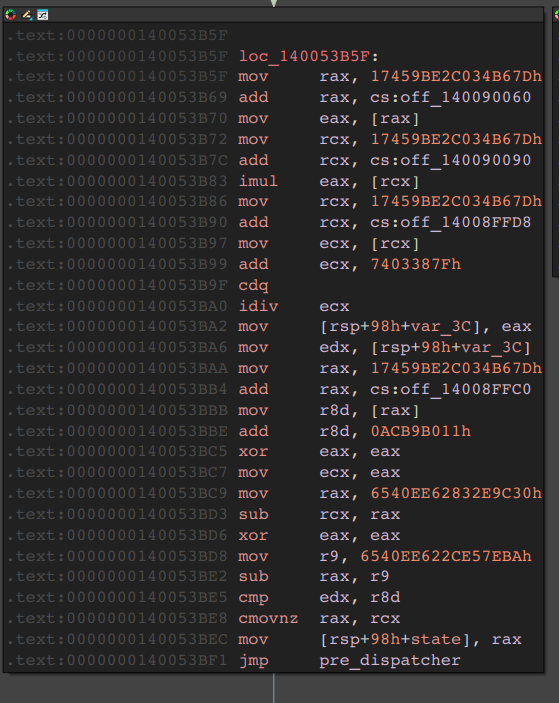 idiv instruction
 creates a split in ircfg due to its exception handling.
1
2
3
4
5
6
7
8
    for ins in current_asm_block.lines:
        if ins.name == 'IDIV': # just added this in the symb exe
            address_loc = ins.offset + ins.l # skipped the idiv instruction execution
        elif ins.name in ['CMP', 'TEST']:
            cmp_ins = ins
        elif ins.name.startswith('CMOV'):
            cmovcc_ins = ins
            break
1
2
3
4
5
6
7
8
9
10
11
12
13
14
15
$ python cff_slowtempest.py
imagebase:  0x140000000
RET:  0x140053d73
STATE:  @64[RSP + 0x50]
CMOVNZ   0x1400536f4 CC_EQ(zf)?(loc_key_167,loc_key_166)
CMOVG   0x140053791 CC_S>(nf, of, zf)?(loc_key_175,loc_key_176)
CMOVZ   0x1400538ca CC_EQ(zf)?(loc_key_170,loc_key_171)
CMOVA   0x140053993 CC_U>(cf, zf)?(loc_key_186,loc_key_187)
CMOVNZ   0x140053a88 CC_EQ(zf)?(loc_key_189,loc_key_188)
CMOVG   0x140053810 CC_S>(nf, of, zf)?(loc_key_184,loc_key_185)
CMOVNZ   0x140053b00 CC_EQ(zf)?(loc_key_169,loc_key_168)
CMOVNZ   0x140053ba2 CC_EQ(zf)?(loc_key_183,loc_key_182)
CMOVL   0x140053c55 CC_S<(nf, of)?(loc_key_177,loc_key_178)
function prologue 0x140052a70
Patched: slowtempest.cff_deob.bin
Lets check !!!
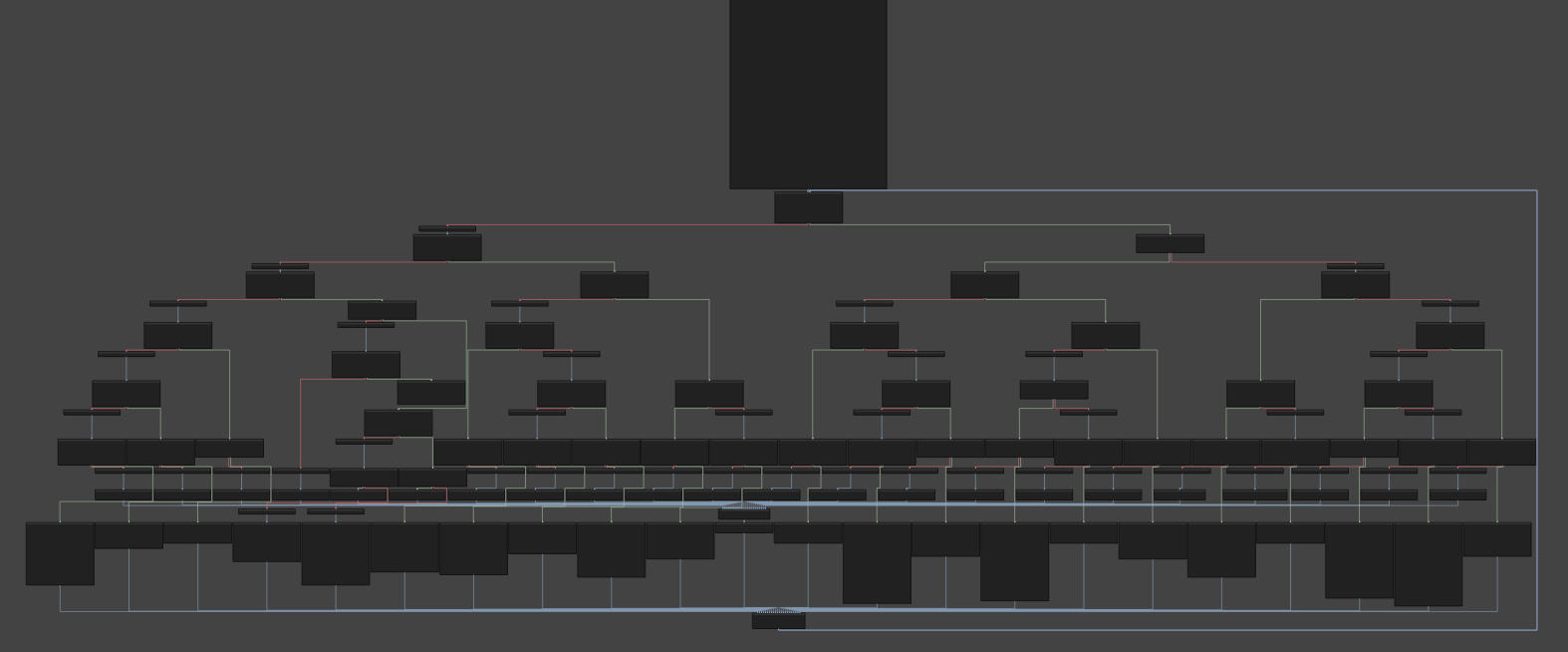 before
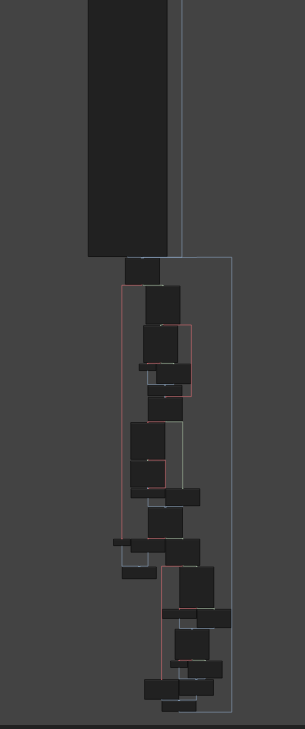 After
Now we want to deobfuscate the entire binary CFG.
First i will get all the addresses of the functions from ida python.
1
2
3
4
5
6
7
8
9
import idautils
import idc

funcs = []
for ea in idautils.Functions():
    flags = idc.get_func_flags(ea)
    if flags & idc.FUNC_LIB:
        continue  # skip library functions
    funcs.append(ea)
we got all the function addresses excluding the library functions.
1
2
3
4
5
6
7
8
9
10
11
12
13
14
15
16
17
18
19
20
21
22
23
24
25
26
27
28
29
30
31
32
33
34
35
36
37
38
39
40
41
42
43
44
45
46
47
48
49
50
51
52
from miasm.analysis.binary import Container
from miasm.analysis.machine import Machine
from miasm.core.locationdb import LocationDB


def calc_flattening_score(asm_graph, loc_db):
    # (c) Tim Blazytko 2021
    # implementation based on the blog post "Automated Detection of Control-flow Flattening"
    # https://synthesis.to/2021/03/03/flattening_detection.html
    # init score
    score = 0.0
    # walk over all entry nodes in the graph
    for head in asm_graph.heads_iter():
        # compute dominator tree
        dominator_tree = asm_graph.compute_dominator_tree(head)
        # walk over all basic blocks
        for block in asm_graph.blocks:
            # get location key for basic block via basic block address
            block_key = loc_db.get_offset_location(block.lines[0].offset)
            # get all blocks that are dominated by the current block
            dominated = set(
                [block_key] + [b for b in dominator_tree.walk_depth_first_forward(block_key)])
            # check for a back edge
            if not any([b in dominated for b in asm_graph.predecessors(block_key)]):
                continue
            # calculate relation of dominated blocks to the blocks in the graph
            score = max(score, len(dominated)/len(asm_graph.nodes()))
    return score

# init symbol table
loc_db = LocationDB()

# open the binary for analysis
container = Container.from_stream(open('slowtempest.jmp_deob.bin', 'rb'), loc_db)

# cpu abstraction
machine = Machine(container.arch)

# init disassemble engine
mdis = machine.dis_engine(container.bin_stream, loc_db=loc_db)
flat = []
for addr in funcs: # all the functions we got from IDA (except the library funcs)

    asm_cfg = mdis.dis_multiblock(addr)

    flattening_score = calc_flattening_score(asm_cfg, loc_db)
    if flattening_score > 0.7: # this condition after i noticed that all functions that were below 7 were not obfuscated
        print(f"flattening score {flattening_score} for function {hex(addr)}")
        flat.append(addr)

print(flat) # all the flattened functions.
Now we got all the flattened functions, and we will iterate through the flattened function addresses and then find each flattened functions dispatcher and pre-dispatcher locations. As pre-dispatcher is the basic block with maximum number of predecessors (there are some exception you will see later), and the successors of pre-dispatcher is the dispatcher block. So we have to find the basic block which has the highest number of predecessors that will be our pre-dispatcher and then its successor is the dispatcher block.
1
2
3
4
5
pre_disp_loc = max(asmcfg.blocks, key=lambda key: len(asmcfg.predecessors(key.loc_key))).loc_key  # getting the pre-disp location
disp_loc = asmcfg.successors(pre_disp_loc) # expected successor.
assert len(disp_loc) == 1 # the pre-disp has only one successor
disp_addr_loc = disp_loc[0]
And now we are good to go? just perform the iteration and each funciton will be deobfuscated. WRONG
1
2
3
4
5
6
7
8
9
10
11
12
13
14
15
16
17
18
19
20
21
imagebase:  0x140000000
0x140001000  ->  0x140001036 0x140001715
CMOVNZ   0x14000146e CC_EQ(zf)?(loc_key_56,loc_key_55)
CMOVZ   0x1400015da CC_EQ(zf)?(loc_key_53,loc_key_54)
CMOVZ   0x1400014f1 CC_EQ(zf)?(loc_key_57,loc_key_58)
0x140001720  ->  0x140001751 0x140001bb6
CMOVNZ   0x140001a78 CC_EQ(zf)?(loc_key_40,loc_key_39)
CMOVZ   0x140001afa CC_EQ(zf)?(loc_key_41,loc_key_42)
0x140001bc0  ->  0x140001bfa 0x1400022eb
CMOVNZ   0x1400020c2 CC_EQ(zf)?(loc_key_59,loc_key_58)
CMOVZ   0x140002145 CC_EQ(zf)?(loc_key_62,loc_key_63)
CMOVZ   0x140002193 CC_EQ(zf)?(loc_key_60,loc_key_61)
0x1400022f0  ->  0x140002485 0x140002483
Traceback (most recent call last):
  File "/home/xyz/working/deob/miasm_101/slow/cff_slowtempest.py", line 238, in <module>
    deobfuscate(addr=addr)
  File "/home/xyz/working/deob/miasm_101/slow/cff_slowtempest.py", line 161, in deobfuscate
    state_variable = disp_block.lines[0].get_args_expr()[1]
                     ~~~~~~~~~~~~~~~~~~~~~~~~~~~~~~~~~~~^^^
IndexError: list index out of range
I added the debug print that shows on which function we are currently at what are its dispatcher are predispatcher block addresses. So lets visit the function at 0x1400022f0
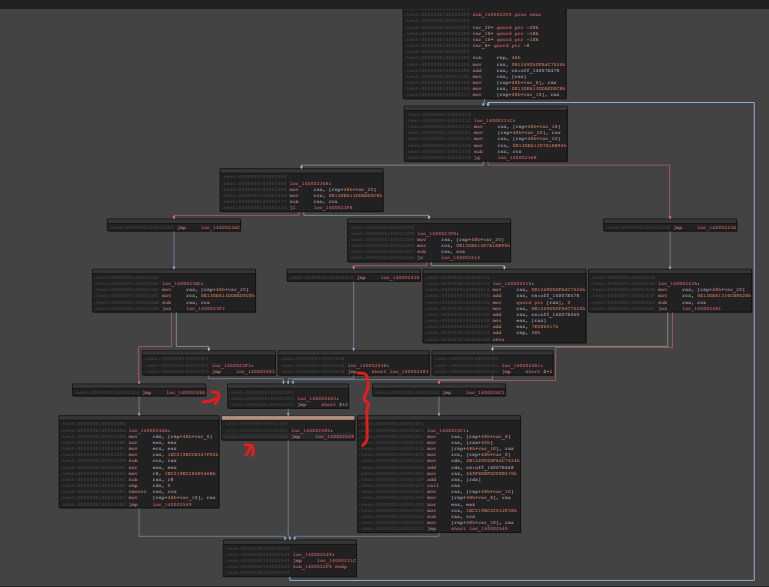 exception
It identified the predipatcher incorrectly, It has the same numbers of predecessors as the pre-dispatcher has. But it comes first due to the BFS traversal of asmcfg.blocks order. So to counter this exception we have to see if the dispatchers first instruction is a jmp than we will find the second max block which will give us the pre-dispatcher.
1
2
3
4
5
6
7
8
9
10
11
12
13
pre_disp_loc = sorted(asmcfg.blocks, key=lambda key: len(asmcfg.predecessors(key.loc_key)), reverse=True)[0].loc_key
disp_loc = asmcfg.successors(pre_disp_loc)
assert len(disp_loc) == 1
disp_addr_loc = disp_loc[0]
print(hex(addr), ' -> ', hex(loc_db.get_location_offset(disp_addr_loc)), hex(loc_db.get_location_offset(pre_disp_loc))) # debug
check_dispatcher = asmcfg.loc_key_to_block(disp_addr_loc)

if check_dispatcher.lines[-1].name == 'JMP':
    pre_disp_loc = sorted(asmcfg.blocks, key=lambda key: len(asmcfg.predecessors(key.loc_key)), reverse=True)[1].loc_key # getting the second max block which was left behind due to BFS on asmcfg.blocks
    disp_loc = asmcfg.successors(pre_disp_loc)
    assert len(disp_loc) == 1
    disp_addr_loc = disp_loc[0]
    print('Fixed exception', hex(addr), ' -> ', hex(loc_db.get_location_offset(disp_addr_loc)), hex(loc_db.get_location_offset(pre_disp_loc)))
Ok so now the wrong pre-dispatcher and dispatcher identification is fixed. But we got another one.
1
2
3
4
5
6
7
8
9
10
11
12
13
14
15
16
17
18
19
20
21
22
23
24
25
26
27
28
29
30
31
32
imagebase:  0x140000000
0x140001000  ->  0x140001036 0x140001715
STATE:  @64[RSP + 0x28]
CMOVNZ   0x14000146e CC_EQ(zf)?(loc_key_56,loc_key_55)
CMOVZ   0x1400015da CC_EQ(zf)?(loc_key_53,loc_key_54)
CMOVZ   0x1400014f1 CC_EQ(zf)?(loc_key_57,loc_key_58)
0x140001720  ->  0x140001751 0x140001bb6
STATE:  @64[RSP + 0x28]
CMOVNZ   0x140001a78 CC_EQ(zf)?(loc_key_40,loc_key_39)
CMOVZ   0x140001afa CC_EQ(zf)?(loc_key_41,loc_key_42)
0x140001bc0  ->  0x140001bfa 0x1400022eb
STATE:  @64[RSP + 0x30]
CMOVNZ   0x1400020c2 CC_EQ(zf)?(loc_key_59,loc_key_58)
CMOVZ   0x140002145 CC_EQ(zf)?(loc_key_62,loc_key_63)
CMOVZ   0x140002193 CC_EQ(zf)?(loc_key_60,loc_key_61)
0x1400022f0  ->  0x140002485 0x140002483
Fixed exception 0x1400022f0  ->  0x14000231c 0x140002549
STATE:  @64[RSP + 0x30]
CMOVNZ   0x14000248a CC_EQ(zf)?(loc_key_22,loc_key_21)
0x140002550  ->  0x140002e3e 0x140002e3c
Fixed exception 0x140002550  ->  0x14000275f 0x140003648
STATE:  @64[RSP + 0xC0]
CMOVNZ   0x140002e43 CC_EQ(zf)?(loc_key_112,loc_key_111)
CMOVZ   0x140003022 CC_EQ(zf)?(loc_key_117,loc_key_118)
CMOVNZ   0x140003219 CC_EQ(zf)?(loc_key_116,loc_key_115)
Traceback (most recent call last):
  File "/home/xyz/working/deob/miasm_101/slow/cff_slowtempest.py", line 248, in <module>
    deobfuscate(addr=addr)
  File "/home/xyz/working/deob/miasm_101/slow/cff_slowtempest.py", line 204, in deobfuscate
    curr_state_val = int(sb.eval_expr(state_variable))
                     ^^^^^^^^^^^^^^^^^^^^^^^^^^^^^^^^^
TypeError: int() argument must be a string, a bytes-like object or a real number, not 'ExprMem'
I added the debug print again in OBB to check in which basic block the crash occurs the the state variable is ExprMem.
1
2
3
4
5
6
7
8
9
10
11
12
13
14
15
16
17
18
19
20
21
22

debug:  0x140002f77 0xA7D2E3F6154E686C @64[RSP + 0xC0] <class 'miasm.expression.expression.ExprInt'>
debug:  0x140002f93 0xA7D2E3F62A1F3701 @64[RSP + 0xC0] <class 'miasm.expression.expression.ExprInt'>
debug:  0x140002fd5 0xA7D2E3F62A1F3701 @64[RSP + 0xC0] <class 'miasm.expression.expression.ExprInt'>
debug:  0x140002fff 0xA7D2E3F62A1F3701 @64[RSP + 0xC0] <class 'miasm.expression.expression.ExprInt'>
debug:  0x140003022 0xA7D2E3F62A1F3701 @64[RSP + 0xC0] <class 'miasm.expression.expression.ExprInt'>
CMOVZ   0x140003022 CC_EQ(zf)?(loc_key_117,loc_key_118)
debug:  0x140003196 0xA7D2E3F6A124348D @64[RSP + 0xC0] <class 'miasm.expression.expression.ExprInt'>
debug:  0x1400031b1 0xA7D2E3F6A124348D @64[RSP + 0xC0] <class 'miasm.expression.expression.ExprInt'>
debug:  0x1400031cd 0xA7D2E3F6651362FD @64[RSP + 0xC0] <class 'miasm.expression.expression.ExprInt'>
debug:  0x1400031f4 0xA7D2E3F6651362FD @64[RSP + 0xC0] <class 'miasm.expression.expression.ExprInt'>
debug:  0x140003219 0xA7D2E3F6651362FD @64[RSP + 0xC0] <class 'miasm.expression.expression.ExprInt'>
CMOVNZ   0x140003219 CC_EQ(zf)?(loc_key_116,loc_key_115)
debug:  0x140003397 0xA7D2E3F693812698 @64[RSP + 0xC0] <class 'miasm.expression.expression.ExprInt'>
debug:  0x14000346d @64[call_func_stack(0x140008840, RSP_init) + 0xC0] @64[RSP + 0xC0] <class 'miasm.expression.expression.ExprMem'>
Traceback (most recent call last):
  File "/home/xyz/working/deob/miasm_101/slow/cff_slowtempest.py", line 252, in <module>
    deobfuscate(addr=addr)
  File "/home/xyz/working/deob/miasm_101/slow/cff_slowtempest.py", line 205, in deobfuscate
    curr_state_val = int(sb.eval_expr(state_variable))
                     ^^^^^^^^^^^^^^^^^^^^^^^^^^^^^^^^^
TypeError: int() argument must be a string, a bytes-like object or a real number, not 'ExprMem'
So it crashed on 0x14000346d
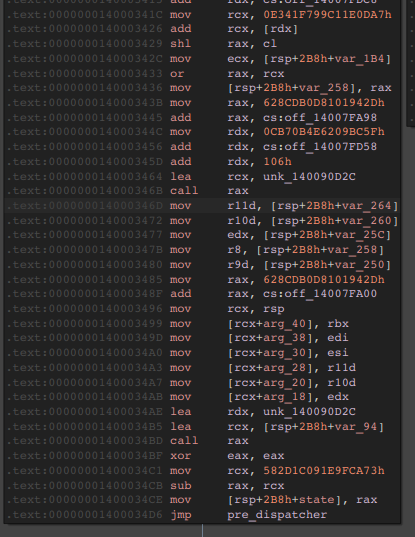
The final state at the end of the Basic block the state calculation is not determined between this block just the last split, but the crash is before that, so i just restored the previous state if the state is an ExprMem.
1
2
3
4
5
6
7
8
9
10
11
12

evaluated_state = sb.eval_expr(state_variable)

if isinstance(evaluated_state, ExprInt): # we need exprint states
    curr_state_val = evaluated_state
    last_good_state_val = curr_state_val  # update previous state

elif isinstance(evaluated_state, ExprMem):
    print('changing state: ', hex(loc_db.get_location_offset(curr_addr_loc)), sb.eval_expr(last_good_state_val), sb.eval_expr(state_variable))
    sb.symbols[state_variable] = last_good_state_val
    curr_state_val = last_good_state_val
This fixed the state variable not being ExprInt problem, and this is the example that there are several problems and edge cases always as i was working through the whole deobfuscator which also there were cases were original basic blocks were needed more pattern matching analysis. I was also not running the symbolic execution in a loop inside a cmovcc IR Block, that caused problems. So after many refactoring and fixing finally we ran the code.
Deobfuscation complete, the functions are unflattened and now only indirect call obfuscation is left.
Unflattened Binary
This is the whole deobfuscation script, as the snippets i gave they were before fixing some issues so they were not part of the class, as i was doing it without a class but those explain the core functionality of the deobfuscator. The Binrewriter can be found here
1
2
3
4
5
6
7
8
9
10
11
12
13
14
15
16
17
18
19
20
21
22
23
24
25
26
27
28
29
30
31
32
33
34
35
36
37
38
39
40
41
42
43
44
45
46
47
48
49
50
51
52
53
54
55
56
57
58
59
60
61
62
63
64
65
66
67
68
69
70
71
72
73
74
75
76
77
78
79
80
81
82
83
84
85
86
87
88
89
90
91
92
93
94
95
96
97
98
99
100
101
102
103
104
105
106
107
108
109
110
111
112
113
114
115
116
117
118
119
120
121
122
123
124
125
126
127
128
129
130
131
132
133
134
135
136
137
138
139
140
141
142
143
144
145
146
147
148
149
150
151
152
153
154
155
156
157
158
159
160
161
162
163
164
165
166
167
168
169
170
171
172
173
174
175
176
177
178
179
180
181
182
183
184
185
186
187
188
189
190
191
192
193
194
195
196
197
198
199
200
201
202
203
204
205
206
207
208
209
210
211
212
213
214
215
216
217
218
219
220
221
222
223
224
225
226
227
228
229
230
231
232
233
234
235
236
237
238
239
240
241
242
243
244
245
246
247
248
249
250
251
252
253
254
255
256
257
258
259
260
261
262
263
264
265
266
267
268
269
270
271
272
273
274
275
276
277
278
279
280
281
282
283
284
285
286
287
288
289
from miasm.analysis.binary import Container
from miasm.analysis.machine import Machine
from miasm.core.locationdb import LocationDB, LocKey
from miasm.expression.simplifications import ExpressionSimplifier, expr_simp
from miasm.arch.x86.regs import all_regs_ids, all_regs_ids_init
from miasm.expression.expression import ExprCond, ExprMem, ExprInt, ExprLoc, ExprVisitorCallbackTopToBottom
from miasm.ir.symbexec import SymbolicExecutionEngine
from collections import deque, defaultdict
from cff_patcher import BinaryRewriter
import shutil
import struct
import lief

class deob_slowtempest:
    def __init__(self, file='slowtempest.cff_deob.bin', out=None):
        self.file = file
        self.out = out if out is not None else file

        self.pe = lief.PE.parse(file)
        print('imagebase: ', hex(self.pe.imagebase))
        data_section = self.pe.get_section('.data')

        self.u64 = lambda data, i: struct.unpack('<Q', data[i:i + 8])[0]
        self.u32 = lambda data, i: struct.unpack('<I', data[i:i + 4])[0]

        # concrete values of the .data section
        self.concreteSymbols = {}
        self.add_data(self.concreteSymbols, data_section.virtual_address + self.pe.imagebase, bytes(data_section.content))

        self.custom_simp = ExpressionSimplifier()
        self.custom_simp.enable_passes(ExpressionSimplifier.PASS_COMMONS)
        self.custom_simp.enable_passes(ExpressionSimplifier.PASS_HIGH_TO_EXPLICIT)
        self.custom_simp.enable_passes({ExprMem: [self.simpExprMem]})

    def add_data(self, symb, offset, data):
        for i in range(0, len(data), 8):
            symb[ExprMem(ExprInt(offset + i, 64), 64)] = ExprInt(self.u64(data, i), 64)
        for i in range(0, len(data), 4):
            symb[ExprMem(ExprInt(offset + i, 32), 32)] = ExprInt(self.u32(data, i), 32)

    def simpExprMemCallBack(self, expr):
        if isinstance(expr, ExprMem):
            if expr in self.concreteSymbols:
                newExpr = expr.replace_expr({expr: self.concreteSymbols[expr]})
                return newExpr
        return None

    def simpExprMem(self, _, expr):
        # https://github.com/cea-sec/miasm/blob/master/miasm/expression/expression.py#L614
        visitor = ExprVisitorCallbackTopToBottom(lambda expr: self.simpExprMemCallBack(expr))
        return visitor.visit(expr)

    def deobfuscate(self, addr):

        loc_db = LocationDB()
        container = Container.from_stream(open(self.file, 'rb'), loc_db=loc_db)
        machine = Machine(container.arch)
        lifter = machine.lifter_model_call(loc_db=loc_db)
        mdis = machine.dis_engine(container.bin_stream, loc_db=loc_db)
        asmcfg = mdis.dis_multiblock(addr)
        ircfg = lifter.new_ircfg_from_asmcfg(asmcfg=asmcfg)

        self.loc_db = loc_db
        self.asmcfg = asmcfg
        self.ircfg = ircfg
        self.lifter = lifter

        pre_disp_loc = sorted(asmcfg.blocks, key=lambda key: len(asmcfg.predecessors(key.loc_key)), reverse=True)[0].loc_key
        disp_loc = asmcfg.successors(pre_disp_loc)
        assert len(disp_loc) == 1
        disp_addr_loc = disp_loc[0]
        print(hex(addr), ' -> ', hex(loc_db.get_location_offset(disp_addr_loc)), hex(loc_db.get_location_offset(pre_disp_loc)))

        check_dispatcher = asmcfg.loc_key_to_block(disp_addr_loc)

        if check_dispatcher.lines[-1].name == 'JMP': # fixing the exception
            pre_disp_loc = sorted(asmcfg.blocks, key=lambda key: len(asmcfg.predecessors(key.loc_key)), reverse=True)[1].loc_key
            disp_loc = asmcfg.successors(pre_disp_loc)
            assert len(disp_loc) == 1
            disp_addr_loc = disp_loc[0]
            print('Fixed exception', hex(addr), ' -> ', hex(loc_db.get_location_offset(disp_addr_loc)), hex(loc_db.get_location_offset(pre_disp_loc)))

        OBB = self.findOBB(pre_disp_loc)

        # the state variable read by the dispatcher, e.g. @64[RSP + 0x18]
        disp_block = asmcfg.loc_key_to_block(disp_addr_loc)
        state_variable = disp_block.lines[0].get_args_expr()[1]
        print('STATE: ', state_variable)

        init_symbols = {}
        for i, r in enumerate(all_regs_ids):
            init_symbols[r] = all_regs_ids_init[i]

        state_to_state_map = defaultdict(list)
        state_to_addr_map = defaultdict(list)
        first_state_val = None
        q = deque([(loc_db.get_offset_location(addr), first_state_val, init_symbols)])
        visited_location = set()

        while q:
            curr_addr_loc, curr_state_val, symbols = q.popleft()
            sb = SymbolicExecutionEngine(lifter, symbols, sb_expr_simp=self.custom_simp)
            while True:
                r = self.symbolic_execution(sb, curr_addr_loc)
                if r is None:
                    break

                if r.is_cond():
                    cond_true = {r.cond: ExprInt(1, 32)}; cond_false = {r.cond: ExprInt(0, 32)}
                    jt = self.to_loc_key(expr_simp(sb.eval_expr(r.replace_expr(cond_true), {})))
                    jf = self.to_loc_key(expr_simp(sb.eval_expr(r.replace_expr(cond_false), {})))
                    q.append((jf, curr_state_val, sb.symbols.copy()))  # false branch for later
                    curr_addr_loc = jt
                else:
                    curr_addr_loc = self.to_loc_key(expr_simp(sb.eval_expr(r)))

                if curr_addr_loc in OBB:
                    evaluated_state = sb.eval_expr(state_variable)
                    if isinstance(evaluated_state, ExprInt):  # we need exprint states
                        curr_state_val = evaluated_state
                        last_good_state_val = curr_state_val  # update previous state
                    elif isinstance(evaluated_state, ExprMem):
                        print('changing state: ', hex(loc_db.get_location_offset(curr_addr_loc)), sb.eval_expr(last_good_state_val), sb.eval_expr(state_variable))
                        sb.symbols[state_variable] = last_good_state_val
                        curr_state_val = last_good_state_val
                    else:
                        print('state is some other type')
                    curr_state_val = int(curr_state_val)

                    if (curr_addr_loc, curr_state_val) in visited_location:
                        break
                    visited_location.add((curr_addr_loc, curr_state_val))
                    # print('debug: ', hex(loc_db.get_location_offset(curr_addr_loc)), sb.eval_expr(state_variable), state_variable, type(sb.eval_expr(state_variable)))

                    # check if the current address is already added in the correspinding state list
                    if curr_addr_loc not in state_to_addr_map[curr_state_val]:
                        state_to_addr_map[curr_state_val].append(curr_addr_loc)

                    if first_state_val is None:
                        first_state_val = curr_state_val

                elif curr_addr_loc == pre_disp_loc:
                    nState_val = int(sb.eval_expr(state_variable))

                    if nState_val not in state_to_state_map[curr_state_val]:
                        state_to_state_map[curr_state_val].append(nState_val)
                    curr_state_val = None

        # keep only the state blocks + prologue, drop the dispatcher tree
        OBB = []
        for locations in state_to_addr_map.values():
            for loc in locations:
                OBB.append(loc)

        state_to_state_map[0].append(first_state_val)

        for loc in asmcfg.predecessors(disp_addr_loc):
            if loc == pre_disp_loc: # skipping the pre-dispatcher because its also predecessors
                continue
            func_prologue = loc # then the predecessors is function prologue
            OBB.append(func_prologue)
            state_to_addr_map[0].append(func_prologue)
            # chaining the prologue if its split.
            prev_prologue_block = asmcfg.predecessors(func_prologue)
            if len(prev_prologue_block) == 0:
                break
            while len(prev_prologue_block) != 0:
                OBB.append(prev_prologue_block[0])
                state_to_addr_map[0].append(prev_prologue_block[0])
                assert len(prev_prologue_block) == 1
                prev_prologue_block = asmcfg.predecessors(prev_prologue_block[0])
            break  # because we have the function prologue blocks

        self.remove_irrelevant_BB(original_BB=OBB)

        state_to_addr_map[0] = state_to_addr_map[0][::-1]  # correct the order of function prologue

        # patche function
        rewriter = BinaryRewriter(container.arch, original_filename=self.file,
                                  va_function_lief=lambda addr: self.pe.va_to_offset(addr))
        rewriter.patch_binary(asmcfg, addr, state_to_state_map, state_to_addr_map, sb, out_filename=self.out)

    def to_loc_key(self, expr):
        if isinstance(expr, LocKey):
            return expr
        if isinstance(expr, ExprLoc):
            return expr.loc_key
        if isinstance(expr, int):
            return self.loc_db.get_offset_location(expr)
        if isinstance(expr, ExprInt):
            return self.loc_db.get_offset_location(int(expr))
        return None

    def remove_irrelevant_BB(self, original_BB):
        irrelevant_locations = []
        for bb in self.asmcfg.blocks:
            if bb.loc_key not in original_BB:
                irrelevant_locations.append(bb.loc_key)
        for loc in irrelevant_locations:
            self.asmcfg.del_block(self.asmcfg.loc_key_to_block(loc))

    def fallthrough_preds(self, loc):
        preds = self.asmcfg.predecessors(loc)
        if len(preds) <= 1:
            return preds
        ft = [p for p in preds if not self.asmcfg.loc_key_to_block(p).lines[-1].name.startswith('J')]
        return ft if ft else preds

    def findOBB(self, pre_disp_loc):
        OBB = []
        # for original basic blocks
        for curr_loc in self.asmcfg.predecessors(pre_disp_loc):
            pre_obb_loc = self.fallthrough_preds(curr_loc); OBB.append(curr_loc)
            assert len(pre_obb_loc) == 1
            while True:
                pre_obb_block = self.asmcfg.loc_key_to_block(pre_obb_loc[0])
                if pre_obb_block.lines[-1].name.startswith('J'):
                    break
                curr_loc = pre_obb_loc[0]
                pre_obb_loc = self.fallthrough_preds(curr_loc)
                assert len(pre_obb_loc) == 1
                OBB.append(curr_loc)

        # for ret basic blocs/tail calls
        for bb in self.asmcfg.blocks:
            ret_loc = bb.loc_key
            if len(self.asmcfg.successors(ret_loc)) == 0:
                ret_pre_loc = self.fallthrough_preds(ret_loc); OBB.append(ret_loc)
                assert len(ret_pre_loc) == 1
                while True:
                    ret_pre_block = self.asmcfg.loc_key_to_block(ret_pre_loc[0])
                    if ret_pre_block.lines[-1].name.startswith('J'):
                        break
                    ret_loc = ret_pre_loc[0]
                    ret_pre_loc = self.fallthrough_preds(ret_loc)
                    assert len(ret_pre_loc) == 1
                    OBB.append(ret_loc)

        return OBB

    def symbolic_execution(self, sb, address_loc):
        cmp_ins = None
        cmovcc_ins = None
        current_asm_block = self.asmcfg.loc_key_to_block(address_loc)
        if current_asm_block is None:
            return sb.run_block_at(ircfg=self.ircfg, addr=address_loc)
        for ins in current_asm_block.lines:
            if ins.name == 'IDIV':
                address_loc = ins.offset + ins.l  # skipped the idiv instruction execution (a cheap fix xD)
            elif ins.name in ['CMP', 'TEST']:
                cmp_ins = ins
            elif ins.name.startswith('CMOV'):
                cmovcc_ins = ins
                break

        if current_asm_block.lines[-1].name == 'CALL':
            rsp = sb.symbols[self.lifter.arch.regs.RSP]; rbp = sb.symbols[self.lifter.arch.regs.RBP]
            r = sb.run_block_at(ircfg=self.ircfg, addr=address_loc)
            sb.symbols[self.lifter.arch.regs.RSP] = rsp; sb.symbols[self.lifter.arch.regs.RBP] = rbp
            return r

        if cmovcc_ins is not None and cmp_ins is not None:
            curr_loc = address_loc
            while True:
                current_ir_block = self.ircfg.get_block(addr=curr_loc)
                for ir_ins in current_ir_block:
                    if ir_ins.instr.name.startswith('CMOV'):
                        cmov_cond_expr = ir_ins.values()[-1]
                        sb.run_block_at(ircfg=self.ircfg, addr=curr_loc)  # this was fixed later. (without this the ir block execution is not valid/reliable)
                        if str(cmovcc_ins).startswith('CMOVN'):
                            print(ir_ins.instr.name, ' ', hex(self.loc_db.get_location_offset(self.to_loc_key(curr_loc))), cmov_cond_expr)
                            return cmov_cond_expr.copy()
                        print(ir_ins.instr.name, ' ', hex(self.loc_db.get_location_offset(self.to_loc_key(curr_loc))), cmov_cond_expr)
                        return ExprCond(cmov_cond_expr.cond.copy(), cmov_cond_expr.src2.copy(), cmov_cond_expr.src1.copy())  # flip the condition
                curr_loc = sb.run_block_at(ircfg=self.ircfg, addr=curr_loc)
        else:
            return sb.run_block_at(ircfg=self.ircfg, addr=address_loc)


if __name__ == '__main__':

    shutil.copy("slowtempest.jmp_deob.bin", "slowtempest.cff_deob.bin")

    deob = deob_slowtempest()

    for addr in [0x140001000,0x140001720,0x140001bc0,0x1400022f0,0x140002550,0x140003990,0x140003e30,0x140004dd0,0x1400051f0,0x1400055c0,0x140005970,0x140005c30,0x140006590,0x140007200,0x140007790,0x140007d30,0x1400082c0,0x140008840,0x140008dc0,0x140009350,0x1400098d0,0x140009e40,0x14000a3c0,0x14000a950,0x14000afb0,0x14000b260,0x14000bdb0,0x14000c3b0,0x14000c930,0x14000d040,0x14000dbc0,0x14000df90,0x14000f0f0,0x14000f780,0x14000ff30,0x140010600,0x1400115c0,0x140011b40,0x1400120d0,0x1400128c0,0x140014120,0x140016780,0x140016d30,0x1400179e0,0x140017d90,0x1400184c0,0x140018920,0x140018f10,0x1400199e0,0x140019bf0,0x14001a2b0,0x14001a5d0,0x14001ac90,0x14001b170,0x14001b670,0x14001bae0,0x14001c100,0x14001c500,0x14001c730,0x14001c950,0x14001d060,0x14001d7f0,0x14001e050,0x14001e4f0,0x14001f8f0,0x14001fc50,0x140021970,0x140021d70,0x140022930,0x140023300,0x140023660,0x1400240e0,0x140024810,0x140024ce0,0x140025150,0x140025d20,0x140026660,0x140026be0,0x140027170,0x140027700,0x140027c90,0x140028210,0x1400287a0,0x140028d20,0x1400292a0,0x140029830,0x140029dc0,0x14002a350,0x14002a8d0,0x14002ae50,0x14002b530,0x14002bd40,0x14002c300,0x14002caa0,0x14002d360,0x14002ee20,0x14002f550,0x14002f7c0,0x1400303f0,0x140031a10,0x1400325f0,0x140032ad0,0x140033260,0x1400337f0,0x140033d70,0x140034330,0x140034d60,0x1400352d0,0x1400355b0,0x140035d70,0x140036bb0,0x140037240,0x14003f830,0x14003fe60,0x1400403f0,0x140040970,0x140040f00,0x1400422c0,0x140042da0,0x140043660,0x140043b30,0x1400441a0,0x140044720,0x140044cb0,0x140045230,0x1400457c0,0x140045d40,0x140045fc0,0x140046240,0x1400465f0,0x140046d30,0x140047160,0x1400474d0,0x1400480d0,0x1400483d0,0x1400495d0,0x140049e50,0x14004a3d0,0x14004a950,0x14004aee0,0x14004b470,0x14004b9f0,0x14004c1f0,0x14004c4e0,0x14004c830,0x14004cba0,0x14004d270,0x14004d4d0,0x14004d7f0,0x14004db10,0x14004dfa0,0x14004e470,0x14004e980,0x14004ed50,0x14004f190,0x14004f680,0x14004fb10,0x1400506a0,0x140050e80,0x1400517c0,0x140052140,0x140052680,0x140053e80,0x140054230,0x140054870,0x140054e00,0x140055390,0x140055910,0x140055e90,0x140056410]:# the function address we got from 7+ flatttening score. (some functions were false positives btw, and tbh i don't know why xD)
        deob.deobfuscate(addr=addr)
    print('written: ', deob.out)
Indirect Call Obfuscation
The binary has compelete indirect call obfuscation.
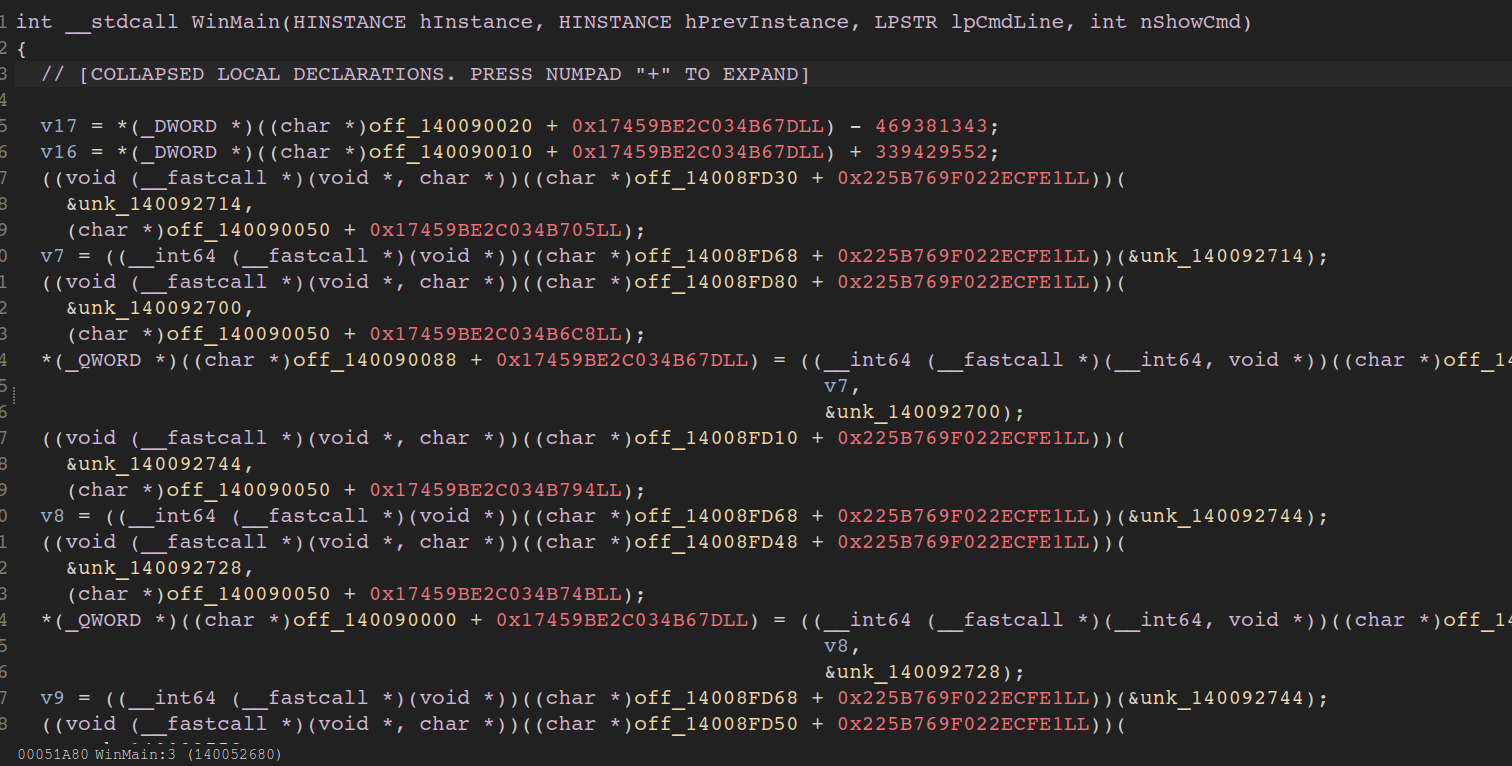 Indirect Call Obfuscation
1
2
3
4
5
6
7
8
9
import idc

ea = 0x140001000 # start of text section
ind = []
while ea < 0x140057495: # end of text section
    if idc.print_insn_mnem(ea) == 'call' and idc.get_operand_type(ea, 0) is idc.o_reg: # call reg
        print(hex(ea)); ind.append(ea)
    ea = idc.next_head(ea)
print('indirect calls: ', len(ind))
1
indirect calls:  945
But as this is the last section of the post and we have extensively used miasm and its capabilities, I wanted to do it differently, So we will use hexrays decompiler hooks to manipulate microcode hexrays own IR, and by using hexrays api we can easily manipulate different stages of microcode with out custom optimizations which can strip away intended obfuscation.
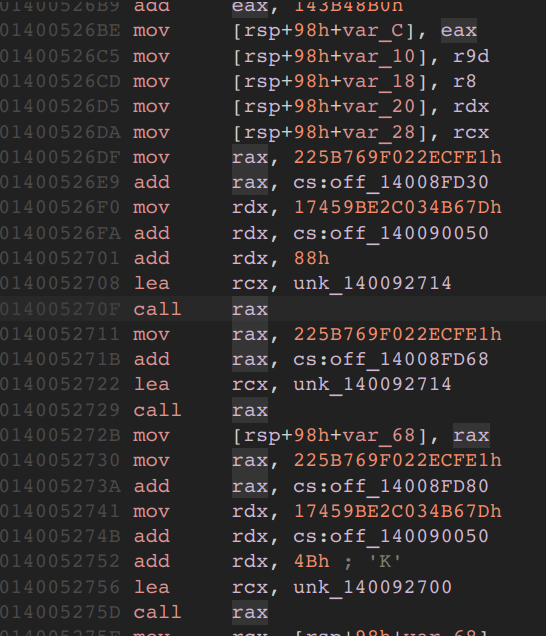 indirect calls pattern
fortunately enough for our sample the indirect call pattern is not complicated, first rax is loaded with a constant, and then it added with another constant which will be read from the .data section.
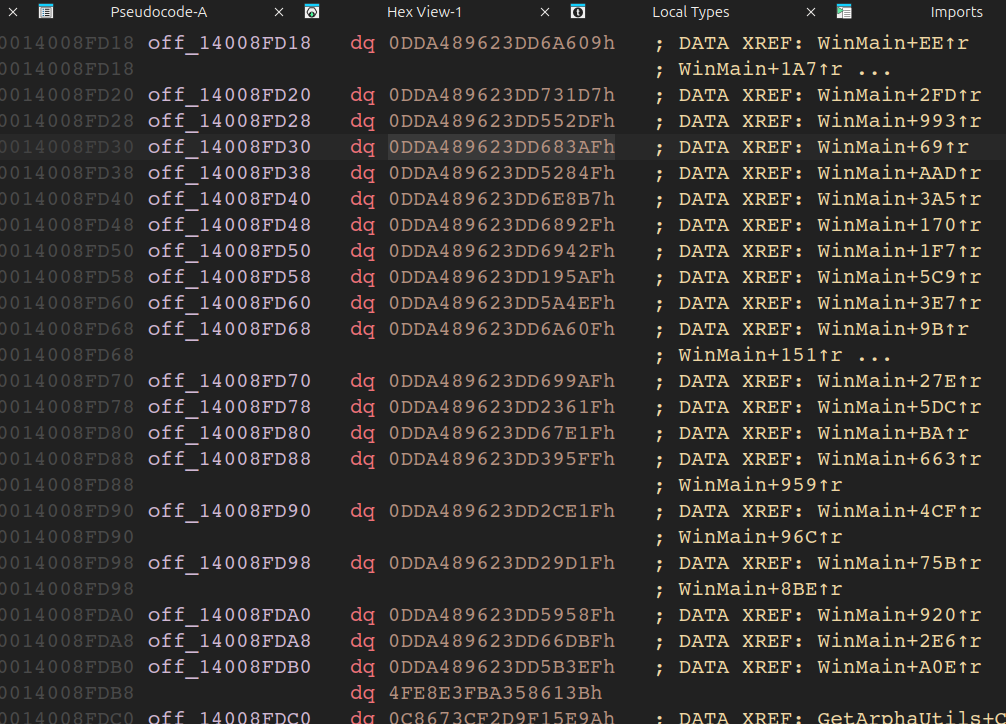 Global constants
Hexrays Microcode
Microcode has different maturity levels. Each maturity level apply specific type of optimizations.
First one is MMAT GENERATED. It preserves all the eflag semantics per instruction. Its the first microcode layer which is generated.
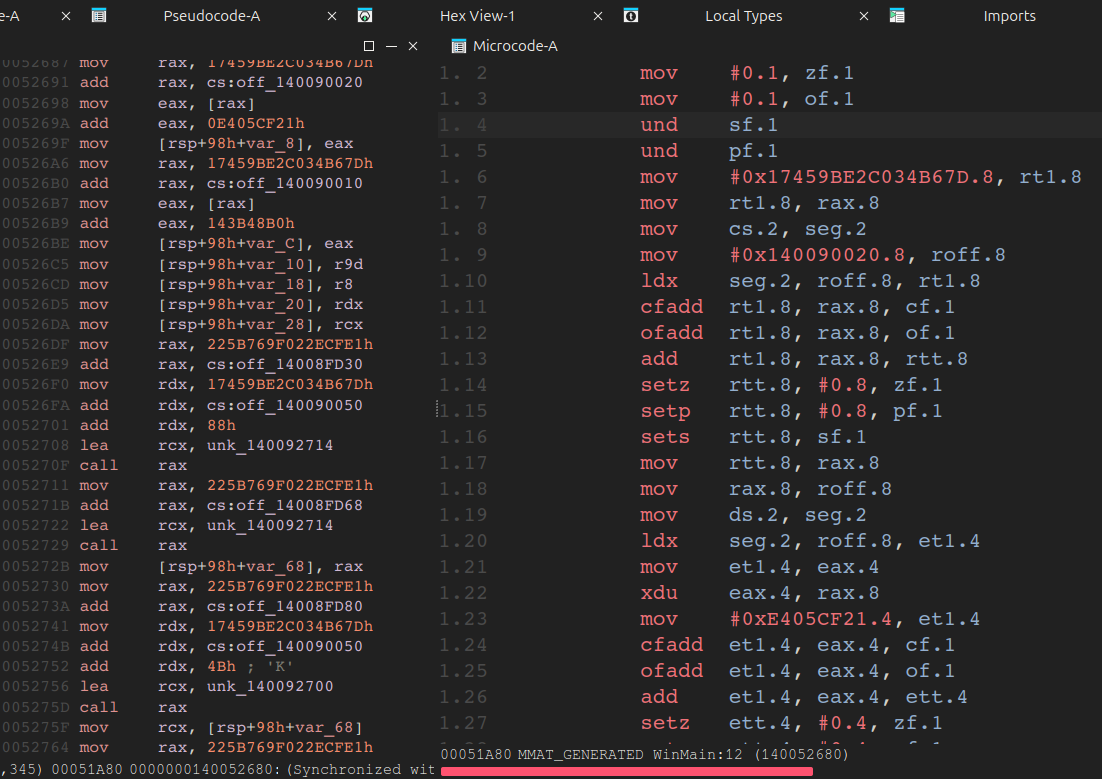 MMAT GENERATED
Second is MMAT PREOPTIMIZED. Use-Def info is used to do deadcode removal and constant propagation.
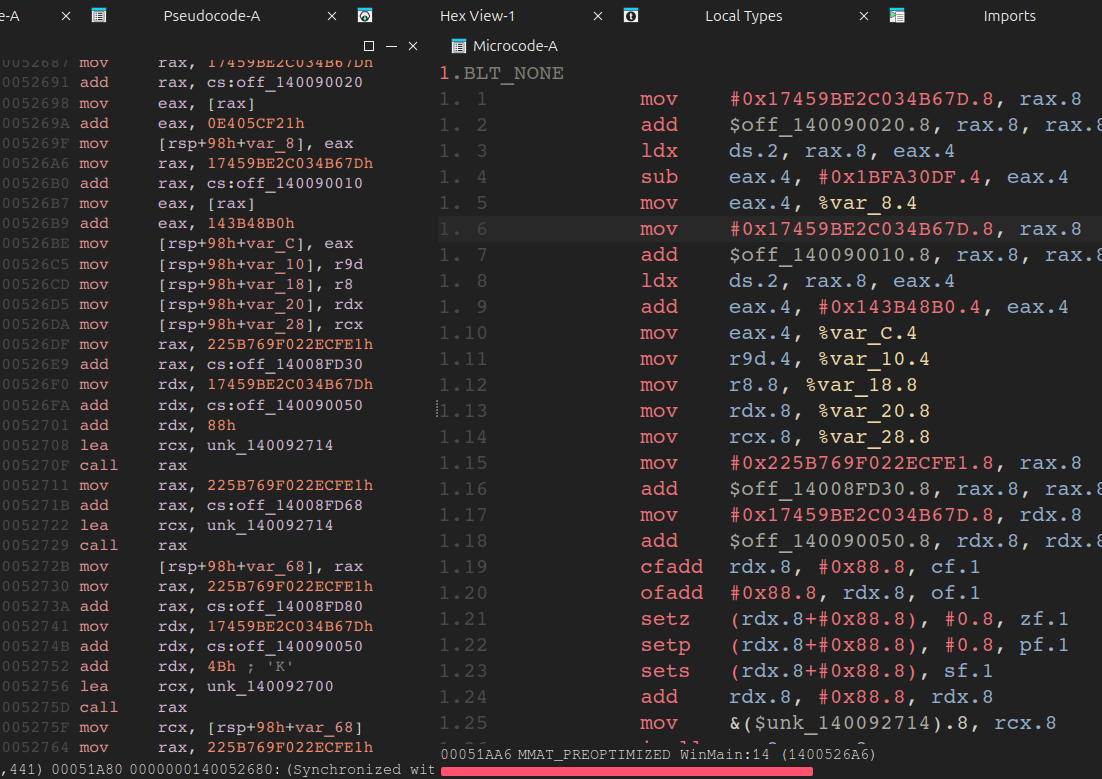 MMAT PREOPTIMIZED
Third is MMAT LOCOPT. This what we will deal with today and manipulate via decompiler hook.
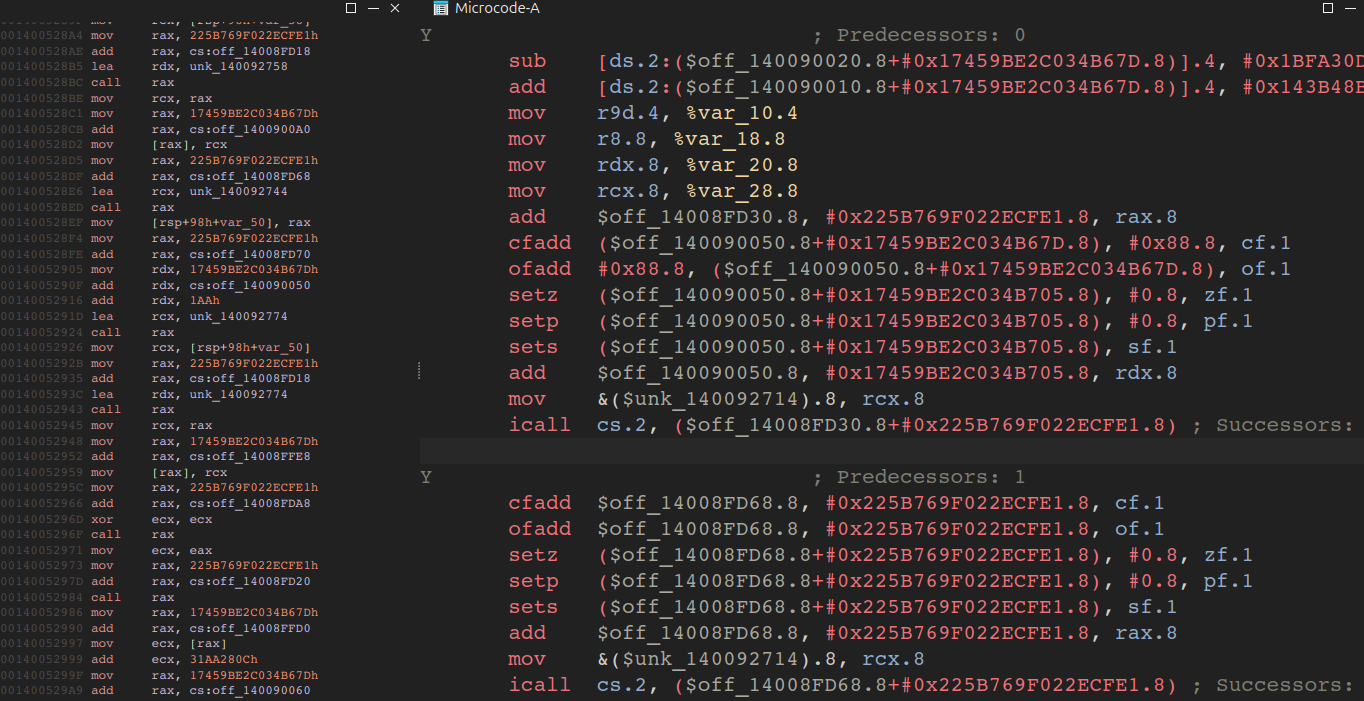 MMAT LOCOPT
There are other layers as well but we will only deal with LOCOPT. You can read about microcode here.
If you want to play with microcode you need to know its various classes and their members only than you know the functionality of what can be done.
If you want to play with microcode instructions which are misn_t
1
2
3
4
5
6
7
8
9
10
11
12
13
14
15
16
[...]
class minsn_t
{
  void hexapi init(ea_t _ea);
  void hexapi copy(const minsn_t &m);
public:
  mcode_t opcode;
  int iprops;
  minsn_t *next;
  minsn_t *prev;
  ea_t ea;
  mop_t l;
  mop_t r;
  mop_t d;
[...]
And the operands which are mop_t
1
2
3
4
5
6
7
8
9
10
11
12
13
14
15
16
17
18
19
20
21
22
23
24
25
26
27
28
29
30
31
32
33
34
35
36
37
//-------------------------------------------------------------------------
class mop_t
{
  void hexapi copy(const mop_t &rop);
public:
  mopt_t t;
  uint8 oprops;
#define OPROP_IMPDONE 0x01
#define OPROP_UDT     0x02
#define OPROP_FLOAT   0x04
#define OPROP_CCFLAGS 0x08
#define OPROP_UDEFVAL 0x10
#define OPROP_LOWADDR 0x20
#define OPROP_ABI     0x40
  uint16 valnum;
  int size;
  union
  {
    mreg_t r;           // mop_r   register number
    mnumber_t *nnn;     // mop_n   immediate value
    minsn_t *d;         // mop_d   result (destination) of another instruction
    stkvar_ref_t *s;    // mop_S   stack variable
    ea_t g;             // mop_v   global variable (its linear address)
    int b;              // mop_b   block number (used in jmp,call instructions)
    mcallinfo_t *f;     // mop_f   function call information
    lvar_ref_t *l;      // mop_l   local variable
    mop_addr_t *a;      // mop_a   variable whose address is taken
    char *helper;       // mop_h   helper function name
    char *cstr;         // mop_str utf8 string constant, user representation
    mcases_t *c;        // mop_c   cases
    fnumber_t *fpc;     // mop_fn  floating point constant
    mop_pair_t *pair;   // mop_p   operand pair
    scif_t *scif;       // mop_sc  scattered operand info
  };
  // -- End of data fields, member function declarations follow:
[...]
Only with this information we start playing with microcode.
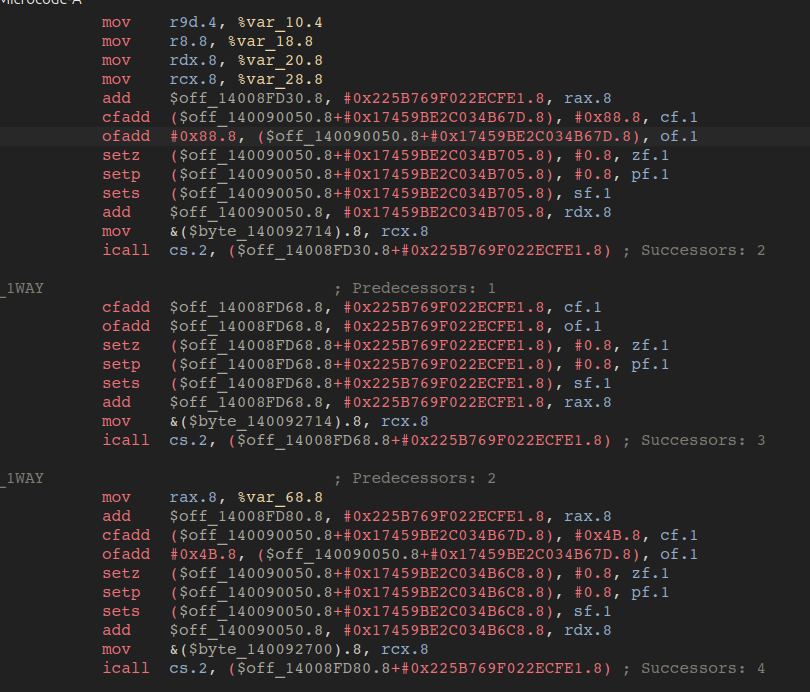 locopt
We can see that the icall is formed by just addition of a global constant with another constant. We will make two classes one for the decompiler hook and the other which visit the instructions and optimizer, Which will just replace the global data reference with the constant one so that constant propagation can be applied to it and the decompiler will see the constant propagated final IR so we will se indirect call deobfuscation in our decompiler.
1
2
3
4
5
6
7
8
9
10
11
12
13
14
15
16
17
18
19
20
21
22
23
24
25
26
27
28
29
30
31
32
33
34
35
36
37
38
39
40
41
42
43
import idaapi
import ida_hexrays

dataStart = 0x14007E000
dataEnd = 0x140093FFF
simplify = False

class operand_optimizer(ida_hexrays.minsn_visitor_t):
    def visit_minsn(self):
        global simplify
        insn = self.curins # the current instruction (minsn_t) to be visited

        if insn.opcode in (ida_hexrays.m_add, ida_hexrays.m_sub): # memory operands that appear as operands of an add/sub
            for op in (insn.l, insn.r):
                # we can see these in the reference i provided and also can see ida sdk for hexrays.hpp
                if op.t == ida_hexrays.mop_v and op.size == 8 and op.g >= dataStart and op.g <= dataEnd:
                    ea = op.g
                    const = int.from_bytes(idaapi.get_bytes(ea,8),byteorder="little") # reading the global constant
                    op.make_number(const, 8) # making it constant
                    if self.blk:
                        self.blk.mark_lists_dirty()
                    simplify = True # used in the decompiler hook
        return 0

class DecompilerHook(ida_hexrays.Hexrays_Hooks):
    def locopt(self, mba):
        #walk through the mblocks
        global simplify

        simplify = True
        while simplify:
            simplify = False
            repl = operand_optimizer()
            mba.for_all_insns(repl)
            mba.optimize_local(0)

        mba.verify(True) # verify microcode
        print("Verified")
        return 0

event_hook = DecompilerHook()
event_hook.hook()
Before
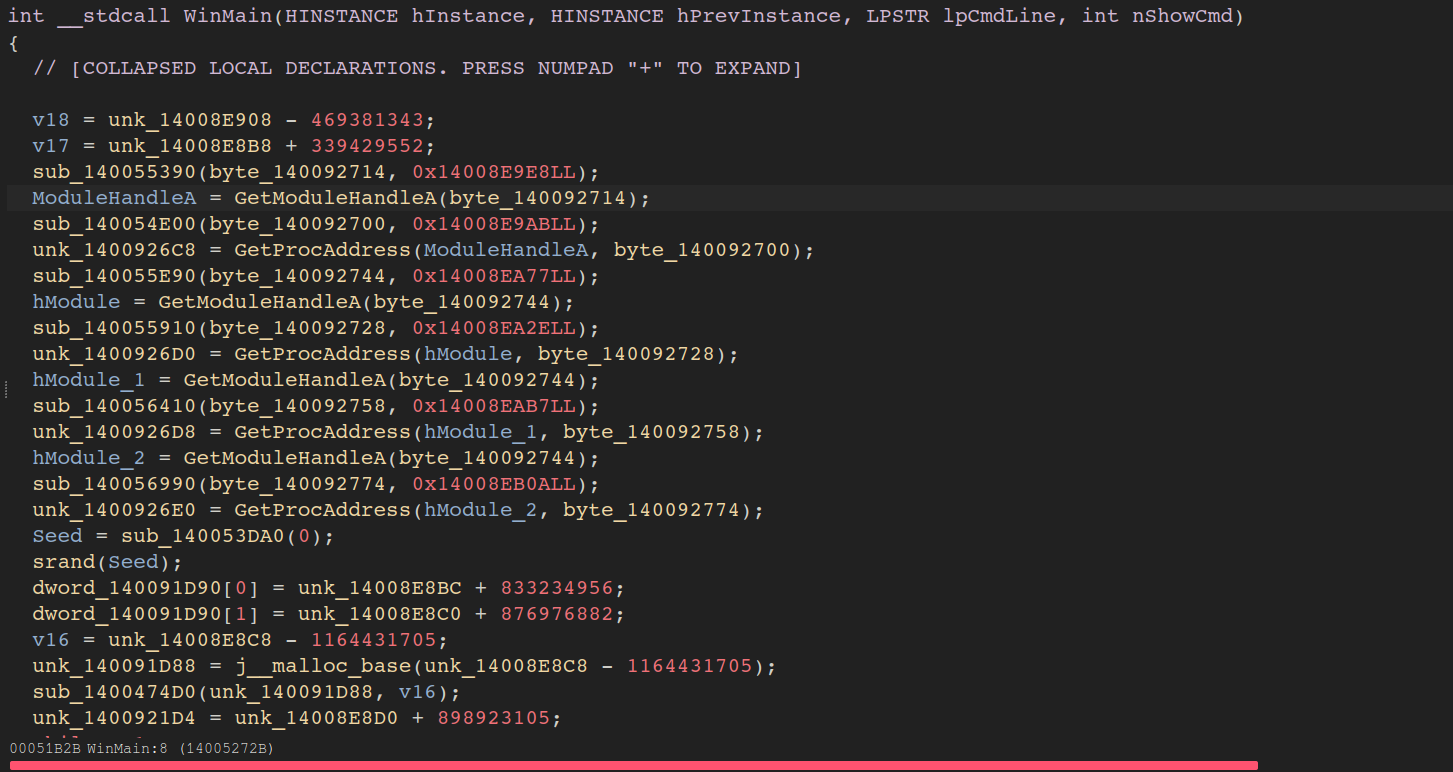 After
We have come a long way, From a very obfuscated binary where there was only jmp rax in the decompiler to CFF to unflatten and then resolved indirect calls. We have made so far ! <3
Here is the Deobfuscated binary :p
Clean Deobfuscated Functions
What’s Next !?
We missed a very hot topic in obfuscations which is MBA we will use Triton and Cobra, It requires its own post. I will also write about deobfuscation via LLVM IR using Remil. So stay tuned, See you soon.